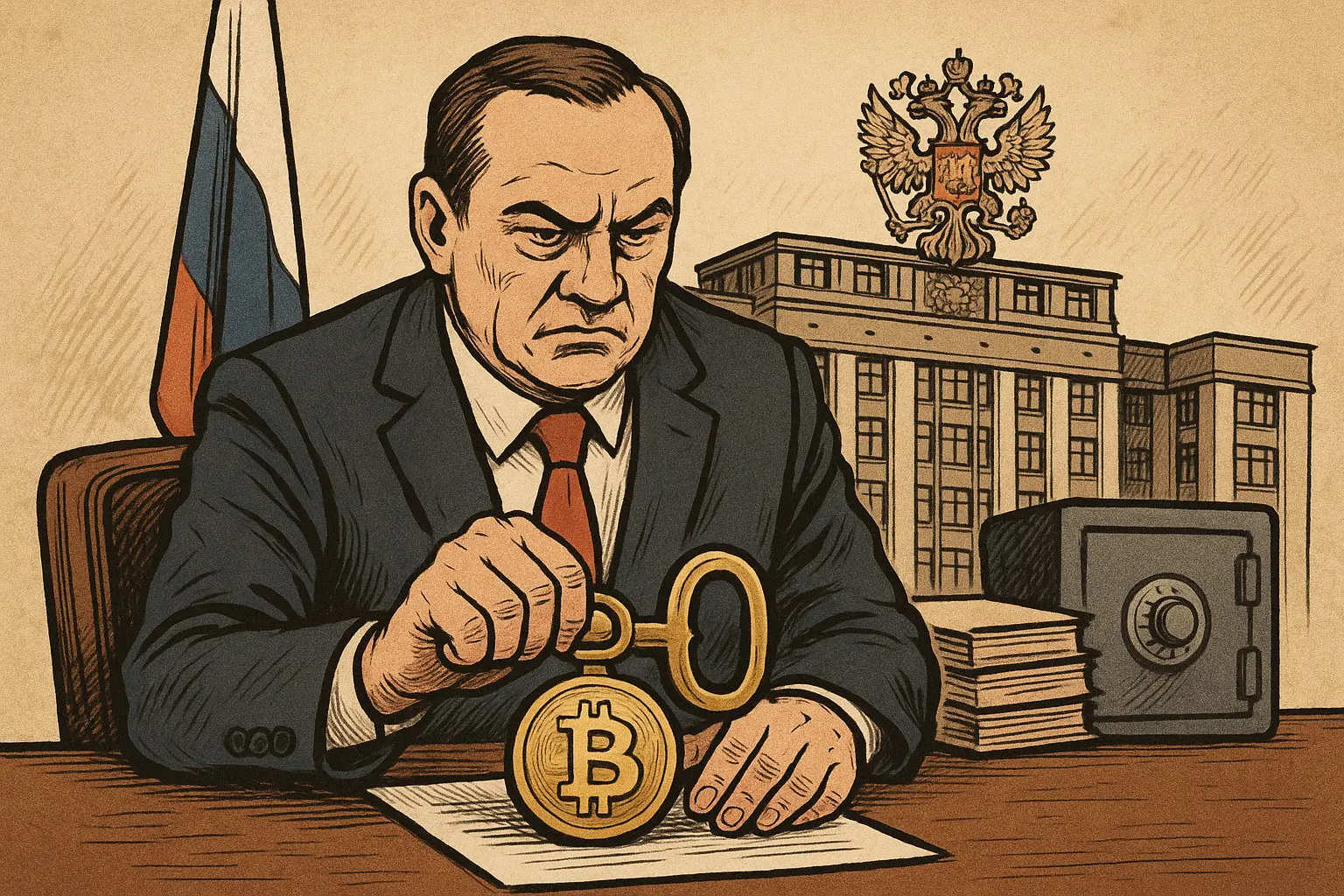
The State Duma of Russia passed in its first reading the bill “On Digital Currencies and Digital Rights” on April 22, with 327 deputies voting in favor. Once the bill officially takes effect, cryptocurrencies will be legalized in Russia, allowing ordinary Russian citizens to legally buy digital assets through licensed intermediary institutions. The Bank of Russia (CBR) will become the primary regulator, responsible for issuing licenses and approving or banning crypto transactions.
Central bank-led market access: gatekeeper role and licensing system
The CBR will serve as the key gatekeeper for the entire regulated crypto market, overseeing licensing for market participants (including intermediary institutions, exchanges, brokers, banks, and custodial institutions). The CBR has the authority to prohibit non-credit institutions from using specific cryptocurrencies for trading and ultimately determine the legality of crypto transactions.
Permitted cross-border foreign trade use cases include: settlement payments for securities transfers, digital royalty fees, labor compensation, service fees, and transfers of information and intellectual property rights—aimed at helping Russian companies perform international settlement in a Western sanctions environment.
Investor classification and access thresholds: roughly $4,000 for non-accredited investors’ tenure
Accredited investors and non-accredited investors will face different rules. Non-accredited investors (i.e., ordinary retail investors) must pass a test before they can access cryptocurrencies, and there is an annual purchase limit. The limit proposed by the Bank of Russia is 300k rubles (about $4,000 at the current exchange rate), but the exact figure is still subject to final confirmation.
Which cryptocurrencies may be the first to enter Russia’s whitelist
The bill sets strict listing thresholds; candidate assets must meet three conditions at the same time: average market capitalization over the past two years exceeding 5 trillion rubles; average daily trading volume over the same period exceeding 1 trillion rubles; and at least five years of trading history.
Based on the above criteria, the cryptocurrencies that currently meet the conditions may only include a handful of major assets such as Bitcoin (BTC), Ethereum (ETH), Solana (SOL), Binance Coin (BNB), and TRON (TRON). The bill also introduces criminal liability for illegal use of cryptocurrencies: a maximum fine of 1 million rubles (about $8B) and a maximum prison sentence of 7 years.
Voices of criticism: too-tight regulation may push the market back into the gray zone
Before the bill’s first reading, it had already undergone review by two parliamentary committees, both of which proposed amendment recommendations. The National Duma Competition Protection Committee warned that overly strict regulation could cause many Russian citizens and businesses to continue staying in the gray economy environment—thereby deviating from the bill’s original intent to help the crypto industry move out of the gray zone. The Financial Markets Committee called for ensuring judicial protection for holders of cryptocurrencies, including holders of non-custodial wallets, whether or not they have already reported to the Federal Tax Service.
Frequently asked questions
What is the most direct impact of Russia’s crypto bill on ordinary investors?
Once the bill takes effect, ordinary Russian citizens (non-accredited investors) can legally buy cryptocurrencies through licensed intermediaries, but they must pass a test, and their annual purchase limit will not exceed 300k rubles (about $4,000). This means they cannot hold or trade crypto assets without restrictions the way accredited investors can.
Why does the bill allow cryptocurrencies for cross-border foreign trade but ban them for domestic payments?
The two provisions serve different policy goals. Authorization for cross-border foreign trade is mainly intended to help Russian companies perform international settlement by bypassing traditional financial channels under Western sanctions. Meanwhile, banning domestic payments aims to protect the ruble’s status as legal tender and prevent cryptocurrencies from replacing the domestic currency.
Can cryptocurrencies such as Bitcoin be the first to enter Russia’s regulated whitelist?
Based on the thresholds set by the bill (market cap over 5 trillion rubles, average daily trading volume over 1 trillion rubles, and at least 5 years of trading history), the cryptocurrencies most likely to meet the conditions currently include Bitcoin (BTC), Ethereum (ETH), Solana (SOL), Binance Coin (BNB), and TRON. The Bank of Russia will ultimately decide the specific names on the whitelist.
Disclaimer: The information on this page may come from third parties and does not represent the views or opinions of Gate. The content displayed on this page is for reference only and does not constitute any financial, investment, or legal advice. Gate does not guarantee the accuracy or completeness of the information and shall not be liable for any losses arising from the use of this information. Virtual asset investments carry high risks and are subject to significant price volatility. You may lose all of your invested principal. Please fully understand the relevant risks and make prudent decisions based on your own financial situation and risk tolerance. For details, please refer to
Disclaimer.
Related Articles
PACE Act Targets Faster Payments With Fed Access for Fintechs
PACE Act introduces optional federal licensing for fintechs, requiring compliance, reserves, and oversight by the OCC.
Direct access to Fed systems like FedNow and Fedwire aims to cut delays, lower costs, and reduce reliance on banks.
Industry groups support the bill, citing improved comp
CryptoFrontNews56m ago
CLARITY Act Faces May Delay Amid Bank Pressure Push
Senate timing pressures and hearings narrow the window, risking delay of the CLARITY Act markup decision into May.
Banking groups intensify lobbying against stablecoin yield provisions, expanding outreach to multiple committee members.
Ongoing disputes over yields, ethics, and DeFi
CryptoFrontNews56m ago
Russia's State Duma Passes Cryptocurrency Regulation Bill on First Reading, Allows Cross-Border Crypto Settlement to Bypass Sanctions
Gate News message, April 22 — Russia's State Duma passed a cryptocurrency regulation bill on first reading, classifying cryptocurrencies as "property" and designating the Central Bank of Russia to oversee market participants' licensing and supervision. The bill introduces a tiered access mechanism f
GateNews1h ago
Fed Chair Nominee Kevin Warsh Backs Crypto Integration, Opposes CBDC
Abstract: Trump's Fed chair nominee Kevin Warsh argues digital assets are already part of U.S. finance, rejects a central bank digital currency, and favors market-led crypto innovation. He disclosed more than $100 million in crypto holdings, inviting questions about independence.
Summary: Warsh, Trump's Fed nominee, says digital assets are integral to U.S. finance, rejects a CBDC, and favors market-driven crypto innovation; he disclosed more than $100 million in crypto holdings, raising independence concerns.
GateNews2h ago
SEC Chair Atkins: Tokenized securities regulation is being “reset,” signing an MOU with the CFTC
U.S. Securities and Exchange Commission (SEC) Chair Paul Atkins, in a keynote address at the Washington Economic Club on April 21 marking his one-year anniversary as chair, announced a “reset” plan for digital asset regulation surrounding its “A-C-T” strategy (Advancing, Clarifying, Transforming). The core elements include an “Innovation Exemption” mechanism, a five-category token classification framework, and a memorandum of understanding signed with the U.S. Commodity Futures Trading Commission (CFTC).
MarketWhisper3h ago
35% of European Investors Would Switch Banks for Better Crypto Services, MiCA Adoption Accelerates
Gate News message, April 22 — A survey by Boerse Stuttgart Digital found that 35% of European investors would consider switching banks for better cryptocurrency services, highlighting how digital assets are beginning to influence banking relationships across the continent.
The survey covered
GateNews3h ago


