
The U.S. Securities and Exchange Commission (SEC) has issued a new order allowing broker-dealers to use a diversified stock portfolio of the S&P 500 Index and the Russell 1000 Index as eligible collateral when borrowing securities from large institutional investors, while also applying to non-leveraged ETFs that track these two major indexes. This is a significant amendment to Rule 15c3-3 under the Securities Exchange Act.
Core Definition and Scope of “Eligible Equity Collateral”
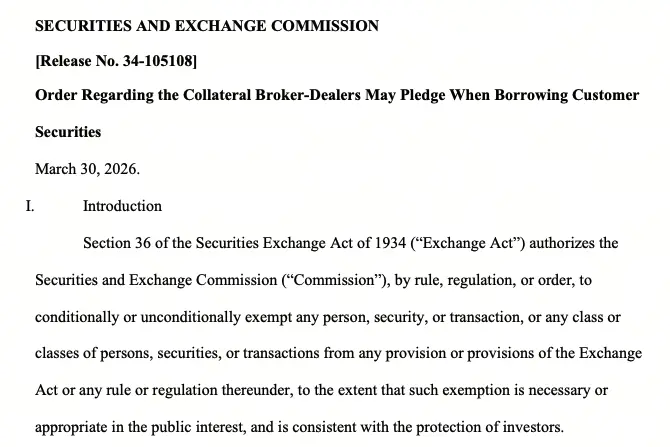 (Source: SEC)
The new order introduces the concept of “Eligible Equity Collateral,” which is defined as a diversified portfolio of long customer margin securities or broker-dealer proprietary account securities extracted from the Russell 1000 Index and the S&P 500 Index, as well as non-leveraged ETFs that track the above-mentioned indexes.
The SEC’s rationale for choosing these two indexes includes four key criteria: liquidity, low volatility, market depth, and issuer size, ensuring that the selected stocks have the market characteristics needed to serve as sound collateral.
Three Qualification Conditions to Become an “Eligible Institutional Securities Lender”
Meet the eligibility for a Qualified Institutional Buyer (QIB): a Qualified Institutional Buyer as defined under Rule 144A of the U.S. Securities Act of 1933
Maintain a holding of at least $100 million in securities through proprietary investment: a securities investment portfolio managed through proprietary investment reaching the $100 million threshold
Operate through an agent bank: conduct operations through an agent bank that has at least $100 million in outstanding securities lending
Risk Management Framework: Overcollateralization, Daily Settlement, and Grace Period Design
While opening a new collateral category, the SEC also establishes stringent risk management standards. Broker-dealers must provide 1% overcollateralization for securities loans denominated in major currencies (euro, British pound, Swiss franc, Canadian dollar, yen), and 5% overcollateralization for loans denominated in other currencies.
All collateral must be held at a bank or a registered broker-dealer, and it must be marked to market on a daily basis. Both parties must agree on concentration and diversification standards; if the collateral or the lender no longer meets eligibility requirements, a grace period of five business days is provided to complete transitional adjustments.
Before the rule amendment, the strict limitations of Rule 15c3-3 of the Securities Exchange Act made collateral options in the securities lending market extremely limited, leaving broker-dealers with little flexibility when managing lending transactions. The new rule gives broker-dealers greater room for collateral management, which is expected to reduce borrowing costs and improve overall market liquidity. Whether market participants will adopt the new framework at scale is expected to become clear gradually over the coming months.
Frequently Asked Questions
How does the SEC’s new collateral rule change the way the securities lending market operates?
Previously, broker-dealers could use only traditional assets such as cash and U.S. government treasuries as lending collateral. The new rule allows the use of diversified stock portfolios of the S&P 500 and Russell 1000, as well as related ETFs, expanding the collateral pool. This is expected to reduce borrowing costs, improve market liquidity, and provide more flexible capital management tools for institutional investors.
Which investors can use the new eligible equity collateral arrangements?
The new rule applies only to “eligible institutional securities lenders” that meet specific qualification requirements: including institutional investors that are qualified institutional buyers (QIBs) under applicable regulations, those that hold at least $100 million in securities through proprietary investment, or those that operate through an agent bank that has at least $100 million in outstanding loans. These thresholds clearly position the rule at the institutional level, and retail investors are not within scope.
How does the SEC ensure risk control for stock collateral during market volatility?
The SEC requires all eligible stock collateral to be marked to market daily (Mark-to-Market) and mandates overcollateralization requirements (1% for major currencies, 5% for other currencies). At the same time, both parties must agree on concentration and diversification standards, with a five-business-day grace period. These mechanisms ensure that the market value of the collateral remains sufficient at all times to cover lending risk exposure.
Disclaimer: The information on this page may come from third parties and does not represent the views or opinions of Gate. The content displayed on this page is for reference only and does not constitute any financial, investment, or legal advice. Gate does not guarantee the accuracy or completeness of the information and shall not be liable for any losses arising from the use of this information. Virtual asset investments carry high risks and are subject to significant price volatility. You may lose all of your invested principal. Please fully understand the relevant risks and make prudent decisions based on your own financial situation and risk tolerance. For details, please refer to
Disclaimer.


