The crypto VC market has experienced true differentiation for the first time. a16z Crypto, with a $2 billion fund, remains committed to a long-term vision; Dragonfly is shifting towards a financialization strategy; Paradigm is expanding into frontier technologies like AI. These top-tier firms are facing the same industry downturn but offering very different responses.
(Background: a16z raised another $2 billion for its crypto fund despite the downturn, while neighboring venture firms are already exploring AI and robotics.)
(Additional context: a16z aims to find Web3 talent with a crypto spirit, moving beyond just academic credentials and big-company resumes.)
Table of Contents
Toggle
- Guard: a16z Crypto’s long-term logic
- Transform: Dragonfly’s evolution into financialization
- Breakthrough: Paradigm’s boundary narratives
- Three paradigms, three bets
Many believe that crypto VC is heading toward its twilight.
Over the past decade, crypto VCs have been highly homogeneous—clustering in the same sectors, telling similar stories, competing for the same projects. Seemingly lively, but actually fragile within the industry.
But what’s happening now might be one of the most promising moments since the industry’s inception: for the first time, the market is truly diverging.
By late February 2026, two fundraising announcements emerged in succession.
One was Dragonfly Capital completing its fourth fund, raising $650 million, focusing on stablecoins, on-chain financial infrastructure, and real-world asset tokenization.
The other was Paradigm seeking up to $1.5 billion for its new fund, expanding its investment scope from crypto to frontier tech like AI and robotics.
Both are top-tier crypto VCs in a downturn cycle—why have they taken such different paths?
If we include a16z Crypto in the picture, the question becomes even more interesting: recently, the firm is raising $2 billion for its fifth fund.
These three funds represent three very different answers to the current industry crisis faced by crypto VCs.
Guard: a16z Crypto’s Long-Term Logic
In the crypto VC fundraising landscape, a16z Crypto has long held a top-tier position. It’s a dedicated crypto investment fund line under Andreessen Horowitz (a16z), which has raised four funds since 2013, totaling over $7.6 billion, making it one of the largest crypto funds globally.
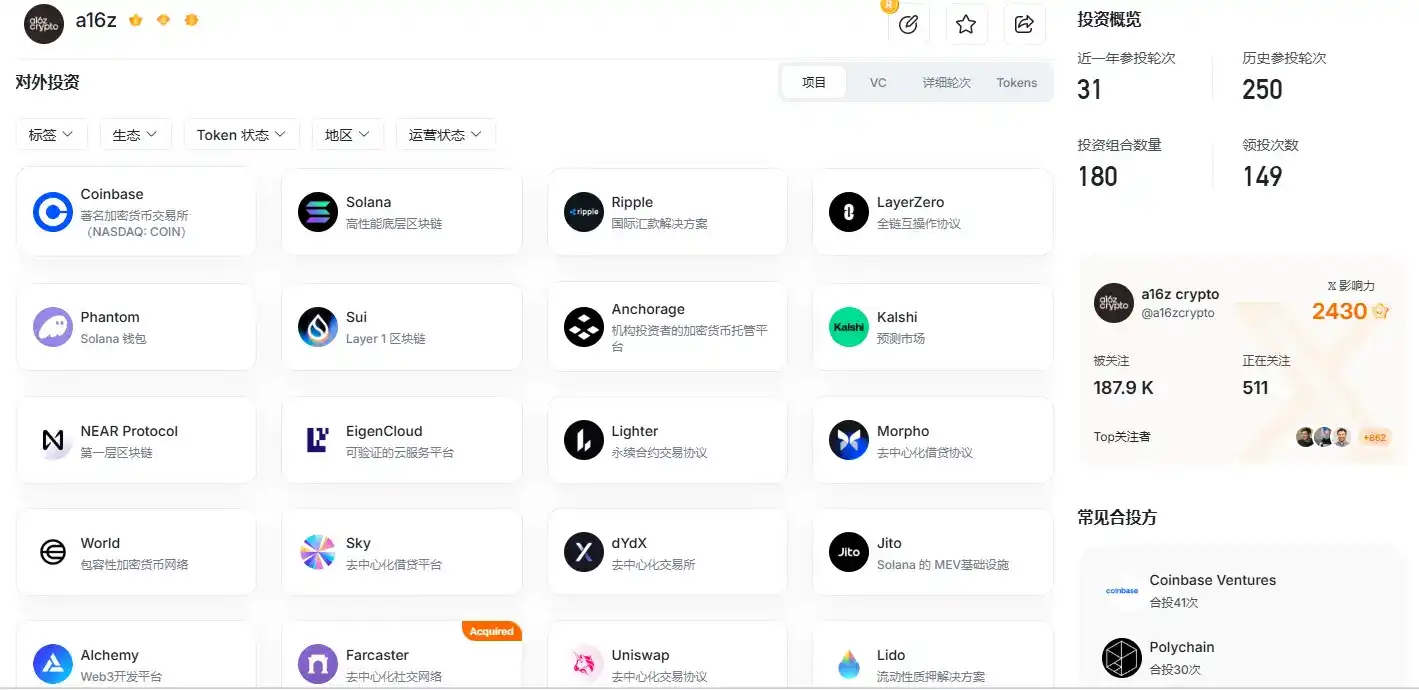
Earlier this year, a16z completed a new round of fundraising totaling $15 billion, covering infrastructure, application layers, and growth funds, with a focus on the intersection of AI and crypto as a key investment area.
According to Forbes, a16z Crypto is currently raising its fifth fund, targeting about $2 billion, aiming to close before mid-2026.
Chris Dixon, a partner at a16z Crypto, views blockchain as the next foundational layer of the internet, believing the crypto industry is in a long “building phase,” similar to how neural network papers from 1943 laid the groundwork for today’s AI; mainstream adoption will take decades of groundwork.
Dixon has publicly stated that 95% of assets held by a16z Crypto are from investments made early on, because in venture capital, selling quality assets too early is the worst decision.
Their annual industry report signals to investors: even in downturns, they are serious about understanding what’s happening in the industry.
The investors targeted by a16z Crypto are long-term institutional capital, deeply believing in the industry’s potential.
For them, as long as they believe in crypto’s future, a16z Crypto is the natural choice.
Transform: Dragonfly’s Financialization Evolution
Founded in 2018, Dragonfly started as an early-stage crypto VC connecting Asian and US markets. Its first fund was just $100 million, with its core advantage being the geographic arbitrage of co-founders operating across China and the US.
From 2019, Dragonfly gradually expanded into secondary markets, managing liquidity funds and building its own trading team. This not only served as a risk hedging tool but also provided real-time market data for primary investments, offering an auxiliary perspective on project evaluation.
In 2022, Dragonfly acquired Metastable, a crypto hedge fund co-founded by Naval Ravikant in 2014, integrating it into its operations. This created three parallel business lines: primary VC (Dragonfly Ventures), liquidity strategies (Dragonfly Liquid), and hedge fund (Metastable).
The core difference between Dragonfly and pure primary crypto funds lies in its combined primary and secondary market trading capabilities.
But building this system wasn’t overnight. Establishing an investment framework spanning both primary and secondary markets required developing two completely different decision-making, risk management, and talent structures—early-stage deep technical judgment, and secondary market quantitative skills.
Dragonfly’s external job postings explicitly require expertise in delta-neutral hedging, derivatives risk management, and related skills—rare talents in crypto, often requiring long adaptation periods from traditional finance.
This trading system is a barrier accumulated over years, making it difficult for other funds to replicate directly.
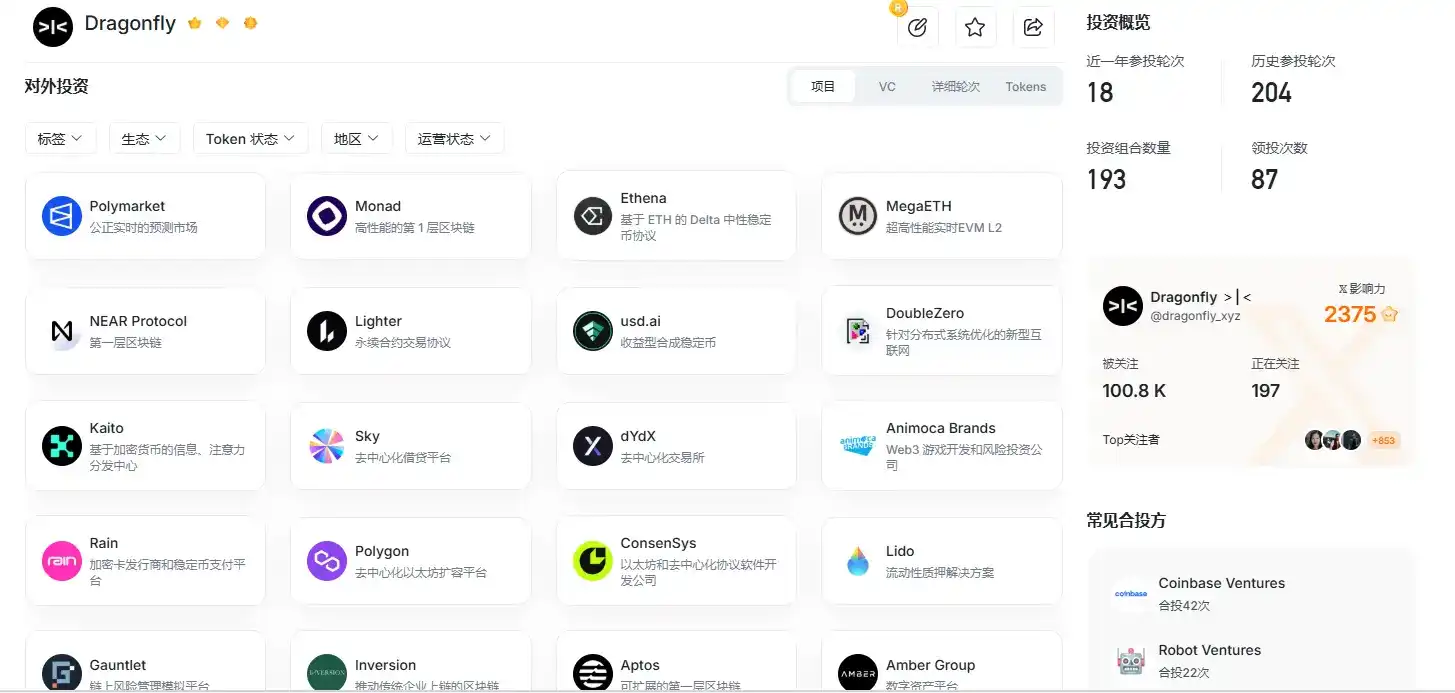
Today, Dragonfly is a trading-driven, cross-market firm managing about $4 billion, with investments in unicorns like Ethena, Polymarket, Monad Labs.
But behind this success lies a less optimistic industry trend.
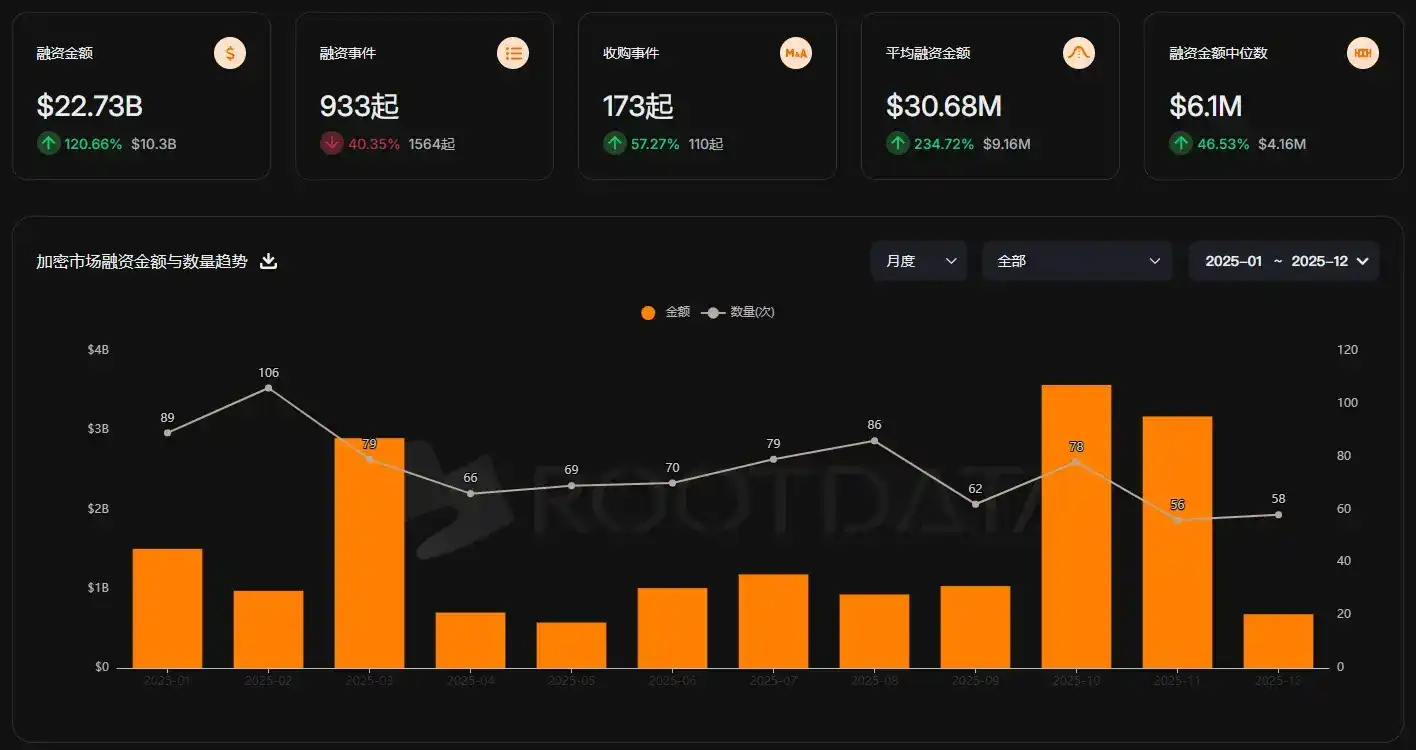
According to RootData, in 2025, the total crypto primary market funding reached $22.73 billion (excluding post-IPO and debt financing), up 120.6% from 2024; however, the number of funding events was only 933, down 40.3% year-over-year, hitting a five-year low, with monthly funding events trending downward.
Total funding amount is rising, but the number of projects receiving funding is falling—money is becoming more concentrated, leaving less room for small and early-stage projects.
Haseeb Qureshi, managing partner at Dragonfly, believes that the era of broad, non-financial crypto experiments has been disproven by the market. The new fund will focus on stablecoins, DeFi, and on-chain financial services.
He points out that recent investments in Ethena, Polymarket, Rain, and Mesh demonstrate this shift: “Crypto’s coverage is about to explode, and we want to support founders at the center.”
The investors Dragonfly targets are those who believe in blockchain financialization, driven by trading capabilities, and pragmatic crypto investors.
They may not need grand narratives about crypto changing the world; real liquidity and sustainable trading returns are what they seek.
The key to Dragonfly’s path is to go with the trend: as crypto becomes increasingly financialized, it’s just earlier than others in turning this trend into a core competitive advantage.
Breakthrough: Paradigm’s Boundary Narratives
Paradigm’s story begins with a set of numbers.
In 2021, Paradigm raised $2.5 billion, setting a record for the largest single crypto fund at the time.
By 2024, its third fund shrank to $850 million.
Now, it aims for $1.5 billion, expanding from crypto into AI, robotics, and other frontier tech.
Paradigm’s foundation is VC incubation. Co-founder Matt Huang comes from Sequoia Capital, having founded a machine learning startup at 19 that was acquired by Twitter; co-founder Fred Ehrsam was a Coinbase co-founder.
Their strength lies in early trend judgment and technical risk control. Matt Huang’s colleague, Stripe founder Patrick Collison, described him as “calm, rigorous, patient—traits well-suited for complex, impact-driven tech.”
Paradigm’s portfolio includes early protocols like Uniswap and Coinbase, which established its industry position.
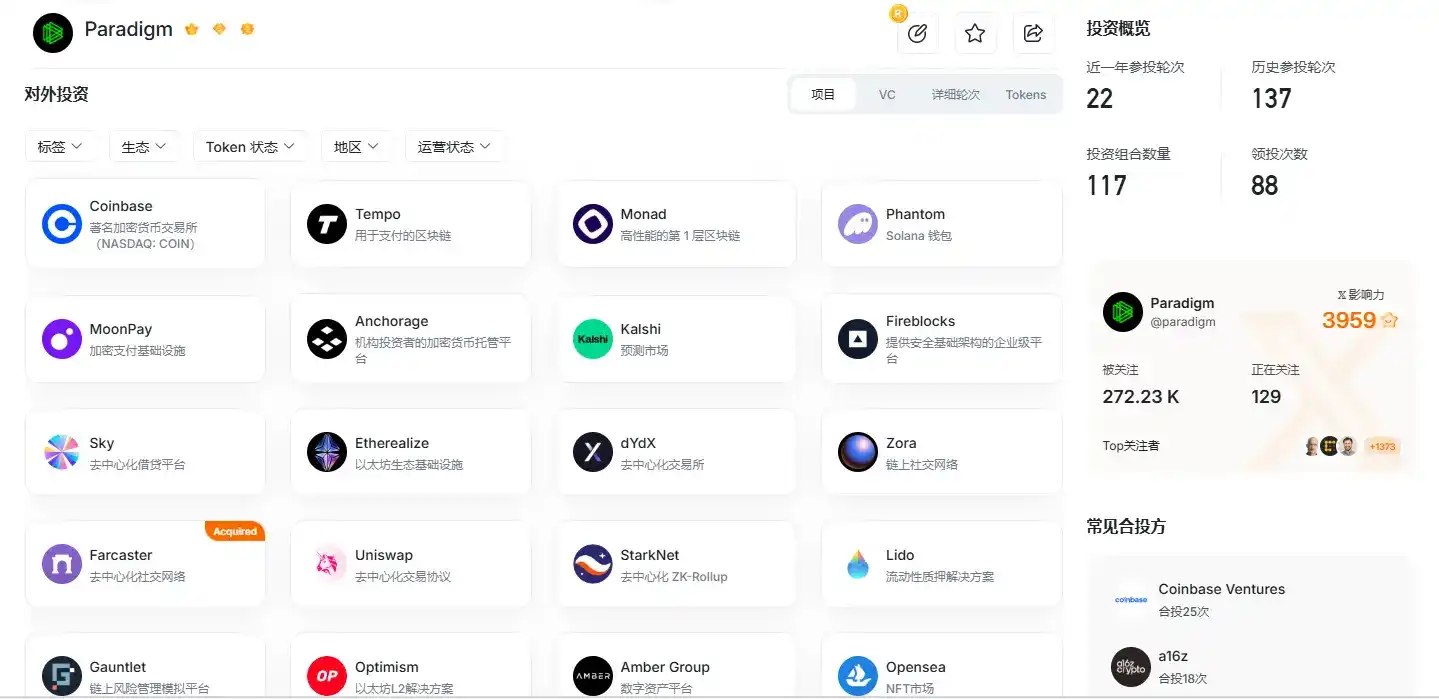
As a result, Paradigm is often described as “more of a research lab combined with an engineering organization than a traditional VC.”
After the FTX collapse, Paradigm spent three years rebuilding. But the fundamental issue of a lack of quality early-stage targets in crypto remains unresolved. For a firm emphasizing judgment and incubation, not having good projects to invest in is a deeper problem than market cap decline.
Thus, Paradigm’s shift to AI is not a temporary move.
In fact, as early as 2023, Paradigm quietly removed references to Web3 from its website. Matt Huang explained that “AI progress is too interesting to ignore,” and emphasized that crypto and AI are not zero-sum; they will overlap significantly. Earlier this year, Paradigm partnered with OpenAI to release EVMbench, a benchmark tool to test AI models’ ability to identify and fix smart contract vulnerabilities.
According to OECD data, global VC investment in AI will reach $258.7 billion in 2025, accounting for 61% of total VC investments worldwide, up from just 30% in 2022.
But on a more pragmatic level, Paradigm’s move into AI has deeper structural reasons.
Within the entire crypto VC landscape, a16z Crypto holds the top long-term capital position, while Dragonfly is the most transaction-capable player in financialization.
Paradigm’s team DNA neither replicates a16z Crypto’s long-term faith narrative nor fits Dragonfly’s trading-driven approach.
Its team’s nature means it can only craft narratives around innovative integration, aiming to attract those who have moved beyond pure crypto but are still willing to bet on cross-industry tech fusion.
This is the underlying motivation for Paradigm’s pivot—and its only misalignment.
Alexander Pack, managing partner at Hack VC (former Dragonfly partner), notes that KKR and Bain Capital have shifted from private equity to credit and public markets, and a16z has funds across various tech segments. Paradigm’s move signals that the company is maturing and re-integrating into broader tech fields, mirroring industry trends.
Three Paradigms, Three Bets
Putting these three funds side by side reveals a clear strategic divergence.
They each answer the same question: in a crypto industry downturn, what justifies a fund’s continued existence?
a16z Crypto’s answer is scale and faith. Large enough to withstand cycles, deeply researched to represent the industry, continuously conveying confidence to the market.
Dragonfly’s answer is capability and focus. Deeply engaged in crypto financialization, leveraging trading skills to compensate for primary market limitations, maintaining active capital during scarce project periods.
Paradigm’s answer is narrative and boundary-breaking. Using stories of AI and crypto fusion to attract investors beyond traditional crypto VCs, expanding its scope from a single industry to a broader wave of technological integration.
These three funds, three responses. No single paradigm is the final answer, and none can be easily copied—what stories they tell ultimately depends on team DNA.
This may be a sign of crypto VC’s maturing: no longer crowding the same path, but each finding its own way. A homogeneous industry is fragile; only by cultivating diverse species can the market truly thrive.


