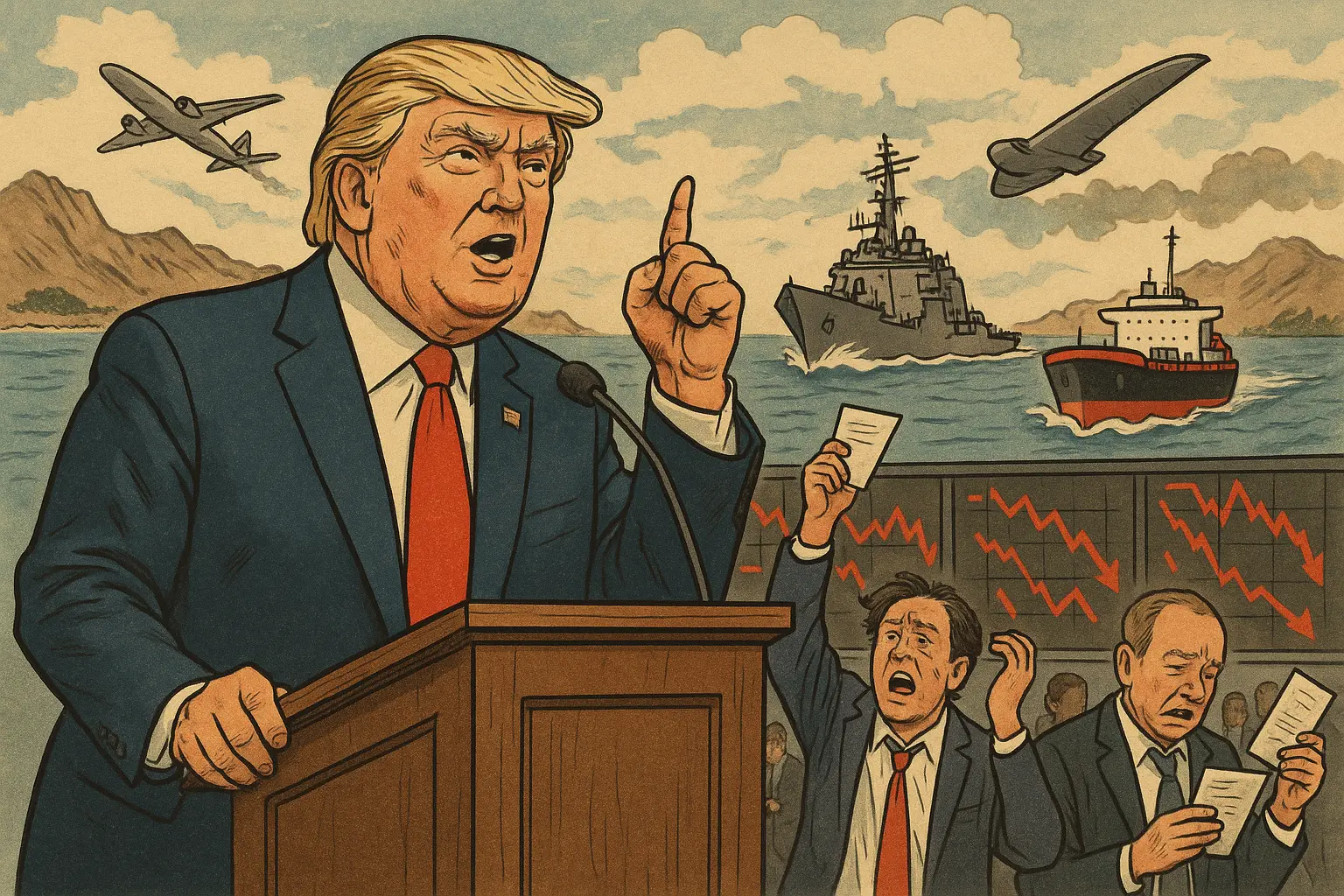
U.S. President Trump delivered a speech during prime time on Wednesday regarding Iran’s military actions. This was his first nationwide address since the launch of the “Epic Rage Operation” on February 28, offering an optimistic description of a “natural opening” for the Strait of Hormuz. The market showed disagreement through selling: Brent crude broke above $105 per barrel, Bitcoin fell from its intraday high to $67,336, and gold, stock index futures, and U.S. Treasury yields all moved sharply in both directions.
Trump’s Core Message: A Two-Week Assignment and a Vague Strait Path
In the speech, Trump claimed that Iran’s “core strategic objectives are about to be completed,” and that U.S. forces would “finish this work” in two to three weeks. He said the Strait of Hormuz would be “naturally open” after the war, but he did not propose any specific reopening mechanism or a timeline.
Instead, Trump directly named South Korea, Japan, and China, urging allies to “occupy it, protect it, and put it to use,” meaning that countries that rely on energy transport through the strait would assume responsibility for subsequent security on their own. This kind of shift in responsibility triggered an immediate diplomatic response: South Korea’s composite stock price index (KOSPI) fell 2% right after the speech, while defense stocks related to security surged sharply in tandem.
Market Reaction: A Systematic Repricing Across Asset Classes
Trump’s speech triggered systematic hedging sentiment across assets. The main market moves were as follows:
Energy: Brent crude broke above $105 per barrel, and U.S. crude moved above $102 per barrel; the market interpreted Trump’s remarks threatening Iran’s nuclear power plants as a signal that the conflict would be prolonged
Gold: It fell below $4,700 per ounce; the safe-haven premium that had been running high earlier due to tensions in the strait was released as uncertainty extended
Stock futures: S&P 500 futures fell 0.54%, and Nasdaq futures fell 0.66%
U.S. Treasury yields: The 10-year yield rose to 4.36%, approaching the 4.40% technical level
Bitcoin (BTC): Down 0.9% in 24 hours, retreating from the intraday high of $69,135 to $67,336
This basket of assets—oil up, stocks down, yields rising, and crypto down—indicates that the market’s reaction was not just simple geopolitical hedging, but a broad repricing of uncertainty surrounding overall policy.
Iran’s Response: Strait Toll Legislation, “Zero Trust”
In stark contrast to Trump’s optimistic remarks, Iran showed no sign of any concession. Iran’s Foreign Minister Abbas Araghchi explicitly stated in an interview with Al Jazeera that “there is zero trust between the two sides.”
More structurally significant is Iran’s legislative action in parliament: authorities are drafting legislation intended to legally lock in the Strait of Hormuz toll system, to be calculated in stablecoins and renminbi, with a maximum fee of $2 million per transit vessel. If this legislation is passed, the strait’s charging mechanism would be upgraded from temporary wartime measures into a long-term system with legal force. That would push the complexity of the reopening issue well beyond the scope of a military ceasefire, extending into the level of economic negotiations involving Iran’s revenue structure.
The gap between Trump’s optimistic remarks and Iran’s real-world response is widely viewed by market analysts as the main tail risk when expectations for a rapid resolution of crypto and risk-asset concerns fade.
FAQ
Why did the market sell rather than rise after Trump’s speech?
The market expected the speech would bring a clear path to a ceasefire, driving a rebound in risk assets. But the speech did not provide a specific mechanism for reopening the Strait of Hormuz; instead, it asked allies to assume security responsibilities themselves, extending uncertainty, triggering systematic selling, and lifting oil prices in step due to Trump’s remarks threatening Iran’s nuclear power plants.
What is the stablecoin toll system for the Strait of Hormuz?
Iran’s parliament is legislating to solidify a Strait toll system calculated in stablecoins and renminbi, with a maximum charge of $2 million per transit vessel. If approved, this would shift control of the strait from a military issue to an economic framework involving Iran’s legal income, greatly increasing the complexity of reopening negotiations.
Why did Bitcoin fall in response to Trump’s speech?
Before the speech, Bitcoin had already rebounded from around $67,000 to $69,135 based on ceasefire expectations. The speech failed to deliver the anticipated specific ceasefire path. The market took profits on the prior rally, and with overall risk sentiment weakening, Bitcoin fell back to $67,336, with the 24-hour decline at about 0.9%.
Disclaimer: The information on this page may come from third parties and does not represent the views or opinions of Gate. The content displayed on this page is for reference only and does not constitute any financial, investment, or legal advice. Gate does not guarantee the accuracy or completeness of the information and shall not be liable for any losses arising from the use of this information. Virtual asset investments carry high risks and are subject to significant price volatility. You may lose all of your invested principal. Please fully understand the relevant risks and make prudent decisions based on your own financial situation and risk tolerance. For details, please refer to
Disclaimer.


