U.S. Navy Vice Admiral Samuel Paparo said Tuesday, during a hearing of the Senate Armed Services Committee, that Bitcoin, as a means of power projection, is “a highly valuable computer science tool,” and that its proof-of-work (PoW) technology “imposes higher costs on attackers seeking to infiltrate networks,” adding that its cybersecurity applications have “very important” computer science significance.
Paparo’s specific remarks at the hearing
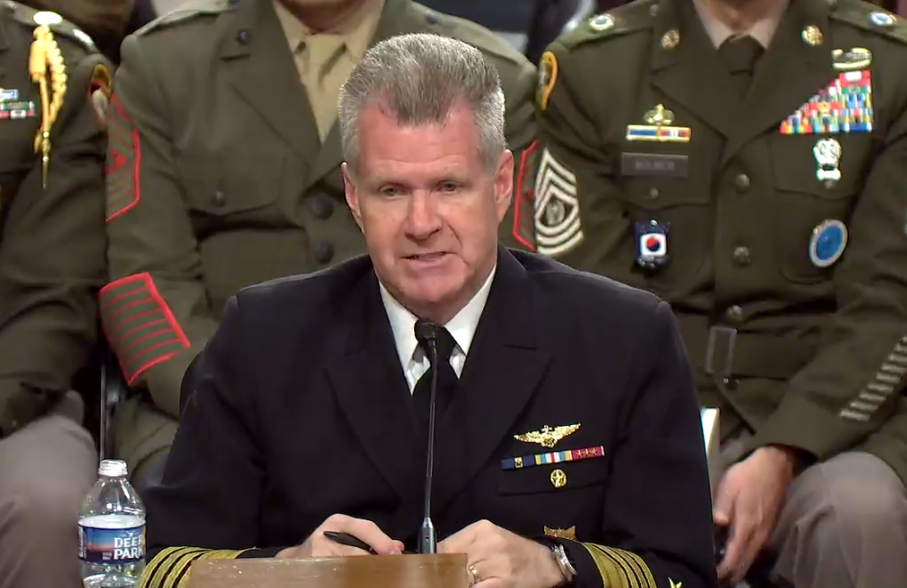
(Source: U.S. Senate Armed Services Committee)
According to the publicly available hearing transcript of the Senate Armed Services Committee, Paparo said, “Leaving aside its economic significance, it has very important computer science applications in the field of cybersecurity.” He also said, “Bitcoin is real. It’s a point-to-point value transfer method with zero trust. Anything that helps U.S. national power is a good thing.”
The above remarks were Paparo’s response to a question from U.S. Senator Tommy Tuberville; Tuberville asked how the United States and Congress can take the lead in the competition for Bitcoin, and noted that China’s top think tank on money has now regarded Bitcoin as a strategic asset.
U.S. Bitcoin legislative developments
According to publicly available information, the United States currently has the largest Bitcoin reserves among all countries and also holds the largest share of Bitcoin computing power, but it still relies on mining equipment manufactured abroad, creating supply-chain security risks. Last month, U.S. Senators Bill Cassidy and Cynthia Lummis introduced the “U.S. Mining Act,” aiming to bring more Bitcoin mining manufacturing back to the United States to address supply-chain problems, while also seeking to codify President Trump’s executive order establishing a strategic Bitcoin reserve.
Related historical statement: U.S. Space Force Jason Lowery, 2023 commentary
According to publicly available information, Paparo’s remarks align with a December 2023 comment by Jason Lowery, a member of the U.S. Space Force. At the time, Lowery said that Bitcoin and other proof-of-work blockchain networks could be used to protect “all forms of data, message, or command signal,” and said that underestimating this technology “underestimates its broad strategic significance for cybersecurity and even national security.”
Frequently asked questions
At what occasion did Paparo make his Bitcoin statement?
According to the publicly available hearing record, on Tuesday Paparo made remarks regarding Bitcoin’s cybersecurity applications at a hearing of the U.S. Senate Armed Services Committee. The hearing backdrop was a review of the United States’ strategic posture in the Indo-Pacific region, and his comments were in response to a question from Senator Tommy Tuberville.
How did Paparo describe the cybersecurity value of Bitcoin’s proof-of-work technology?
According to the hearing record, Paparo said that Bitcoin’s proof-of-work “brings higher costs to attackers trying to infiltrate networks,” and called it “very important computer science applications in the field of cybersecurity,” while adding that “leaving aside its economic significance.”
What Bitcoin-related legislation did the U.S. Senate recently propose?
According to publicly available information, Senators Cassidy and Lummis introduced the “U.S. Mining Act” last month (March 2026), aiming to bring more Bitcoin mining manufacturing back to the United States to address supply-chain security problems, and also seeking to codify President Trump’s executive order establishing a strategic Bitcoin reserve.
Disclaimer: The information on this page may come from third parties and does not represent the views or opinions of Gate. The content displayed on this page is for reference only and does not constitute any financial, investment, or legal advice. Gate does not guarantee the accuracy or completeness of the information and shall not be liable for any losses arising from the use of this information. Virtual asset investments carry high risks and are subject to significant price volatility. You may lose all of your invested principal. Please fully understand the relevant risks and make prudent decisions based on your own financial situation and risk tolerance. For details, please refer to
Disclaimer.
Related Articles
Iran's Revolutionary Guards Vow Swift Response to Any Future Aggression
IRGC says it is on high alert and ready to deliver a decisive, swift response to threats and potential aggression, reaffirming its commitment to confronting hostile forces.
Abstract: Iran's Islamic Revolutionary Guard Corps states its forces are on high alert and prepared to mount a decisive, comprehensive, and swift response to threats or potential future aggression, underscoring deterrence and its ongoing confrontation of hostile forces as reported by Tasnim News Agency.
GateNews46m ago
Russia's State Duma Passes Cryptocurrency Regulation Bill on First Reading, Allows Cross-Border Crypto Settlement to Bypass Sanctions
Gate News message, April 22 — Russia's State Duma passed a cryptocurrency regulation bill on first reading, classifying cryptocurrencies as "property" and designating the Central Bank of Russia to oversee market participants' licensing and supervision. The bill introduces a tiered access mechanism f
GateNews1h ago
Iran Conflict Cuts Muscat Airport Passenger Traffic Nearly 40% in March
Gate News message, April 22 — Passenger traffic at Muscat International Airport, Oman's main hub, fell nearly 40 percent in March 2026 compared with January 2026 due to the ongoing US-Israeli conflict with Iran and subsequent airspace closures across the Gulf region. International passenger
GateNews1h ago
Privacy Protocol Umbra Shuts Down Frontend to Block Attackers from Laundering Stolen Kelp Funds
Gate News message, April 22 — Privacy protocol Umbra has shut down its frontend website to prevent attackers from using the protocol to transfer stolen funds following recent attacks, including the Kelp protocol breach that resulted in losses exceeding $280 million. Approximately $800,000 in stolen
GateNews2h ago
Bitcoin Jumps 2.7% on Market Optimism Over Trump's Iran Ceasefire Extension
Gate News message, April 22 — Bitcoin surged 2.7% on Wednesday after President Donald Trump announced an extension of the ceasefire with Iran, boosting market confidence. The cryptocurrency traded around $77,500 at 1 p.m. Singapore time, marking its highest price since Friday when it touched a two-m
GateNews3h ago
Trump’s nominee for Fed chair: won’t be a White House puppet—crypto assets will become the new financial normal
Warsh emphasized the Federal Reserve’s independence at the hearing, denied being a White House puppet, and did not commit to rate cuts; if he takes office or adopts a more accommodative policy, it would be positive for risk assets such as Bitcoin. U.S. stocks fell amid the hearing and geopolitical risks, with the three major indexes down by about 0.6%. Changes in Middle East talks also intensified market risk sentiment.
ChainNewsAbmedia4h ago


