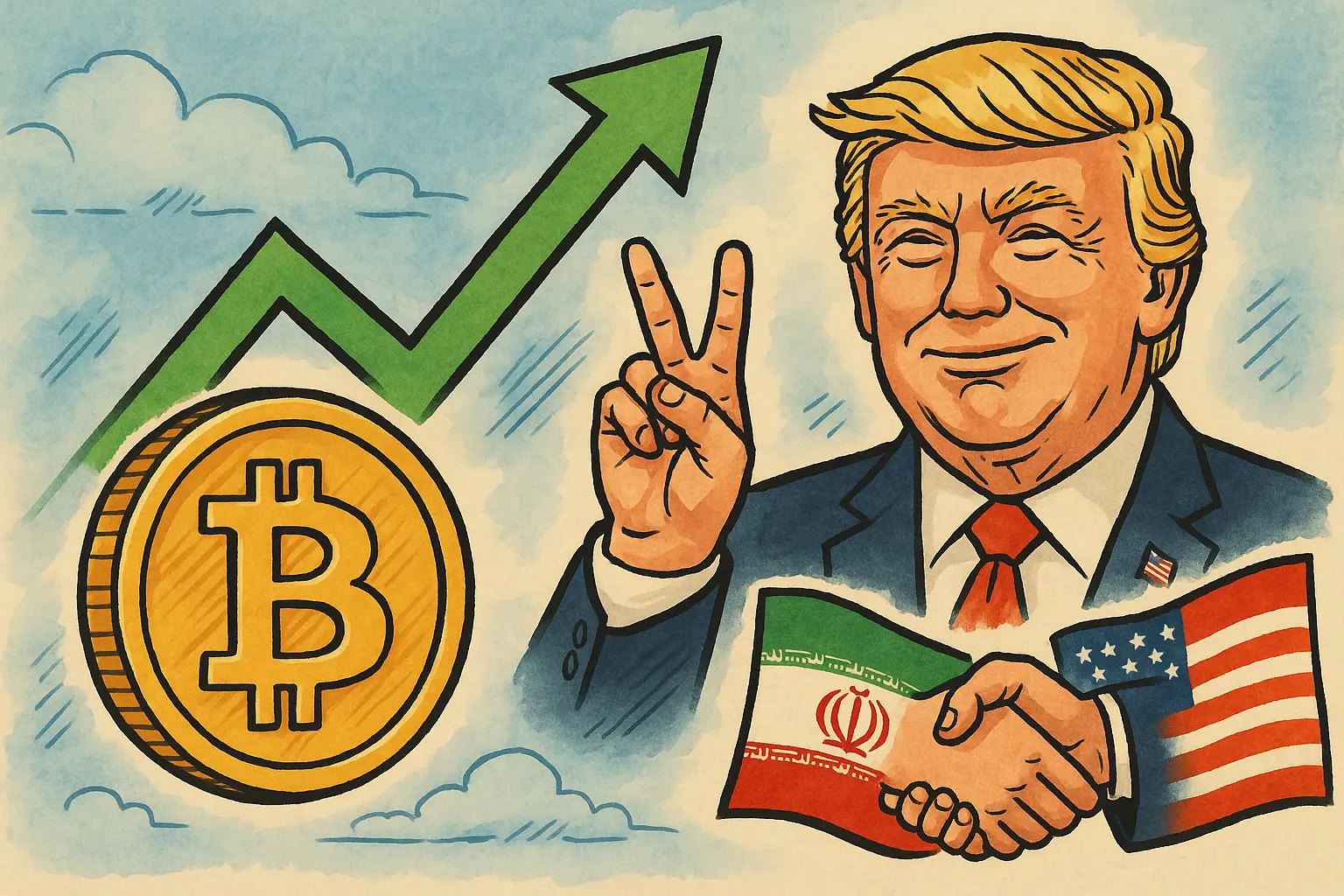
On April 15, Bitcoin sharply rebounded by about 6% over the past 24 hours, rising from roughly the Sunday low of about $70,000 to nearly $75,000. The main driving force was President Trump’s remarks during an interview with Fox News: although the U.S. side’s blockade of the Strait of Hormuz is still ongoing, Iran is “currently very eager to reach an agreement.” Market expectations for de-escalation between the U.S. and Iran surged significantly, with global risk assets rising across the board and Asian equities following with a rebound.
Key triggers behind today’s rise: Trump’s comments reignite negotiation expectations
The most direct answer to why Bitcoin is up today points to a major shift in a geopolitical signal. In the interview, Trump said he believes Iran is “very eager to reach an agreement,” and revealed that the next round of talks could take place “within the next two days” in Pakistan. With the timing arriving after the previous talks (April 11–12) ended without results, the market interpreted it as the window for negotiations reopening.
Bolstered by this, Asian stock markets rose, the tension level in the crude oil market eased, and Bitcoin—an high-beta risk asset—responded first with a sharp move. Damien Loh, Chief Investment Officer at Ericsenz Capital, noted: “Bitcoin is following the broader rally in risk assets, and trading performance continues to outperform other risk assets.”
Meanwhile, Wall Street also showed signs of “immunity” to the Iran conflict—since March 27, the S&P 500 has rebounded by nearly 10%, and the Nasdaq 100 is up by about 12% cumulatively, setting the longest 10-day winning streak since 2021.
Short-squeeze waterfall: $6 billion forced buybacks accelerate the rally
The acceleration mechanism behind this rebound comes from a chain reaction of technical liquidations. Analysts previously estimated that roughly $6 billion in leveraged short positions were concentrated in the price range of $72,200 to $73,500. After Bitcoin broke through this key dense zone, a large number of short positions were forced to close, creating additional technical buying pressure that pushed prices even higher.
Main drivers behind Bitcoin’s rise today
Geopolitical catalyst: Trump says Iran is actively seeking an agreement; the next round of talks may soon begin in Pakistan
Risk sentiment fully returns: Asian stock markets are rising; the market is gradually adjusting and “coexisting” with the Iran conflict
Forced short-liquidation cascade: The $6 billion shorts in the $72,200 to $73,500 range are being liquidated; buying continues to pour in
Relative strength confirmation: Since the conflict erupted at the end of February, BTC has risen cumulatively by more than 10%; gold is down nearly 10%; the S&P 500 is basically flat
Technical outlook: $80,000 is the key threshold to confirm a trend reversal

(Source: Trading View)
Bitcoin’s primary resistance level at present is $80,000, about 10% above the current price. Even more crucial is the 200-day moving average, which is currently slightly above $83,000. The market views it as the core pivot level confirming a reversal to the bull trend.
If the U.S.-Iran de-escalation trend continues, the pressured short position setup may persist, and Bitcoin could attempt to break through $80,000, with further upside targets pointing to the $83,000 to $94,000 range. Standard Chartered and Bernstein both predict a year-end target price of $150,000. Analysts also noted that before the regulatory framework under the U.S. “CLARITY Act” is formally established, Bitcoin may be difficult to sustain a large-scale, continuous rally; the macro outlook over the next seven days is crucial.
FAQ
Why is Bitcoin up today? What is the most core driver?
The most direct reason is that Trump said Iran is “very eager to reach an agreement.” A new round of talks is about to start, and market expectations for de-escalation in the U.S.-Iran conflict have surged, lifting global risk assets broadly. On the technical side, the roughly $6 billion leveraged shorts concentrated in the $72,200 to $73,500 range were forced into liquidation, further accelerating this rebound.
Why is Bitcoin’s rise today outperforming gold and equities?
Ericsenz Capital CIO noted that Bitcoin continues to perform better than other risk assets. Since the Iran conflict erupted at the end of February, BTC has risen by more than 10% cumulatively, while gold is down nearly 10% and the S&P 500 is basically flat. In this conflict, the market has positioned Bitcoin as a special asset with both risk-asset and non-sovereign hedging characteristics, and these dual attributes stand out particularly when geopolitical risks ease.
Where is Bitcoin’s next key resistance level?
The most recent major resistance is at $80,000 (about 10% above the current price). After a breakout, the next target is near $83,000, around the level of the 200-day moving average. If the geopolitical situation continues to ease, analysts expect Bitcoin could further move toward its target range of $83,000 to $94,000. Standard Chartered and Bernstein both have year-end targets of $150,000.
Disclaimer: The information on this page may come from third parties and does not represent the views or opinions of Gate. The content displayed on this page is for reference only and does not constitute any financial, investment, or legal advice. Gate does not guarantee the accuracy or completeness of the information and shall not be liable for any losses arising from the use of this information. Virtual asset investments carry high risks and are subject to significant price volatility. You may lose all of your invested principal. Please fully understand the relevant risks and make prudent decisions based on your own financial situation and risk tolerance. For details, please refer to
Disclaimer.
Related Articles
Bitmine is promoted to the NYSE main board! Tom Lee: US stocks may be at a bottom, and selling pressure on Ether could ease
Bitmine officially transferred from the NYSE American market to the main board, marking a significant milestone for the company. Despite a sharp drop in its share price, it still increased the share repurchase program to $4 billion. The company holds a large amount of Ether, and expects that a rebound in the crypto market will help improve its assets and share price performance.
CryptoCity2h ago
ETH 15-minute up 0.66%: On-chain large transfers in sync drove a net inflow of funds, boosting spot buying pressure
2026-04-15 00:00 to 00:15 (UTC), ETH shows a local anomaly. The 15-minute return rate is +0.66%. The trading price range is 2321.93–2343.2 USDT, with a range of 0.92%. During this period, market attention increased, volatility slightly intensified, buy pressure in the order book shifted upward in the short term, and quickly pushed spot prices up into a key resistance area.
The main drivers of this anomaly are large on-chain transfers and inflows of capital in combination. At the beginning of the window, multiple large ETH transfers appeared, including 8,676 ETH and 6,551 ETH, respectively, transferring from a large source to the
GateNews3h ago
BTC 15-minute drop of 0.54%: Liquidity worsens and whales actively reduce positions, putting short-term pressure on the market
From 22:15 to 22:30 (UTC) on 2026-04-14, BTC saw a short-term pullback of 0.54% within the high-range band of 73911.6 - 74314.4 USDT, with a return of -0.54%. During this period, market swings were evident, volatility intensified, attention from the market quickly increased, and downward pressure on the order book was prominent.
The main drivers behind this unusual move were the continued deterioration of market liquidity and a clear lack of order book depth, which made the BTC price extremely sensitive to large sell orders. At the same time, during the key time window, whale wallets carried out large transfers and also engaged in active de-risking,
GateNews4h ago
ETH 15-minute drop of 0.61%: Sell orders concentrate and release while bearish sentiment intensifies, increasing downward pressure
2026-04-14 22:15 to 2026-04-14 22:30 (UTC) during this period, on the 15-minute K-line, ETH recorded a -0.61% return, with a price range of 2313.68 to 2328.54 USDT and a fluctuation of 0.64%. During this period, market attention increased, trading volume expanded noticeably, and heightened short-term volatility sparked strong interest in the subsequent trend.
The main drivers behind this unusual move are the concentrated release of sell orders and continued net outflows of on-chain funds. Specifically, the sell volume share rose to 52%, higher than the buy side at 48%, indicating heavy selling pressure
GateNews4h ago
TAO Falls 6.9% in 24 Hours as Covenant Exit and Market Rotation Weigh on Price
Bittensor's TAO token fell 6.9% to $238.91 amid a week-long decline linked to Covenant AI's exit due to centralized control concerns. Competing AI tokens had smaller declines. Despite the downturn, TAO remains the top AI token by market cap, with Grayscale increasing its allocation.
GateNews5h ago
Bitmine advances to the NYSE main board! Tom Lee: The US stock market may have bottomed out, and selling pressure on Ether could ease
Bitmine has officially moved from the NYSE American board to the main board in the United States, marking a major milestone for the company. Despite a sharp drop in its stock price, it has still increased its share buyback plan by raising the authorization to $4 billion. The company holds a large amount of Ethereum, and predicts that a rebound in the crypto market will help improve its assets and stock performance.
CryptoCity5h ago


