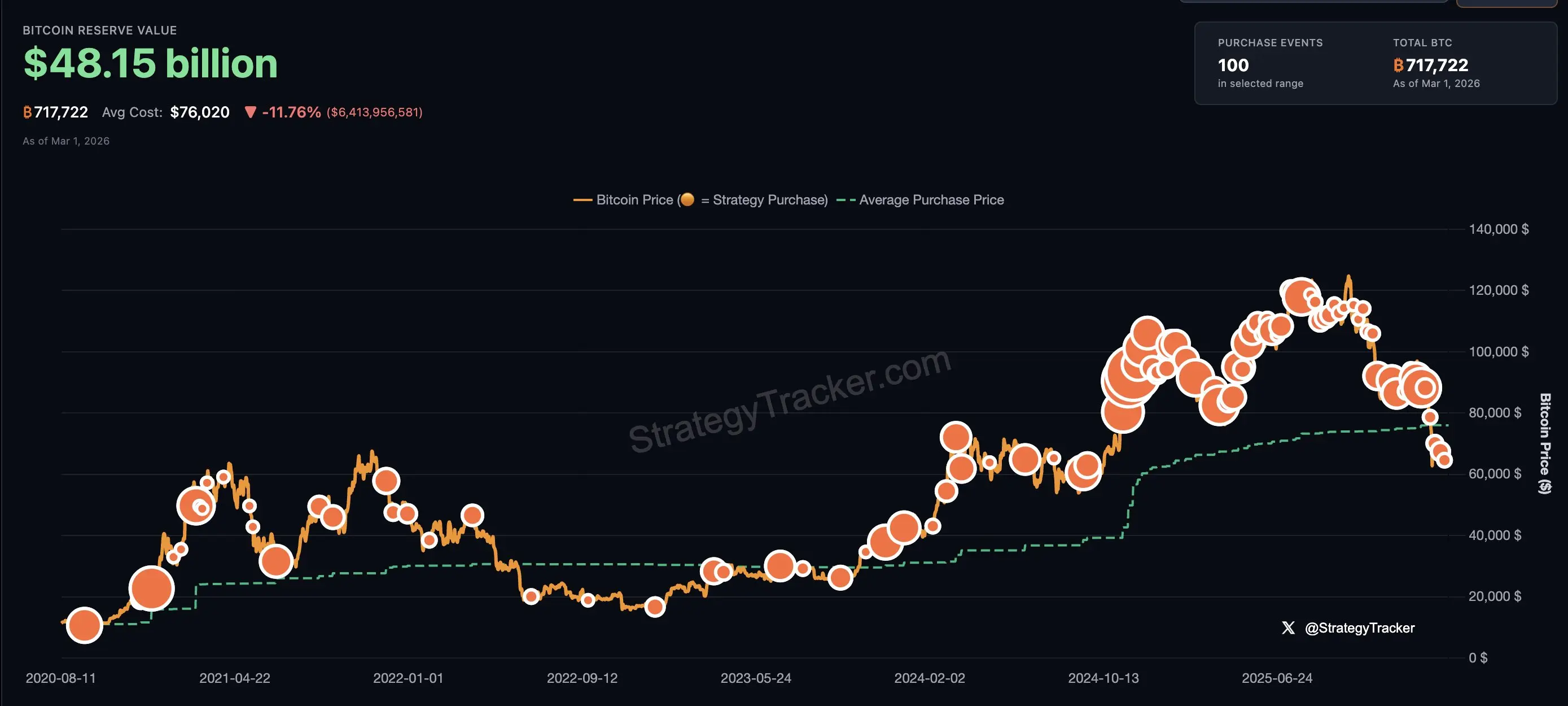
 Strategy (formerly MicroStrategy) executive chairman Michael Saylor posted his characteristic “orange dot” Bitcoin chart on social media platform X on March 1, 2026, with the caption “The Turn of the Century,” a move historically followed by formal disclosure of additional Bitcoin acquisitions.
The company currently holds 717,722 BTC valued at approximately $48.09 billion, with an average purchase price of $56,020. Separately, Saylor addressed quantum computing risks to Bitcoin, arguing the threat will not materialize this decade and that the network would upgrade first. Strategy also raised the annual dividend on its perpetual preferred STRC series by 25 basis points to 11.50% for March 2026, marking the seventh increase since the stock began trading in July 2025.
Saylor’s Orange Dot Chart Fuels Bitcoin Accumulation Speculation
Saylor shared his signature orange dot Bitcoin chart on March 1, featuring the company’s well-known acquisition format that plots each completed Bitcoin purchase as an orange marker against price performance over time. The post “The Turn of the Century” follows a pattern where similar posts have been followed by formal filings detailing new buys, typically released the following business morning.
According to Strategy’s publicly displayed holdings dashboard, the company currently holds 717,722 BTC valued at approximately $48.09 billion, with Bitcoin priced near $67,010 at the time of the update. The firm’s average purchase price stands at $56,020, representing a total Bitcoin cost of about $26.4 billion across 100 purchase events. Strategy’s holdings represent approximately 59.45% of total Bitcoin held by publicly traded companies.
The company’s most recent acquisition occurred between February 17-22, 2026, when Strategy purchased 592 BTC at an average price of $67,286, funded by approximately $39.7 million raised through an at-the-market equity offering.
The data also shows MSTR trading at $129.50, down 2.92%, with a market capitalization of $43.27 billion. Open interest tied to the stock measures $35.18 billion, while 30-day historical volatility is 114%. MSTR closed February with its eighth consecutive monthly decline, falling 14% as Bitcoin tumbled nearly 20% during the month.
Saylor Addresses Quantum Computing Threat to Bitcoin
Saylor pushed back on fresh debate over quantum computing risks, arguing the threat won’t materialize this decade and that Bitcoin would upgrade first. Speaking on a podcast, Saylor argued that a quantum computer capable of threatening modern cryptography is not an “in this decade” event.
He added that even if the risk becomes real, upgrades across global digital infrastructure would follow, including Bitcoin. “Bitcoin is software, and software can change — before an attacker can reliably exploit a breakthrough,” Saylor stated.
The sharper concern targets public-key cryptography — the digital signatures that prove ownership of coins. If large-scale, fault-tolerant quantum machines reach sufficient capability, Shor’s algorithm could undermine widely used public-key systems. However, not every Bitcoin output is equally exposed, as many outputs commit to a hash of a public key and only reveal the key when the owner spends.
Bitcoin’s development process includes BIP 360, which introduces Pay-to-Merkle-Root (P2MR) as a new output type via soft fork. The proposal frames P2MR as a way to avoid a Taproot spending path that can reveal a public key, potentially making future post-quantum cryptography integration cleaner.
Saylor identified human-related factors such as ignorance, poor education, or regulatory overreach as greater threats to Bitcoin than quantum computing. The Ethereum Foundation has listed “quantum readiness” among its 2026 priorities, reflecting broader industry attention to the issue.
Strategy Raises STRC Preferred Dividend to 11.5%
Strategy lifted the annualized payout on its perpetual preferred STRC series by 25 basis points to 11.50% for March 2026, with the next payout scheduled for March 31 to shareholders of record. This marks the seventh dividend increase since STRC began trading in July 2025.
Strategy describes STRC as a short-duration, high-yield savings account. The dividend rate is set each month to help the shares trade close to their $100 par value and to limit price volatility. STRC closed at $100 on February 28 but had traded somewhat below that level during February’s market decline, necessitating the payout boost.
The company reports $2.25 billion in USD reserves, $904 million in annual dividends, $8.25 billion in debt, and $8.46 billion in preferred equity. Net leverage is listed at 12%, with 53.2 Bitcoin years of dividend coverage and 29.9 months of USD dividend coverage.
Despite the preferred stock’s stability, Strategy’s common stock has underperformed significantly. MSTR shares declined sharply in the trailing 12 months through February 2026, lagging the broader finance sector. The stock trades below both its 50-day and 200-day simple moving averages, signaling sustained bearish momentum.
FAQ: Michael Saylor and Strategy Developments
Why does Michael Saylor’s orange dot chart matter to investors?
It has historically preceded formal disclosures of new Bitcoin purchases by Strategy. Saylor’s March 1, 2026 post with the caption “The Turn of the Century” featuring the orange dot chart has led market participants to anticipate another acquisition disclosure.
How much Bitcoin does Strategy currently hold?
Strategy holds 717,722 Bitcoin valued at approximately $48.09 billion as of March 1, 2026, with an average purchase price of $56,020. This represents approximately 59.45% of all Bitcoin held by public companies.
What is Strategy’s view on quantum computing risks to Bitcoin?
Saylor argues that a credible quantum threat to Bitcoin is likely more than a decade away and that Bitcoin would upgrade first through implementation of post-quantum cryptography. He identifies human factors like regulatory overreach as greater immediate risks.
What is the STRC preferred stock and why was its dividend increased?
STRC is Strategy’s perpetual preferred stock designed to trade near its $100 par value through monthly dividend adjustments. The dividend was increased to 11.50% for March 2026 to maintain price stability after STRC traded somewhat below par during February’s market decline.
Disclaimer: The information on this page may come from third parties and does not represent the views or opinions of Gate. The content displayed on this page is for reference only and does not constitute any financial, investment, or legal advice. Gate does not guarantee the accuracy or completeness of the information and shall not be liable for any losses arising from the use of this information. Virtual asset investments carry high risks and are subject to significant price volatility. You may lose all of your invested principal. Please fully understand the relevant risks and make prudent decisions based on your own financial situation and risk tolerance. For details, please refer to
Disclaimer.


