RedTelephoneBoothSite

vip
Age 0.1 Yıl
Peak Tier 0
No content yet
The scale of 965 billion indicates that the market is no longer a solo performance by retail traders; institutions are using rules to reshape the narrative.
View Original
Furan86999
In the past, Wall Street looked at Bitcoin as if it were a “rogue-style” asset—criticizing it out loud, while keeping a close watch on it with their hands. Now, no more pretending—within a month, four major firms have almost simultaneously moved: Morgan Stanley rolled out a spot BTC ETF (MSBT, fee 0.14%), Goldman Sachs filed an application for a Bitcoin Premium Income ETF with the SEC, BlackRock has reapplied for a Bitcoin yield-related ETF (BITA), and Citigroup has stepped in more deeply in the capacity of an authorized participating institution (AP). Meanwhile, the total size of US Bitcoin spot ETFs has surged to $96.5 billion, and BlackRock’s IBIT alone has taken $55 billion, accounting for about 57% of the entire market; on the same day, Goldman Sachs–related actions also saw a net inflow of $411 million.
This batch of signals is actually very straightforward: Wall Street isn’t here to “buy coins by following the trend.” They’re here to standardize Bitcoin, productize it, and bring it into compliance. You can understand it as an “asset identity upgrade”—from what used to be a “non-mainstream asset,” it is being rewrapped as a standard financial product that can be bought, allocated, and used to enhance yield within institutional accounts. For institutions, the significance of ETFs is not about whether prices go up or down, but about a compliant channel + a risk-control framework + a continuous pool of funds: being able to enter the investment-advisory system, fit into a pension logic, and make strategy allocations is the most critical incremental value.#GatePreIPOs首发SpaceX #加密市场回升
  • Reward
  • Comment
  • Repost
  • Share
Every year as the year comes to an end, I want to uninstall the trading software: it’s not that I’m losing money—it’s the mountain of reporting records that can drive you absolutely crazy.
Later I learned my lesson, and in my day-to-day I only do two things: keep my exchange and on-chain addresses recorded separately, and at the end of each month export a CSV of trades/transfers into the same folder, then jot down a quick line—“this one is for rebalancing / this one is for transferring to a cold wallet”—otherwise I won’t even recognize my own records after three months.
Especially now that
View Original
  • Reward
  • Comment
  • Repost
  • Share
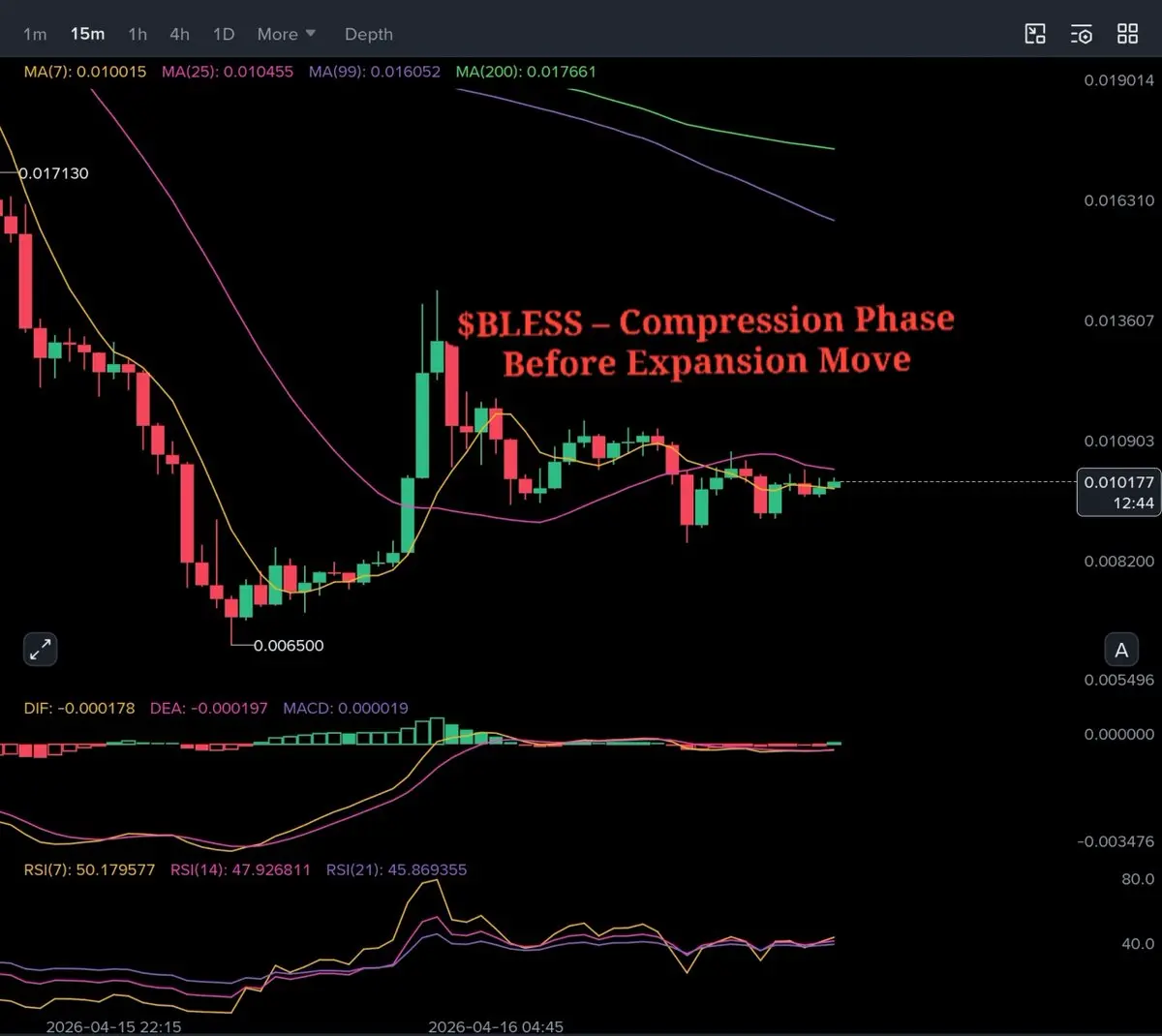
Small entity candlesticks + moving averages leveling out, this kind of consolidation is frustrating but often the most promising; patience is more important than quick reflexes.
View Original
CryptoSat
💰 $BLESS – Compression Phase Before Expansion Move
🔼 LONG
✳️ ENTRY : 0.0101 - 0.0096 - 0.0094
🎯 TARGETS: 0.0104, 0.01090, 0.01125, 0.01205, 0.0133, 0.014680, 0.018
🀄️ LEVERAGE: 20x
🔴 STOPLOSS: 0.0091
After a sharp correction, price has entered a tight consolidation zone, indicating seller exhaustion ⚖️
MA7 & MA25 are flattening, showing loss of bearish momentum, while price is stabilizing above key support.
Multiple small-bodied candles suggest accumulation phase, where smart money is slowly positioning before the next move.
If breakout confirms above recent range, this can quickly push towards liquidity zones near 0.014+ 🚀
Patience is key here — this is not a chase trade, but a calculated DCA opportunity before expansion.
repost-content-media
  • Reward
  • Comment
  • Repost
  • Share
Every time I see discussions about stablecoins "pegging or not," my first reaction isn't technical, but human: once someone starts doubting whether the reserves are clean or can be withdrawn at any time, the panic string will tighten on its own. Transparency, to put it simply, is just giving everyone a reason to "not panic"; otherwise, no matter how much you say there's collateral, it’s useless—emotions will drain the pool first.
Recently, AI agents and automated trading tools have also been quite popular. Many people hype them up as fully automatic money-printing machines, but I’m actually mo
View Original
  • Reward
  • Comment
  • Repost
  • Share
Recently, someone posted a screenshot of the APY from a yield aggregator in a group chat, accompanied by the phrase "passive income," which gave me a bit of PTSD... To put it simply, those numbers are not magic; they are just a pipeline assembled from multiple contracts: you send your money out, the contract then moves funds to other pools for arbitrage, and if any part of that process (permissions, upgrades, oracles, liquidation, even the operator’s private keys) goes wrong, you're the one footing the bill.
Adding the counterparty risk on top, some so-called "stable" yields are really just
View Original
  • Reward
  • Comment
  • Repost
  • Share
Thor's approach is like laying the foundation for BSC: using rules to reduce short-term noise.
View Original
CarpenterLabs
Currently on BSC, it's not projects that are lacking, but "resilience."
Passing by BSC, I saw that Thor has been quite popular recently, so I took a close look at the documentation. This "anti-burn design" is quite practical: holding more than 500k tokens grants full-level defense directly, or you can use tiered protection. In short, it doesn't give opportunities to those who just want to make a quick profit without effort.
This logic of "having a position first, then discussing returns" makes the current 2M market cap seem especially substantial. It's not built on hype, but on this anti-burn mechanism that firmly establishes consensus.
Goal: Make BSC Great Again. No rush, no impatience, wait for the wind.
Perhaps those who truly want to "Make BSC Great Again" are not in a hurry for a quick surge right now. Listen to this thunder, it's not harsh, even a bit steady.
The Thunder God has now set sail. If you're tired of quick in-and-out gambling, maybe you can listen to this thunder. ⛈
CA: 0x7488ae896e232de4f69da856ec8d7ec4aa8bffff
#DYOR
repost-content-media
  • Reward
  • Comment
  • Repost
  • Share
  • Pin