
















BlackRiderCryptoLord

vip
Age 0.5 Yıl
Peak Tier 0
No content yet
#SECAndCFTCNewGuidelines
A Turning Point in U.S. Crypto Regulation
The United States has entered a decisive new phase in digital asset governance as the U.S. Securities and Exchange Commission (SEC) and the Commodity Futures Trading Commission (CFTC) formalize cooperation through a landmark Memorandum of Understanding.
This is more than policy alignment—it’s a structural reset for the crypto industry, replacing years of regulatory fragmentation with a coordinated, forward-looking framework.
⚖️ From Confusion to Clarity
For years, crypto operated in a legal gray zone:
Was a token a security or
BTC-4,58%
post-image
post-image
  • Reward
  • 1
  • Repost
  • Share
BlackRiderCryptoLordvip:
2026 GOGOGO 👊
#GateSquareAIReviewer
🚀 Gate AI Ecosystem — Redefining Smart Crypto Trading
Artificial intelligence is no longer optional in crypto—it’s the edge that separates winners from spectators. Gate.io has built a powerful AI-driven ecosystem that transforms how users trade, analyze, and automate.
🤖 Gate AI — Smart Trading Companion
An intelligent assistant that simplifies market analysis, guides beginners, and delivers data-driven insights for smarter decisions.
⚙️ Gate Claw — Automation Engine
A next-level platform where users can build custom AI agents, automate strategies, and turn trading into
post-image
post-image
  • Reward
  • 1
  • Repost
  • Share
BlackRiderCryptoLordvip:
Diamond Hands 💎
#Gate13thAnniversaryGlobalCelebration
🚀 13 Years of Dominance — Powering the Future of Crypto
✨ From Vision to Global Authority — Gate’s Unstoppable Evolution
Since its inception in 2013, Gate has not merely grown—it has redefined the architecture of digital asset trading. What began as a bold vision has transformed into a global powerhouse, trusted by over 50 million users worldwide, delivering cutting-edge access to spot markets, derivatives, and next-generation financial ecosystems.
Over 13 years, Gate has consistently stayed ahead of the curve—anticipating market shifts, pioneering innov
post-image
post-image
  • Reward
  • 1
  • Repost
  • Share
BlackRiderCryptoLordvip:
2026 GOGOGO 👊
#CryptoMarketBouncesBack
🚀 Crypto Market Regains Momentum — Structural Shift or Temporary Expansion?
The digital asset landscape is transitioning from passive consolidation into directional expansion, as key assets reclaim critical liquidity zones and re-establish bullish market structure.
This is not just a bounce.
👉 This is capital re-engagement across the risk curve.
🧠 Bitcoin Above $75K — Market Leadership Reconfirmed
Bitcoin’s reclaim above $75K is not merely technical —
it represents a macro-aligned liquidity breakout.
• Aggressive short liquidations
• Sustained ETF inflows
• Institu
BTC-4,58%
ETH-6,25%
SOL-5,81%
post-image
post-image
  • Reward
  • 2
  • Repost
  • Share
CryptoSelfvip:
To The Moon 🌕
View More
#GateSquareAIReviewer
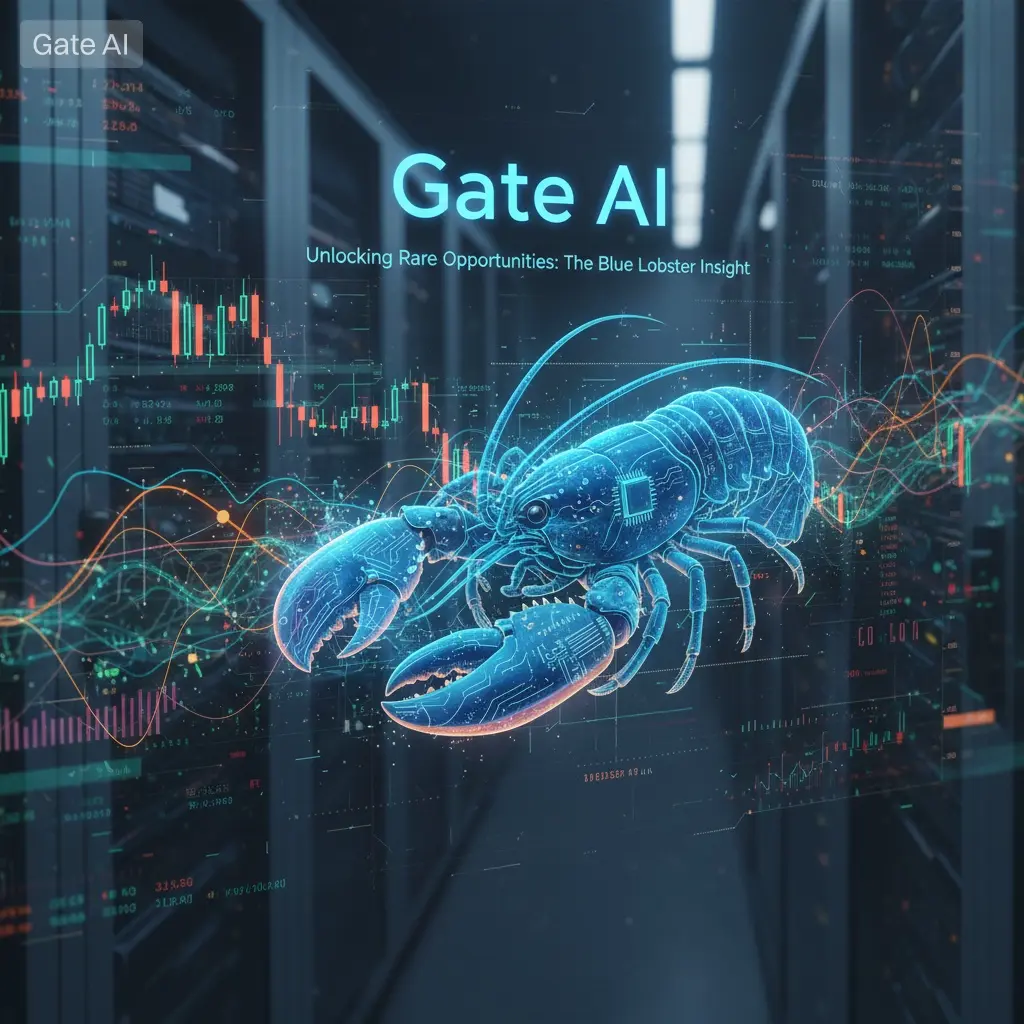
🚨 Gate AI + Blue Lobster — The Intelligence Layer Reshaping Crypto Markets
This isn’t just innovation.
This is algorithmic dominance entering retail trading.
Gate.io is no longer just a trading platform —
it’s evolving into a full-scale AI-powered market intelligence ecosystem.
🧠 Gate AI — Beyond Indicators, Into Predictive Control
Forget lagging indicators.
Gate AI operates on:
• Real-time data ingestion
• Machine learning-driven pattern recognition
• Predictive market modeling
• Continuous adaptive intelligence
👉 It doesn’t follow the market —
It anticipates structu
post-image
post-image
  • Reward
  • 1
  • Repost
  • Share
BlackRiderCryptoLordvip:
To The Moon 🌕
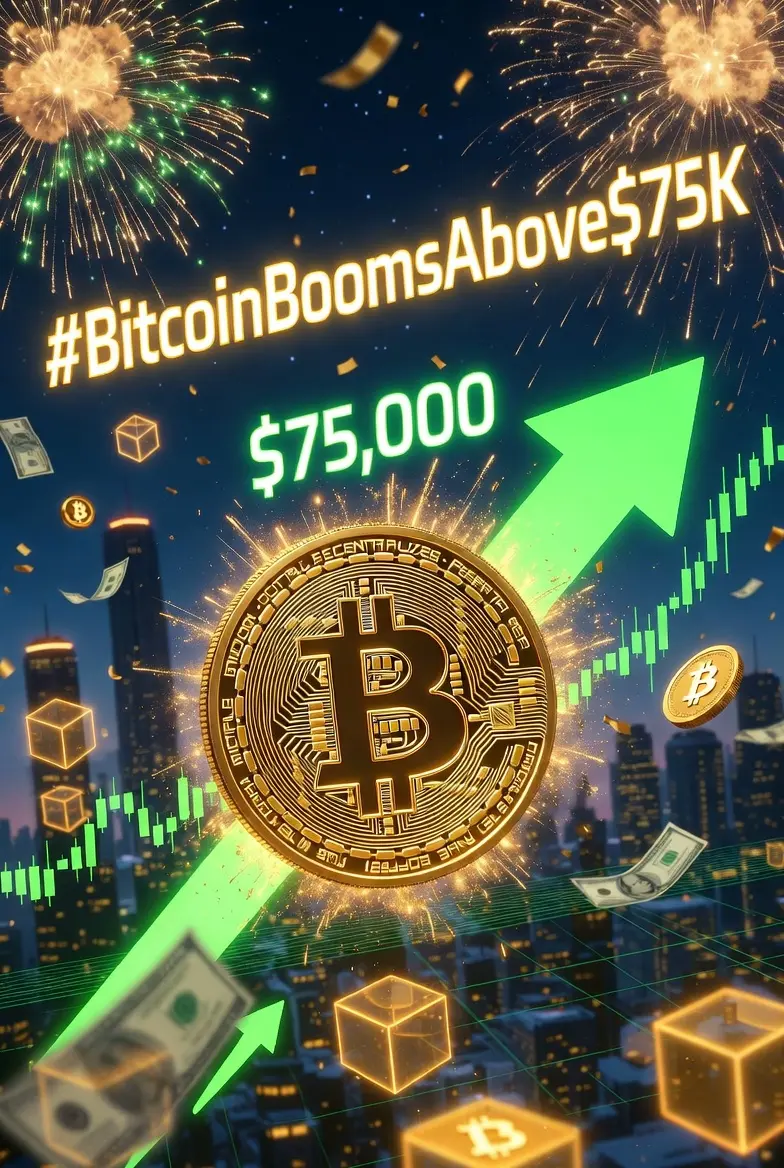
#BitcoinBoomsAbove$75K
Above $75K — This Isn’t a Breakout… It’s a Test of Intelligence
Everyone is celebrating.
Green candles.
Breakout tweets.
“$80K next” everywhere.
But let’s get something straight:
👉 This move is not about price.
👉 This move is about positioning.
⚠️ The Truth Most Traders Are Missing
Bitcoin didn’t “break” $75K.
It touched liquidity… and got rejected.
That wick to $75,900?
That’s not strength.
That’s a message.
“There’s still supply here… and smart money is not done yet.”
🧠 What Actually Caused This Move?
Not demand. Not adoption. Not retail.
This was derivatives press
BTC-4,58%
post-image
post-image
  • Reward
  • 1
  • Repost
  • Share
BlackRiderCryptoLordvip:
Diamond Hands 💎
#GateClawOfficiallyLaunches
🚀 The official launch of GateClaw AI agent platform on March 10, 2026 marks a pivotal milestone in the evolution of AI-driven crypto trading infrastructure. Developed by Gate.io and powered by the advanced OpenClaw framework, this innovation introduces a new paradigm where traders can deploy intelligent AI agents with a single click, eliminating the traditional barriers of coding, complex automation, and technical configuration.
At the core of this ecosystem is the Blue Lobster AI assistant, an autonomous market-analysis agent designed to transform chaotic crypto
post-image
post-image
  • Reward
  • Comment
  • Repost
  • Share
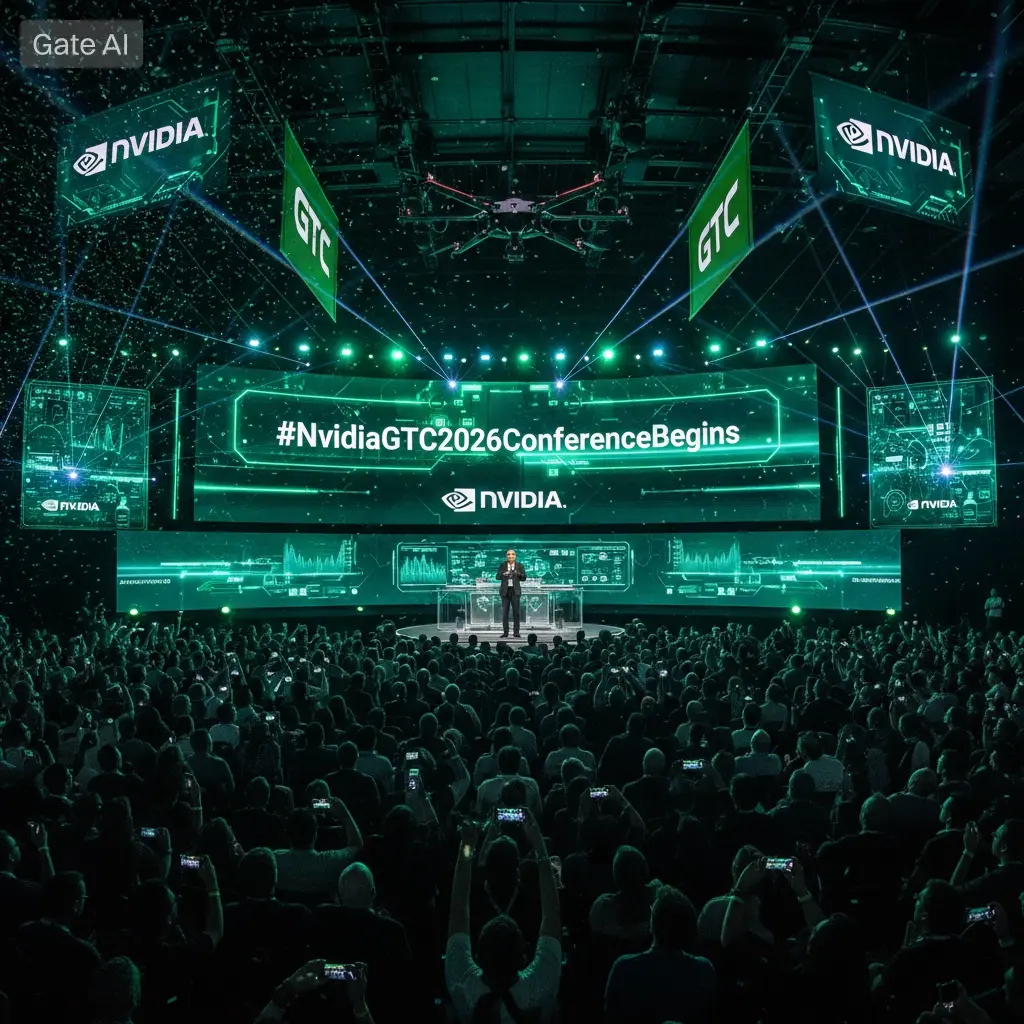
#NvidiaGTC2026ConferenceBegins
🚨 The global technology landscape has entered a new era as NVIDIA GTC 2026 officially begins in San Jose, gathering thousands of industry leaders, developers, and innovators both in person and online. Often referred to as the “Super Bowl of AI,” the conference opened with a powerful keynote from Jensen Huang, CEO of NVIDIA, unveiling the next wave of agentic AI, multimodal intelligence, robotics, and high-performance computing.
This event is not merely a technology showcase—it is a strategic inflection point shaping the convergence of Artificial Intelligence, b
BTC-4,58%
DEFI3,55%
post-image
post-image
  • Reward
  • Comment
  • Repost
  • Share
#GateSquareAIReviewer
🚨 The crypto battlefield in 2026 is no longer driven only by charts — it’s powered by Artificial Intelligence, autonomous agents, and real-time data warfare. As the market evolves at lightning speed, platforms that combine AI intelligence with automated execution are rapidly dominating the next phase of digital trading.
Leading this transformation is Gate.io with its powerful AI ecosystem: Gate AI, Gate Blue Lobster (GateClaw), and Gate Pay for AI — a next-generation infrastructure designed to turn chaotic market data into actionable trading intelligence.
⚡ Gate AI — Yo
AGENT-0,38%
post-image
post-image
  • Reward
  • Comment
  • Repost
  • Share
#CryptoMarketBouncesBack
🚨 #CryptoMarketBouncesBack – Hard & Hot Take! 🔥
#GatePlaza | March 16, 2026
Good morning, Gate Plaza warriors!
BAM! The crypto market just delivered one of the cleanest, most violent morning rebounds we've seen in months — and it's screaming "bulls are back in control... for now."
Bitcoin smashed through the $73,000 psychological wall, briefly tagged $74,416, and is currently trading strong in the $73,400 – $73,900 range with a solid +2.5% to +3.7% 24h gain.
Ethereum exploded past $2,200, now comfortably sitting near $2,240 – $2,268 with +6% to +7% momentum.
Solana
BTC-4,58%
ETH-6,25%
SOL-5,81%
post-image
post-image
  • Reward
  • Comment
  • Repost
  • Share
#BitcoinSurgesAbove$70K
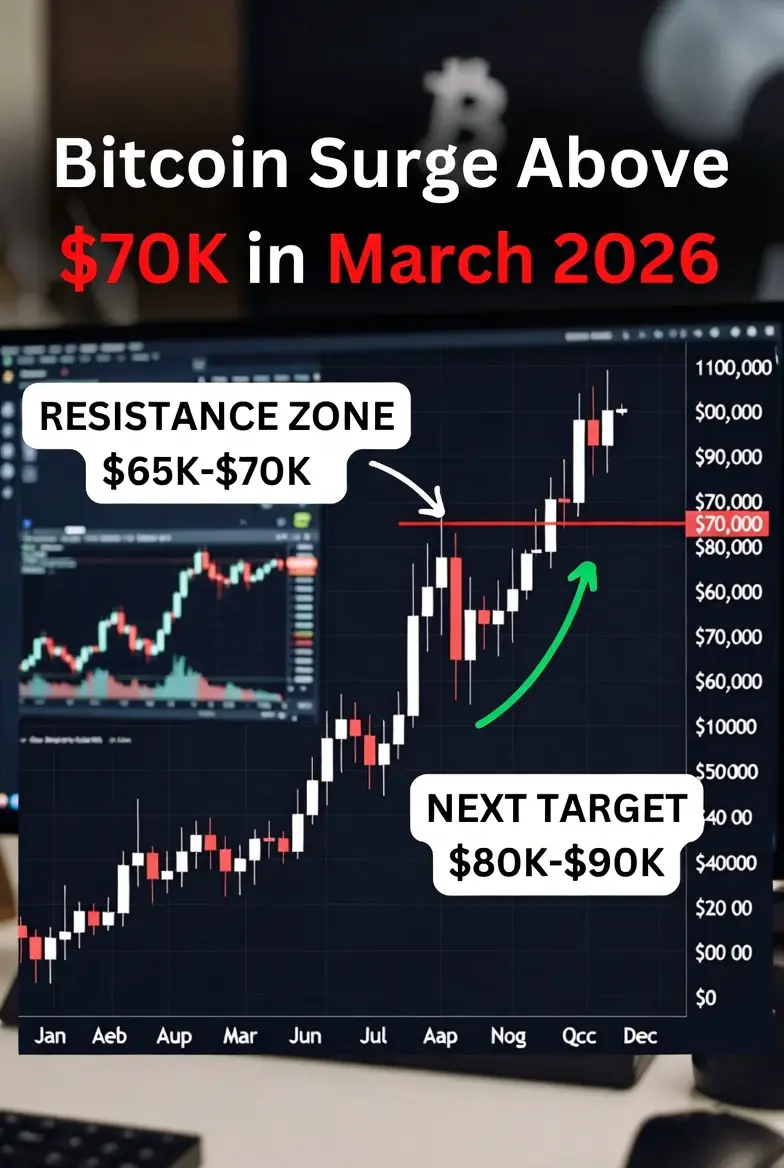
🚨 The cryptocurrency market has ignited once again as Bitcoin smashes through the $70,000 milestone, sending shockwaves across global financial markets and reviving bullish sentiment across the digital asset ecosystem. After weeks of consolidation and macro-driven uncertainty, the king of crypto has staged a decisive breakout that signals renewed institutional confidence and powerful market momentum.
📈 Institutional Capital Reignites the Rally
Major institutional players are once again increasing exposure to Bitcoin, with significant inflows flowing through spot ETFs
BTC-4,58%
post-image
post-image
  • Reward
  • 4
  • Repost
  • Share
ybaservip:
2026 GOGOGO 👊
View More
#FirstTradeOfTheWeek
#FirstTradeOfTheWeek — XBR Weekly Trading Plan
With XBR currently trading around $105.82, the market is sitting near an important psychological support level. Small-cap tokens like XBR often experience strong volatility because liquidity is relatively low and a few large trades can move the price significantly. This means both sharp pumps and quick corrections are possible within a short time frame.
Because of this, the best approach for the week is to focus on clear support zones, breakout levels, and proper risk management before entering any trade.
📊 Current Market S
HighAmbitionvip
#FirstTradeOfTheWeek
#FirstTradeOfTheWeek — XBR Weekly Trading Plan
With XBR currently trading around $105.82, the market is sitting near an important psychological support level. Small-cap tokens like XBR often experience strong volatility because liquidity is relatively low and a few large trades can move the price significantly. This means both sharp pumps and quick corrections are possible within a short time frame.
Because of this, the best approach for the week is to focus on clear support zones, breakout levels, and proper risk management before entering any trade.
📊 Current Market Structure
At the moment, XBR appears to be moving in a short-term consolidation phase after a previous price movement.
Market structure overview:
• Short-term trend: Sideways / consolidation
• Mid-term trend: Potentially bullish
• Volatility level: High
If the price continues holding above the $100 support region, it increases the probability of a bullish rebound during the week.
📈 Key Support Levels
🟢 Support Zone 1 — $100 – $103
This is the main psychological support level.
If buyers defend this area, it can trigger a bounce and start a new upward move.
🟢 Support Zone 2 — $92 – $95
This is a strong accumulation zone where larger traders may start buying.
🟢 Support Zone 3 — $80 – $85
This level would only come into play if the market enters a deeper correction phase.
📉 Key Resistance Levels
🔴 Resistance 1 — $115 – $120
The first barrier where short-term traders may take profits.
🔴 Resistance 2 — $135 – $140
Breaking this level would indicate strong bullish momentum building.
🔴 Resistance 3 — $160 – $180
This would act as a major breakout zone for a strong rally.
🚀 Weekly Trading Scenarios
Scenario 1 — Support Bounce (Higher Probability)
If the price holds the $100 support area, a rebound trade could occur.
Entry zone
👉 $101 – $106
Targets
🎯 $118
🎯 $130
🎯 $150
Stop loss
❌ $94
This setup is suitable for a short-term swing trade during the week.
Scenario 2 — Breakout Momentum Trade
If XBR breaks $120 with strong trading volume, momentum buyers may enter.
Entry
👉 $121 – $125
Targets
🎯 $145
🎯 $165
🎯 $200
This type of move usually happens when market momentum accelerates and traders start chasing the breakout.
Scenario 3 — Bearish Correction
If the price drops and breaks $95 support, the market could temporarily turn bearish.
Possible downside levels:
📉 $85
📉 $72
In this case, it would be better to wait for a new support formation before entering again.
🧠 Smart Trading Strategies
Conservative Strategy
Buy near support.
Entry
👉 $100 – $104
Targets
• $118
• $130
Stop loss
👉 $94
Aggressive Strategy
Trade the breakout momentum.
Entry
👉 Above $120
Targets
• $150
• $180
📊 Important Market Factors
1️⃣ Low Liquidity
Because XBR has relatively limited liquidity, price movements can be faster than larger cryptocurrencies.
2️⃣ Small Market Cap
Small-cap tokens often show 20%–60% weekly moves, especially when market attention increases.
3️⃣ Whale Influence
A small number of large holders can influence price direction, which increases volatility.
📅 Weekly Outlook
Short-term outlook
➡️ Bullish if $100 holds
Mid-term outlook
➡️ Potential move toward $150
Strong breakout scenario
➡️ Possible $180 – $200 range
⚠️ Risk Management
For safer trading:
• Never risk more than 5–10% of your capital on a single trade
• Always place a stop loss
• Avoid entering during extreme volatility spikes
✅ Weekly Bias: Bullish above $100
📊 Best Entry Zone: $100 – $105
🎯 Main Weekly Target: $130 – $150

repost-content-media
  • Reward
  • Comment
  • Repost
  • Share
#GateSquareAIReviewer
The rapid evolution of artificial intelligence is reshaping almost every industry, but in the world of cryptocurrency trading the transformation is happening even faster. Exchanges are no longer just places where users buy and sell assets. They are becoming intelligent financial ecosystems where machines, data, and traders interact continuously. One of the platforms pushing this transformation forward is Gate.io, which is developing a powerful AI ecosystem built around Gate AI, Gate for AI, and the community-driven concept known as Gate Blue Lobster.
To understand why th
BTC-4,58%
ETH-6,25%
RENDER-3,97%
TAO-4,68%
HighAmbitionvip
#GateSquareAIReviewer
The rapid evolution of artificial intelligence is reshaping almost every industry, but in the world of cryptocurrency trading the transformation is happening even faster. Exchanges are no longer just places where users buy and sell assets. They are becoming intelligent financial ecosystems where machines, data, and traders interact continuously. One of the platforms pushing this transformation forward is Gate.io, which is developing a powerful AI ecosystem built around Gate AI, Gate for AI, and the community-driven concept known as Gate Blue Lobster.
To understand why these ideas are gaining attention across the crypto industry, we need to look deeper into how artificial intelligence is changing the way traders research markets, execute strategies, and manage risk.
The Information Explosion in Crypto Markets
Crypto markets generate enormous amounts of information every second. Price movements alone are not enough to understand what is happening. Traders must monitor many different layers simultaneously:
blockchain transactions
liquidity changes across exchanges
macroeconomic developments
social media narratives
derivatives data such as funding rates and liquidations
In earlier years, this analysis required expensive data platforms and advanced programming skills. Only institutional trading desks had access to the tools necessary to process such large datasets.
Today, AI systems are beginning to close this gap.
With the help of advanced models such as ChatGPT and Claude, traders can now interpret complex information using natural language instead of coding or manual analysis.
Gate’s vision is to take this one step further—by embedding AI directly inside the exchange infrastructure itself.
Gate AI: Transforming an Exchange into an Intelligent System
The AI ecosystem developed by Gate.io is designed to turn a traditional trading platform into something closer to a financial intelligence engine.
Instead of simply offering trading tools, Gate AI integrates multiple data layers into a single intelligent interface that allows traders to ask questions and receive structured market insights.
This system can analyze:
spot and derivatives market data
liquidity depth across exchanges
blockchain transaction flows
macroeconomic news
social sentiment trends
For example, a trader could ask the system:
“Explain the current momentum behind BTC and identify the main liquidity zones.”
Within seconds, the AI assistant could return an analysis combining price structure, whale flows, sentiment indicators, and risk levels.
This dramatically reduces the time required to perform research.
Gate Blue Lobster: The Symbol of Rare Market Intelligence
Within the Gate community, Gate Blue Lobster has become a unique symbol representing rare discoveries and valuable insights in the crypto market.
The metaphor comes from nature.
A real blue lobster is extremely rare—appearing in roughly one out of several million lobsters in the ocean. Because of this rarity, it became a symbol of discovering something valuable that most people overlook.
In the context of crypto trading, the “Blue Lobster” represents finding hidden opportunities in massive amounts of market noise.
The role of AI is to help traders discover these rare signals.
Instead of analyzing thousands of random indicators, AI can filter the data and highlight only the patterns that matter most.
This philosophy is deeply connected to Gate’s AI ecosystem.
AI Agents: The Next Generation of Market Participants
One of the most revolutionary ideas behind Gate for AI is the concept of AI agents acting as economic participants.
Traditionally, AI systems only provide analysis. They cannot directly perform financial operations.
Gate’s infrastructure aims to change this.
With systems such as Gate Pay for AI, AI agents can eventually:
pay for premium datasets
execute blockchain transactions
rebalance portfolios
interact with decentralized liquidity pools
These agents can operate with their own wallets and programmable payment logic.
Supported networks include ecosystems such as Ethereum and other multi-chain infrastructures.
This creates the possibility of autonomous trading workflows where machines can research, evaluate, and execute strategies with minimal human intervention.
However, human oversight remains essential for risk control.
Why AI Matters for Retail Traders
The crypto market has historically favored traders with technical knowledge and access to advanced tools.
AI systems like Gate AI are attempting to level the playing field.
Instead of requiring users to learn complex programming languages, traders can simply communicate with the system using natural language.
For example:
“Find AI sector tokens with rising social sentiment and increasing whale accumulation.”
The AI assistant could then analyze projects such as:
Render
Bittensor
Virtual Protocol
By scanning blockchain activity, trading volumes, and sentiment data, the system can identify patterns that might otherwise take hours to detect manually.
This does not guarantee profits, but it significantly improves research efficiency.
Human Intelligence Still Matters
Despite the growing power of artificial intelligence, experienced traders understand that AI is not a replacement for human judgment.
Markets are influenced by emotions, narratives, and unpredictable events. AI models can analyze patterns, but they cannot fully understand the psychological dynamics driving market behavior.
For this reason, Gate’s approach emphasizes human-AI collaboration rather than full automation.
The AI assistant provides insights and possible strategies, while the trader retains final control over execution and risk management.
This balance is essential.
The Vision of an AI-Native Crypto Exchange
The concept of an AI-native exchange means that artificial intelligence is not just an optional feature—it becomes a core component of the platform.
In such a system:
AI handles
• data analysis
• pattern detection
• strategy suggestions
Humans handle
• strategic decisions
• capital allocation
• risk tolerance
Together, they form a hybrid system that combines machine speed with human intuition.
This approach reflects a broader trend across the financial industry, where intelligent systems increasingly assist traders and investors.
The Future of AI in Crypto Markets
Looking ahead, the integration of artificial intelligence into cryptocurrency infrastructure could reshape the entire trading ecosystem.
Potential developments include:
• fully autonomous trading agents
• AI-driven liquidity management
• predictive market analytics
• automated portfolio rebalancing
As blockchain technology continues to evolve, these capabilities may eventually operate across both centralized and decentralized markets simultaneously.
Platforms like Gate.io are attempting to build the foundation for that future.
Final Perspective
The rise of Gate AI and the cultural idea of the Gate Blue Lobster highlight an important shift in the crypto industry.
The challenge of trading is no longer simply about accessing markets. It is about processing information faster and more intelligently than others.
Artificial intelligence offers a powerful solution to this challenge.
By combining real-time data analysis, multi-chain infrastructure, and AI-driven insights, the next generation of exchanges may become something far more sophisticated than traditional trading platforms.
They may become intelligent financial ecosystems where humans and machines collaborate to navigate the complexity of digital markets.
And somewhere within that vast ocean of data, the next Blue Lobster opportunity may already be waiting to be discovered. 🦞🚀
repost-content-media
  • Reward
  • Comment
  • Repost
  • Share
#GateDerivativesHitsNewHighInFebruary
🚀 #GateDerivativesHitsNewHighInFebruary
The Great Derivatives Surge: How Gate.io Reached New Heights
The cryptocurrency market is evolving rapidly. While spot trading remains the entry point for many investors, derivatives trading has become the powerhouse driving liquidity and professional trading strategies across the digital asset ecosystem.
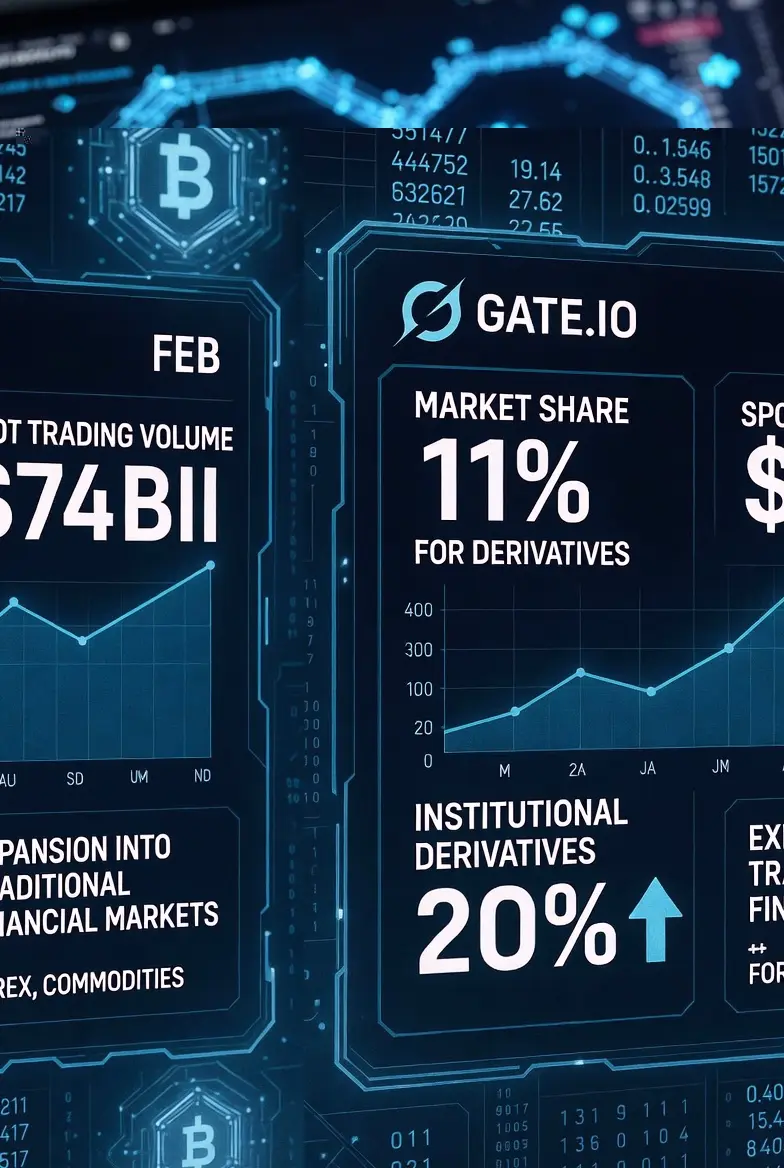
According to the latest February transparency insights, Gate.io experienced a remarkable surge in trading activity, reaching new milestones in both derivatives and spot markets. The exchange captured around 11% of
HighAmbitionvip
#GateDerivativesHitsNewHighInFebruary
🚀 #GateDerivativesHitsNewHighInFebruary
The Great Derivatives Surge: How Gate.io Reached New Heights
The cryptocurrency market is evolving rapidly. While spot trading remains the entry point for many investors, derivatives trading has become the powerhouse driving liquidity and professional trading strategies across the digital asset ecosystem.
According to the latest February transparency insights, Gate.io experienced a remarkable surge in trading activity, reaching new milestones in both derivatives and spot markets. The exchange captured around 11% of the global centralized exchange derivatives market, signaling a strong shift toward advanced trading instruments such as futures and perpetual contracts.
This milestone reflects a broader transformation happening in the crypto industry—where technology, automation, institutional capital, and cross-market integration are shaping the next phase of digital finance.
📊 Record Trading Activity in February
February proved to be a powerful month for the platform, with trading volumes expanding across multiple segments.
Key highlights include:
• Spot trading volume surpassed $74 billion, reflecting an 11% month-over-month increase.
• Derivatives market share reached approximately 11% globally, strengthening Gate’s position among leading crypto exchanges.
• Liquidity improved across major trading pairs, enabling smoother execution and tighter spreads for traders.
This growth demonstrates increasing confidence among both retail and professional traders who rely on stable infrastructure and deep order books to execute complex strategies.
🏛️ Institutional Traders Are Driving Market Expansion
One of the most important trends behind the surge is the growing participation of institutional traders. The crypto market is no longer dominated solely by retail investors. Hedge funds, proprietary trading firms, and algorithmic trading desks are now heavily involved in derivatives markets.
In February:
• Institutional derivatives trading volume increased by around 20% on average.
Professional traders are increasingly using Gate’s infrastructure for strategies such as:
Delta-neutral hedging
Cross-exchange arbitrage
High-frequency algorithmic trading
Leveraged directional trading
Institutional participants typically trade larger volumes and require strong infrastructure, which contributes significantly to rising derivatives activity on the platform.
🤖 Automation and AI Trading Tools Accelerating Growth
Another major driver of February’s derivatives surge is the rapid adoption of automated trading systems.
Modern traders are increasingly shifting away from manual chart analysis toward algorithmic strategies and automated tools that operate continuously.
Key growth metrics include:
• Trading bot users increased by more than 23%
• Copy trading participation rose by about 13%
• Thousands of traders adopted automated strategies to analyze volatility and execute trades more efficiently.
Automation reduces emotional decision-making and allows traders to respond instantly to market movements. As a result, automated trading significantly increases derivatives market activity and overall trading volume.
🌐 Expansion into Traditional Financial Markets (TradFi)
One of the most strategic developments during February was the expansion of the platform’s TradFi trading capabilities.
Through its unified trading system, users can now access both crypto and traditional financial markets using stablecoins as collateral.
Available markets include:
Foreign exchange (Forex)
Precious metals such as gold and silver
Commodities like oil
Global stock indices including the S&P 500 and Nasdaq
The integration of traditional finance into the crypto ecosystem created substantial activity.
TradFi trading volume exceeded $95 billion in February, while peak daily trading volumes reached approximately $12 billion.
This development moves the platform closer to becoming a multi-asset financial hub where users can trade across different global markets within a single account.
🔗 Strong Growth in the Web3 and On-Chain Ecosystem
Growth is not limited to centralized trading alone. The broader blockchain ecosystem connected to the exchange also expanded significantly during the same period.
On-chain metrics highlight the growing adoption:
• More than 100.5 million blockchain addresses
• Over 28.5 million transactions processed
• Approximately 14% month-over-month growth in on-chain activity
These numbers indicate that user engagement continues to expand across both centralized and decentralized components of the ecosystem.
📈 Why Derivatives Markets Are Growing So Fast
The strong expansion of derivatives trading across the crypto industry can be attributed to several factors:
1️⃣ Higher Market Volatility
Price fluctuations create more opportunities for traders to profit from both rising and falling markets.
2️⃣ Leverage Trading Opportunities
Derivatives allow traders to increase market exposure through leverage, making them attractive for active trading strategies.
3️⃣ Professional Risk Management
Institutions often use futures contracts to hedge portfolios and reduce market risk.
4️⃣ Algorithmic and AI-Driven Trading
Automated strategies rely heavily on derivatives markets where liquidity and execution speed are critical.
These factors together are transforming derivatives into the primary engine of liquidity in global crypto markets.
🧠 The Rise of the Intelligent Crypto Exchange
February’s milestone highlights a significant evolution in the crypto industry. Exchanges are no longer just marketplaces for buying and selling digital assets. Instead, they are becoming advanced financial ecosystems integrating AI, automation, derivatives markets, and traditional financial instruments.
By expanding its infrastructure, liquidity depth, automation tools, and multi-asset trading capabilities, Gate.io is positioning itself as a comprehensive digital finance platform rather than simply a crypto exchange.
🚀 Conclusion
The record derivatives performance in February reflects the rapid maturation of the cryptocurrency trading ecosystem. Institutional participation, AI-driven automation, expanding trading tools, and integration with traditional financial markets are all accelerating growth.
As the industry continues evolving, derivatives markets are expected to play an even larger role in shaping global crypto liquidity. With strong infrastructure, expanding market share, and a growing ecosystem, Gate.io appears to be entering a new phase of growth as a global hub for advanced digital asset trading.
repost-content-media
  • Reward
  • Comment
  • Repost
  • Share
#CryptoMarketBouncesBack
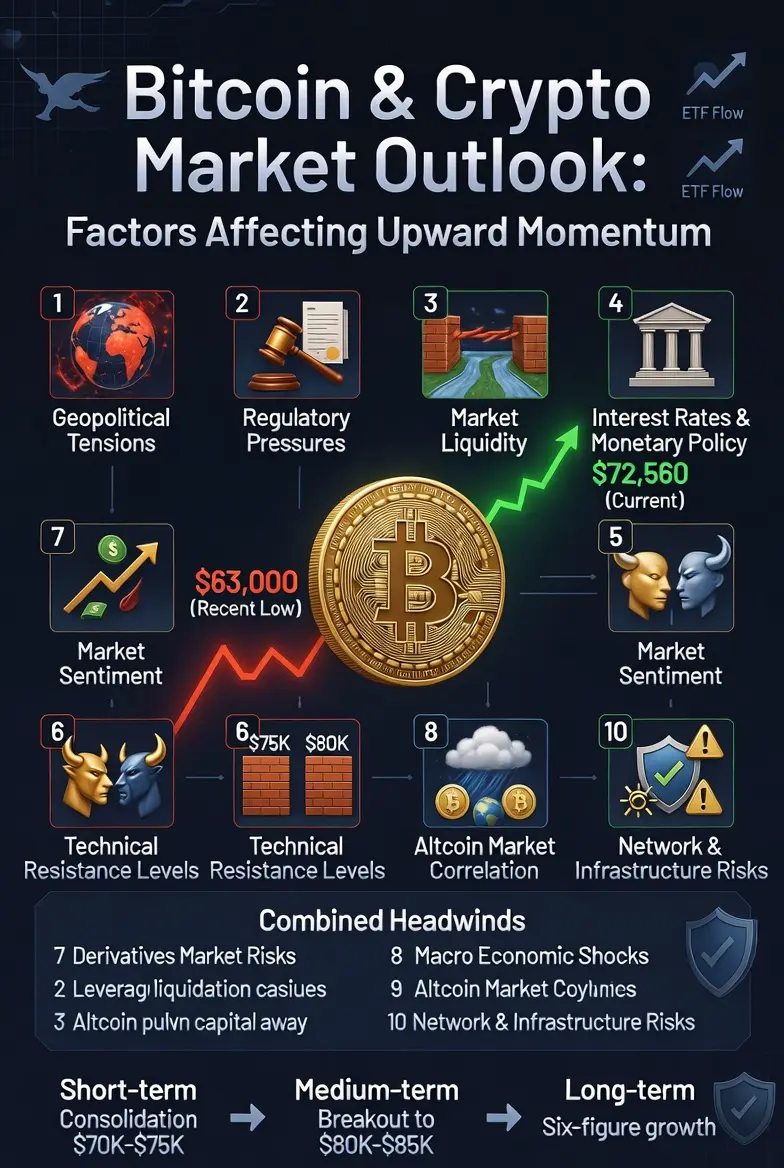
The cryptocurrency market has demonstrated remarkable resilience, with Bitcoin rebounding from a dip near $63,000 to its current level of $72,560. While the recovery signals strong market demand, multiple factors can still limit or slow the upside potential. Understanding these obstacles is critical for both traders and long-term investors as the market navigates volatility, geopolitical uncertainty, and structural challenges.
1. Geopolitical Tensions and Global Risks
Global political instability remains one of the primary headwinds for crypto markets. Recent escalati
BTC-4,58%
HighAmbitionvip
#CryptoMarketBouncesBack
The cryptocurrency market has demonstrated remarkable resilience, with Bitcoin rebounding from a dip near $63,000 to its current level of $72,560. While the recovery signals strong market demand, multiple factors can still limit or slow the upside potential. Understanding these obstacles is critical for both traders and long-term investors as the market navigates volatility, geopolitical uncertainty, and structural challenges.
1. Geopolitical Tensions and Global Risks
Global political instability remains one of the primary headwinds for crypto markets. Recent escalations around the Strait of Hormuz highlight how geopolitical crises can impact investor sentiment.
Impact: Fear-driven selling in both crypto and traditional markets.
Mechanism: Potential disruption in energy supply or sanctions can create uncertainty, prompting liquidity withdrawals from risk assets.
Observation: While Bitcoin has recovered before, sudden escalations could trigger rapid short-term corrections.
Other geopolitical risks include:
Wars or military conflicts affecting major economies.
Political instability in crypto-heavy regions like the U.S., Europe, or Asia.
Sanctions or regulatory actions that indirectly affect liquidity or institutional flows.
2. Regulatory Pressures
Government regulations continue to shape the market environment. While some countries are adopting crypto-friendly policies, others are imposing restrictions on trading, taxation, and institutional participation.
Potential Limitation: Negative regulatory news can create panic or reduce market participation.
Examples:
Restrictions on leveraged trading or derivatives.
Delays in crypto ETF approvals.
Tax policy changes affecting institutional investors.
Effect on Upside: Regulatory uncertainty slows adoption and may suppress speculative buying, limiting BTC’s near-term gains.
3. Market Liquidity and Capital Flows
Liquidity is essential for sustained upward momentum. Limited liquidity can create resistance at key price levels, causing price stagnation or short-term reversals.
Factors Affecting Liquidity:
Reduced participation in spot and derivatives markets during high volatility.
Withdrawal of capital by institutional players during risk-off periods.
Limited stablecoin supply for leveraged trades.
Impact: Thin liquidity can cause exaggerated price swings, making it difficult for the market to maintain a steady upward trend.
4. Interest Rates and Monetary Policy
Macro factors such as interest rates and global liquidity conditions significantly influence crypto markets.
High-Interest Rates: Higher yields in traditional markets reduce appetite for risk assets like crypto.
Central Bank Policies: Tighter monetary policy reduces the capital flowing into speculative markets.
Effect: Even with strong demand, upward momentum can slow if global liquidity conditions tighten.
5. Market Sentiment and Speculative Behavior
Market psychology plays a significant role in crypto volatility. While optimism can fuel rallies, fear and uncertainty can quickly reverse trends.
Risk Factors:
Overly bullish sentiment may lead to over-leverage, triggering liquidations on minor corrections.
Negative news coverage can amplify fear and cause short-term selling pressure.
Short-term traders reacting emotionally to price drops may disrupt upward trends.
6. Technical Resistance Levels
Bitcoin and other major cryptocurrencies often encounter technical barriers that limit immediate upside.
Resistance Levels:
Bitcoin’s $75,000 and $80,000 zones are critical hurdles.
Failure to break above these levels can trigger profit-taking or consolidation.
Effect: Even if the market is fundamentally strong, these technical zones can act as temporary ceilings.
7. Derivatives Market Risks
While derivatives contribute to liquidity, they can also introduce risk to price stability:
Liquidation Cascades: Sharp corrections trigger automatic liquidation of leveraged positions, temporarily amplifying volatility.
Over-Leveraging: Excessive leverage can cause sudden market drops if sentiment shifts.
Effect on Upside: Derivatives can accelerate corrections even when long-term bullish fundamentals remain intact.
8. Macro Economic Shocks
Unexpected economic events can disrupt crypto markets:
Inflation spikes, banking crises, or energy price shocks can reduce risk appetite.
Global stock market corrections often correlate with crypto downturns.
While Bitcoin shows increasing resilience, macro shocks can delay upward momentum.
9. Altcoin Market Correlation
Bitcoin’s growth often supports altcoins, but sometimes altcoins act as a drag:
Capital rotation into altcoins can temporarily reduce BTC buying pressure.
Highly volatile altcoins can amplify market-wide risk perception.
Traders may exit BTC to chase short-term altcoin gains, slowing BTC momentum.
10. Network and Infrastructure Risks
Crypto market growth depends on reliable infrastructure:
Exchange downtime or system failures can temporarily halt trading.
Smart contract exploits, hacks, or wallet vulnerabilities can reduce investor confidence.
Any large-scale incident could trigger panic selling, temporarily limiting upward momentum.
📊 Summary: Combined Headwinds to the Upside
In brief, the main factors limiting crypto market growth and Bitcoin’s near-term upside include:
Geopolitical uncertainty (wars, tensions, energy crises)
Regulatory restrictions and unclear policies
Limited liquidity and capital withdrawals
Higher interest rates and tighter monetary conditions
Market psychology and speculative reactions
Technical resistance at key price levels
Risks from leveraged derivatives positions
Macro-economic shocks affecting risk assets
Altcoin rotations reducing BTC buying pressure
Exchange or infrastructure vulnerabilities
Despite these challenges, Bitcoin’s recovery from $63K to $72,560 demonstrates strong market demand. However, investors should remain aware of these obstacles, as they may create temporary resistance and volatility even in an otherwise bullish environment.

🔮 Outlook
Short-term: BTC may consolidate between $70K– $75K if obstacles persist.
Medium-term: Breaking key resistance levels above $75K could trigger renewed bullish momentum toward $80K–$85K.
Long-term: Institutional adoption, global liquidity, and technical innovation may support multi-cycle growth toward six-figure valuations.
The market is resilient, but these headwinds highlight the importance of risk management, strategic accumulation, and monitoring macro conditions before assuming continued upside.
repost-content-media
  • Reward
  • Comment
  • Repost
  • Share
#BitcoinSurgesAbove$70K
Bitcoin Surges Above $70K
As of mid-March 2026, Bitcoin has surged back above $70,000 and is currently trading around $72,500–$72,900 (with recent highs near $73,000 and lows around $70,800 in the last 24 hours). This rebound follows a volatile period influenced by geopolitical events (e.g., Middle East tensions, Iran-related risks), macro shifts, and renewed institutional flows. The rally from recent lows near $68,000–$70,000 demonstrates persistent demand, ETF inflows in spots, and Bitcoin's maturing role as a macro asset.
However, the path higher remains obstructed
BTC-4,58%
HighAmbitionvip
#BitcoinSurgesAbove$70K
Bitcoin Surges Above $70K
As of mid-March 2026, Bitcoin has surged back above $70,000 and is currently trading around $72,500–$72,900 (with recent highs near $73,000 and lows around $70,800 in the last 24 hours). This rebound follows a volatile period influenced by geopolitical events (e.g., Middle East tensions, Iran-related risks), macro shifts, and renewed institutional flows. The rally from recent lows near $68,000–$70,000 demonstrates persistent demand, ETF inflows in spots, and Bitcoin's maturing role as a macro asset.
However, the path higher remains obstructed by multiple headwinds. Below is the fully extended, updated analysis covering the original 10 points plus additional real-world factors relevant in 2026 (drawn from current market dynamics like institutional outflows, inflation persistence, dollar strength, tokenized assets shift, developer migration to AI, post-halving dynamics, and more). Each point includes mechanism, 2026-specific observations, and direct impact on the current surge.
1. Geopolitical Tensions and Global Risks
Escalations in the Middle East (e.g., Iran conflict fallout, Strait of Hormuz concerns), tariff threats, and broader instability drive risk-off moves. Oil spikes fuel inflation fears, prompting flight to safe havens. In 2026, this has caused sharp corrections despite Bitcoin's resilience. Impact: Sudden sell-offs cap upside; current surge could reverse on any new flashpoint.
2. Regulatory Pressures
While U.S. clarity has improved (pro-crypto administration signals), global restrictions, taxation changes, and potential crackdowns linger. Delays in new products or policy reversals create uncertainty. In 2026: ETF frameworks help, but any hawkish shift (e.g., Fed nominations) adds caution. Impact: Slows speculative inflows, limiting clean breaks above $75K.
3. Market Liquidity and Capital Flows
Thin liquidity amplifies swings; stablecoin levels are high but can dry up fast during volatility. Institutional participation fluctuates. In 2026: Spot ETF outflows (billions in recent months) contrast earlier inflows. Impact: Exaggerated dips stall momentum even with demand.
4. Interest Rates and Monetary Policy
Higher-for-longer rates or hawkish Fed (e.g., potential Kevin Warsh influence) raise borrowing costs and favor traditional yields. Global easing is slower in 2026. Impact: Reduces risk appetite; Bitcoin behaves more like a high-beta asset, pressuring the $70K+ surge if tightening signals emerge.
5. Market Sentiment and Speculative Behavior
Over-leverage leads to cascades; fear from headlines flips rallies. In 2026: "Age of speculation" ending as institutions dominate with lower risk tolerance. Impact: Emotional shorts can derail gains quickly.
6. Technical Resistance Levels
Key hurdles at $75K, $80K–$85K, and prior ATH zones (~$126K from 2025). In 2026: Consolidation ranges dominate; failure here triggers profit-taking. Impact: Current push toward $73K faces immediate resistance; breakout needs volume.
7. Derivatives Market Risks
Liquidation cascades from over-leveraged positions amplify drops (e.g., record cascades in late 2025). Funding rates swing wildly. Impact: Sharp corrections possible despite fundamentals.
8. Macro Economic Shocks
Inflation stickiness, banking stress, dollar strength, or equity corrections correlate with crypto. In 2026: Risk-off rotation to gold/precious metals; labor market uncertainty adds pressure. Impact: Delays upside; Bitcoin down ~14–26% YTD in some views.
9. Altcoin Market Correlation & Rotation
Capital flows to altcoins dilute BTC pressure; high-vol altcoins raise perceived risk. In 2026: Altcoins underperform heavily (many down 40–79%); Bitcoin dominance rises. Impact: Temporary drag on BTC momentum.
10. Network and Infrastructure Risks
Hacks, exchange issues, or exploits erode confidence. In 2026: Developer activity down 75% (shift to AI); network upgrades lag. Impact: Confidence hits cause panic selling.
Additional 2026-Specific Headwinds (Expanded Points)
11. Institutional & ETF Outflows
Spot Bitcoin ETFs saw massive outflows ($7–9B+ in recent quarters); institutions rotate out amid risk aversion. Impact: Removes key buying support for the surge.
12. Post-Halving Dynamics & Supply Pressure
2024 halving's muted effect continues; reduced new supply not sparking explosive rallies as in past cycles. Impact: Less reflexive upside; market absorbs inflows slowly.
13. Dollar Strength & Liquidity Tightening
Strong USD from hawkish policy hurts risk assets. Global liquidity growth slows. Impact: Headwind for speculative crypto; Bitcoin correlates negatively here.
14. Shift to Real-World Assets (RWAs) & Tokenization
Institutions favor tokenized stocks/bonds for lower volatility/returns over pure speculation. Impact: Diverts capital; ends "speculation age" for outsized crypto gains.
15. Developer & Innovation Migration
Blockchain devs fleeing to AI reduces on-chain activity/innovation pace. Impact: Long-term growth concerns; hurts narrative strength.
16. Correlation with Traditional Markets
Bitcoin increasingly tracks equities/Nasdaq during stress; no full decoupling yet. Impact: Equity weakness (e.g., Magnificent Seven struggles) drags crypto.
Combined Headwinds Summary (All 16 Factors)
Geopolitical flares • Regulatory uncertainty • Liquidity squeezes • Hawkish rates/monetary tightening • Emotional/speculative flips • Technical ceilings ($75K–$85K+) • Derivatives cascades • Macro shocks/inflation • Altcoin rotations • Infrastructure vulnerabilities • ETF/institutional outflows • Muted halving effects • Strong USD/liquidity drain • RWA/tokenization shift • Developer migration to AI • Trad market correlations.
Final Outlook – March 2026
Short-term (next weeks/months): Consolidation likely $70K–$75K range; test of $73K–$75K resistance critical. Upside needs macro calm, ETF inflows resumption. Downside risk to $68K–$65K on shocks.
Medium-term (rest of 2026): Breakout above $80K–$85K possible if institutional demand returns and liquidity improves; targets $100K–$140K in base case, higher ($170K–$250K bullish forecasts) on adoption. Bearish: $50K–$75K if headwinds compound.
Long-term: Institutional maturation, store-of-value capture (vs. gold/bonds), and macro liquidity support multi-year growth toward $1M+ scenarios (if Bitcoin takes significant share). But 2026 outlook mixed: incremental gains over explosive rallies.
Bitcoin's surge above $70K is real and backed by demand, but these 16 headwinds highlight why volatility persists. Risk management, monitoring macro/Fed signals, ETF flows, and technical breaks are key. The market is resilient—yet cautious optimism rules in 2026. Stay prepared for both legs up and potential pullbacks.
repost-content-media
  • Reward
  • Comment
  • Repost
  • Share
#AAVETokenSwapControversy
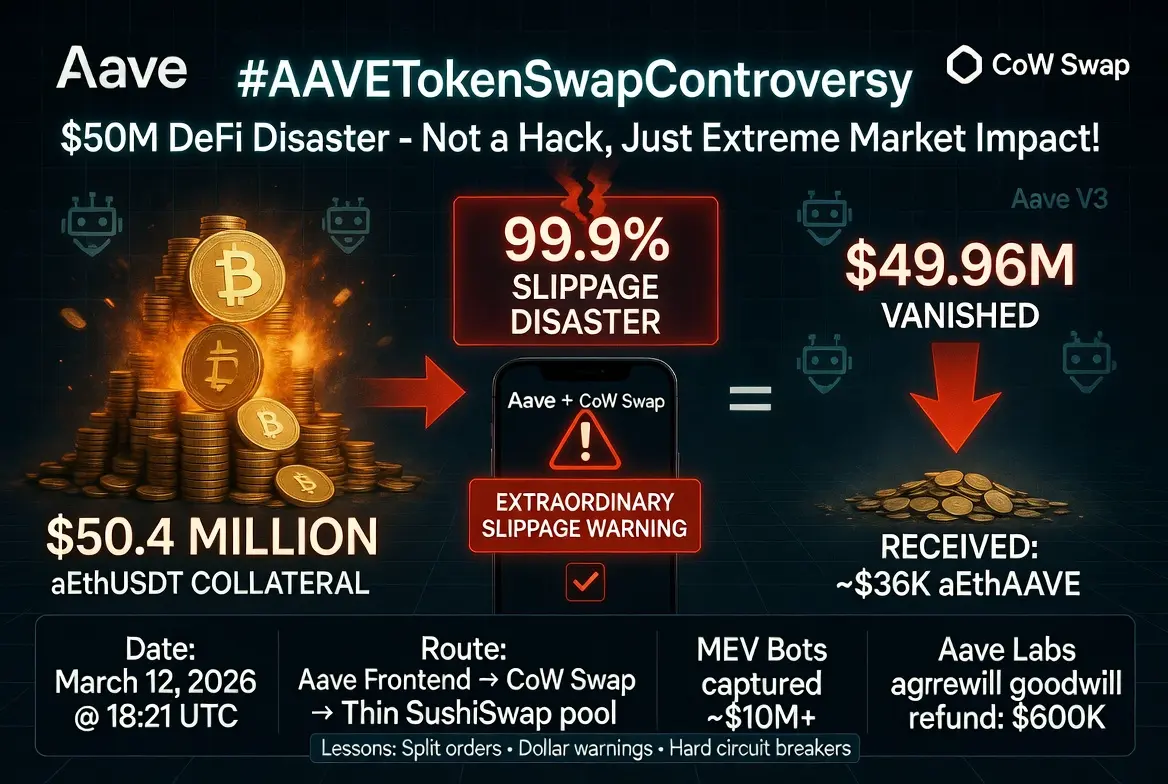
In March 2026, a trader tried to swap about $50.4 million USDT into AAVE on Aave V3 using CoW Swap. Instead of getting the expected amount, they only received about 324–327 AAVE (~$36K). This huge loss was not a hack or exploit, but happened because of thin liquidity, poor routing, MEV bots, and interface risks.
The trade used illiquid pools, so the price dropped drastically when the large order was executed. Mobile confirmation and a simple checkbox warning were not enough to prevent the loss. MEV bots captured a big part of the funds instantly, and builder fees als
AAVE-6,18%
COW-4,46%
DEFI3,55%
HighAmbitionvip
#AAVETokenSwapControversy
In March 2026, a trader tried to swap about $50.4 million USDT into AAVE on Aave V3 using CoW Swap. Instead of getting the expected amount, they only received about 324–327 AAVE (~$36K). This huge loss was not a hack or exploit, but happened because of thin liquidity, poor routing, MEV bots, and interface risks.
The trade used illiquid pools, so the price dropped drastically when the large order was executed. Mobile confirmation and a simple checkbox warning were not enough to prevent the loss. MEV bots captured a big part of the funds instantly, and builder fees also reduced the final amount.
Aave confirmed the incident, refunded $600K in protocol fees, and added Aave Shield to block trades with more than 25% price impact. CoW Swap admitted that gas limits and solver inefficiencies contributed to the problem. The community had mixed reactions—some blamed the user, some blamed the platforms—but everyone agreed this shows the risks of very large DeFi trades.
Lessons for traders: Split large orders, check pool liquidity, avoid trading huge amounts on mobile, and watch for MEV risks.
Lessons for protocols: Use dollar-based warnings, circuit breakers, typed confirmations, and AI-based liquidity checks to protect users.
This event shows that DeFi grows through mistakes. Large losses like this help improve user interfaces, routing algorithms, and safety measures for the whole ecosystem.
repost-content-media
  • Reward
  • Comment
  • Repost
  • Share
#IranSetsClearCeasefireConditions .
Iran Sets Clear Ceasefire Conditions — Ultra-Extended Analysis (March 16, 2026)
1. Background: How the Conflict Re‑Escalated
A fragile ceasefire that ended the 2025 Iran–Israel conflict collapsed by early 2026. Historic tensions over nuclear programs, missile systems, regional proxies, and mutual security concerns were unresolved and worsened. Diplomatic talks — especially in Geneva on nuclear and missile limits — failed earlier in 2026, increasing mistrust. As tensions peaked, coordinated U.S.–Israel airstrikes against Iranian military sites triggered force
HighAmbitionvip
#IranSetsClearCeasefireConditions .
Iran Sets Clear Ceasefire Conditions — Ultra-Extended Analysis (March 16, 2026)
1. Background: How the Conflict Re‑Escalated
A fragile ceasefire that ended the 2025 Iran–Israel conflict collapsed by early 2026. Historic tensions over nuclear programs, missile systems, regional proxies, and mutual security concerns were unresolved and worsened. Diplomatic talks — especially in Geneva on nuclear and missile limits — failed earlier in 2026, increasing mistrust. As tensions peaked, coordinated U.S.–Israel airstrikes against Iranian military sites triggered forceful Iranian retaliation across the region. This dramatic escalation expanded into a broader war involving ballistic missiles, drones, and regional power projections.
2. Iran’s Official Ceasefire Conditions
Iran’s government has publicly stated that it will only consider a ceasefire if three core conditions are met:
A. Recognition of Iran’s Legitimate Rights
Tehran demands formal recognition that it has the sovereign right to self-defense and that it can pursue nuclear enrichment rights allowed under international treaties. Iran sees this as necessary to stop what it calls “double standards” in international politics and security enforcement.
B. Payment of Reparations
Iran has called for financial compensation for damage to civilian infrastructure, economic loss, and deaths caused by foreign strikes. While exact numbers are not public, officials describe this as accountability for harm done to civilians and national resources. Reparations are also used as leverage in negotiations if talks resume.
C. Binding Guarantees Against Future Aggression
This is Tehran’s most critical demand. Iran wants iron-clad, international assurances — potentially backed by multilateral frameworks — that the U.S. and Israel will not attack again. Without such guarantees, Iranian leaders argue that any ceasefire would be tactical only and could collapse once pressures ease. Iran has explicitly rejected ceasefire talks until strikes stop.
Iran’s Foreign Minister stated that Iran has never formally asked for negotiations or a ceasefire while strikes continue, framing the conflict as defensive rather than negotiable under current conditions.
3. Why Iran Rejects Ceasefire Talks Now
Iran argues that previous temporary pauses failed due to lack of security guarantees and enforcement mechanisms. Accepting a ceasefire without these would leave Iran vulnerable to renewed attacks. Hardliners within Iran view diplomacy without preconditions as a sign of weakness. Iran also leverages control over the Strait of Hormuz to maximize bargaining power, since partial closure affects global shipping and oil markets.
4. U.S. and Israeli Position
U.S. Response: President Trump has dismissed Iran’s terms as unacceptable. He emphasizes continuation of military pressure rather than immediate negotiations, while urging regional allies to help secure maritime routes.
Israeli Stance: Israel continues targeting Iranian military capabilities and strategic infrastructure. No credible negotiation channel has reopened, and mediation attempts by regional actors have so far failed.
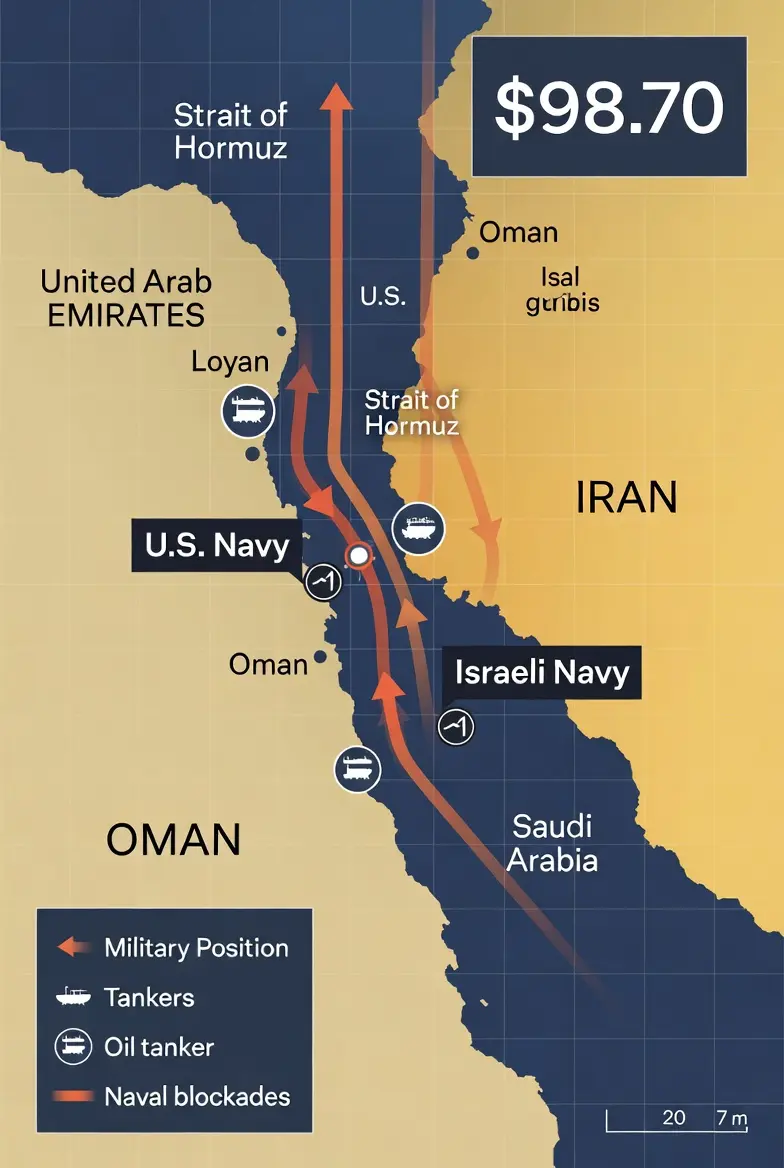
5. Strait of Hormuz Crisis and Global Energy Impact
Iran’s threats have destabilized the Strait of Hormuz, a critical chokepoint through which roughly 20 % of the world’s oil and gas exports transit. Tanker rerouting, insurance hikes, and threats of military escalation have created global energy uncertainty.
Oil Price Update: Brent crude currently trades at $98.70 per barrel due to supply fears and geopolitical risk.
This disruption affects stock markets, currencies in emerging economies, and inflation expectations globally.
6. Humanitarian and Regional Security Consequences
The ongoing conflict has displaced civilians, caused infrastructure destruction, and strained healthcare systems. Spillover violence is seen in Lebanon, Iraq, and Syria. Humanitarian groups and global leaders have called for de-escalation to protect civilians.
7. Failed Mediation and Global Diplomatic Responses
The UN Security Council passed a resolution condemning attacks on civilians and reaffirming sovereign defense rights, but deep geopolitical divisions limit enforcement. China and Russia abstained. Oman and Egypt attempted mediation but were rejected. Global voices, including Pope Leo XIV, have urged immediate dialogue.
8. Likely Scenarios Going Forward
Prolonged Stalemate: Conflict continues with high tensions around the Strait of Hormuz. Oil markets remain volatile.
Gradual De-escalation: Sustained global pressure or interim agreements could eventually lead to partial ceasefire.
Escalation: Further strikes may provoke broader regional confrontations.
Backchannel Negotiations: Quiet diplomacy may produce limited agreements if both sides seek to avoid economic collapse or humanitarian catastrophe.
9. Summary
Iran’s ceasefire demands—rights recognition, reparations, and ironclad guarantees—remain firm. They have explicitly rejected talks while strikes continue. U.S. and Israeli positions are uncompromising. The Strait of Hormuz remains a global economic flashpoint. Oil currently trades at $98.70 per barrel. Humanitarian crises are mounting, mediation has stalled, and the war enters its third week with no near-term resolution. The situation tests regional stability, energy security, and global diplomatic resolve.
repost-content-media
  • Reward
  • Comment
  • Repost
  • Share
#IranSetsClearCeasefireConditions .
Iran Sets Clear Ceasefire Conditions — Ultra-Extended Analysis (March 16, 2026)
1. Background: How the Conflict Re‑Escalated
A fragile ceasefire that ended the 2025 Iran–Israel conflict collapsed by early 2026. Historic tensions over nuclear programs, missile systems, regional proxies, and mutual security concerns were unresolved and worsened. Diplomatic talks — especially in Geneva on nuclear and missile limits — failed earlier in 2026, increasing mistrust. As tensions peaked, coordinated U.S.–Israel airstrikes against Iranian military sites triggered force
HighAmbitionvip
#IranSetsClearCeasefireConditions .
Iran Sets Clear Ceasefire Conditions — Ultra-Extended Analysis (March 16, 2026)
1. Background: How the Conflict Re‑Escalated
A fragile ceasefire that ended the 2025 Iran–Israel conflict collapsed by early 2026. Historic tensions over nuclear programs, missile systems, regional proxies, and mutual security concerns were unresolved and worsened. Diplomatic talks — especially in Geneva on nuclear and missile limits — failed earlier in 2026, increasing mistrust. As tensions peaked, coordinated U.S.–Israel airstrikes against Iranian military sites triggered forceful Iranian retaliation across the region. This dramatic escalation expanded into a broader war involving ballistic missiles, drones, and regional power projections.
2. Iran’s Official Ceasefire Conditions
Iran’s government has publicly stated that it will only consider a ceasefire if three core conditions are met:
A. Recognition of Iran’s Legitimate Rights
Tehran demands formal recognition that it has the sovereign right to self-defense and that it can pursue nuclear enrichment rights allowed under international treaties. Iran sees this as necessary to stop what it calls “double standards” in international politics and security enforcement.
B. Payment of Reparations
Iran has called for financial compensation for damage to civilian infrastructure, economic loss, and deaths caused by foreign strikes. While exact numbers are not public, officials describe this as accountability for harm done to civilians and national resources. Reparations are also used as leverage in negotiations if talks resume.
C. Binding Guarantees Against Future Aggression
This is Tehran’s most critical demand. Iran wants iron-clad, international assurances — potentially backed by multilateral frameworks — that the U.S. and Israel will not attack again. Without such guarantees, Iranian leaders argue that any ceasefire would be tactical only and could collapse once pressures ease. Iran has explicitly rejected ceasefire talks until strikes stop.
Iran’s Foreign Minister stated that Iran has never formally asked for negotiations or a ceasefire while strikes continue, framing the conflict as defensive rather than negotiable under current conditions.
3. Why Iran Rejects Ceasefire Talks Now
Iran argues that previous temporary pauses failed due to lack of security guarantees and enforcement mechanisms. Accepting a ceasefire without these would leave Iran vulnerable to renewed attacks. Hardliners within Iran view diplomacy without preconditions as a sign of weakness. Iran also leverages control over the Strait of Hormuz to maximize bargaining power, since partial closure affects global shipping and oil markets.
4. U.S. and Israeli Position
U.S. Response: President Trump has dismissed Iran’s terms as unacceptable. He emphasizes continuation of military pressure rather than immediate negotiations, while urging regional allies to help secure maritime routes.
Israeli Stance: Israel continues targeting Iranian military capabilities and strategic infrastructure. No credible negotiation channel has reopened, and mediation attempts by regional actors have so far failed.
5. Strait of Hormuz Crisis and Global Energy Impact
Iran’s threats have destabilized the Strait of Hormuz, a critical chokepoint through which roughly 20 % of the world’s oil and gas exports transit. Tanker rerouting, insurance hikes, and threats of military escalation have created global energy uncertainty.
Oil Price Update: Brent crude currently trades at $98.70 per barrel due to supply fears and geopolitical risk.
This disruption affects stock markets, currencies in emerging economies, and inflation expectations globally.
6. Humanitarian and Regional Security Consequences
The ongoing conflict has displaced civilians, caused infrastructure destruction, and strained healthcare systems. Spillover violence is seen in Lebanon, Iraq, and Syria. Humanitarian groups and global leaders have called for de-escalation to protect civilians.
7. Failed Mediation and Global Diplomatic Responses
The UN Security Council passed a resolution condemning attacks on civilians and reaffirming sovereign defense rights, but deep geopolitical divisions limit enforcement. China and Russia abstained. Oman and Egypt attempted mediation but were rejected. Global voices, including Pope Leo XIV, have urged immediate dialogue.
8. Likely Scenarios Going Forward
Prolonged Stalemate: Conflict continues with high tensions around the Strait of Hormuz. Oil markets remain volatile.
Gradual De-escalation: Sustained global pressure or interim agreements could eventually lead to partial ceasefire.
Escalation: Further strikes may provoke broader regional confrontations.
Backchannel Negotiations: Quiet diplomacy may produce limited agreements if both sides seek to avoid economic collapse or humanitarian catastrophe.
9. Summary
Iran’s ceasefire demands—rights recognition, reparations, and ironclad guarantees—remain firm. They have explicitly rejected talks while strikes continue. U.S. and Israeli positions are uncompromising. The Strait of Hormuz remains a global economic flashpoint. Oil currently trades at $98.70 per barrel. Humanitarian crises are mounting, mediation has stalled, and the war enters its third week with no near-term resolution. The situation tests regional stability, energy security, and global diplomatic resolve.
repost-content-media
  • Reward
  • Comment
  • Repost
  • Share
#TrendResearchSuspectedShorting27KETH
Trend Research Suspected Shorting 27K ETH
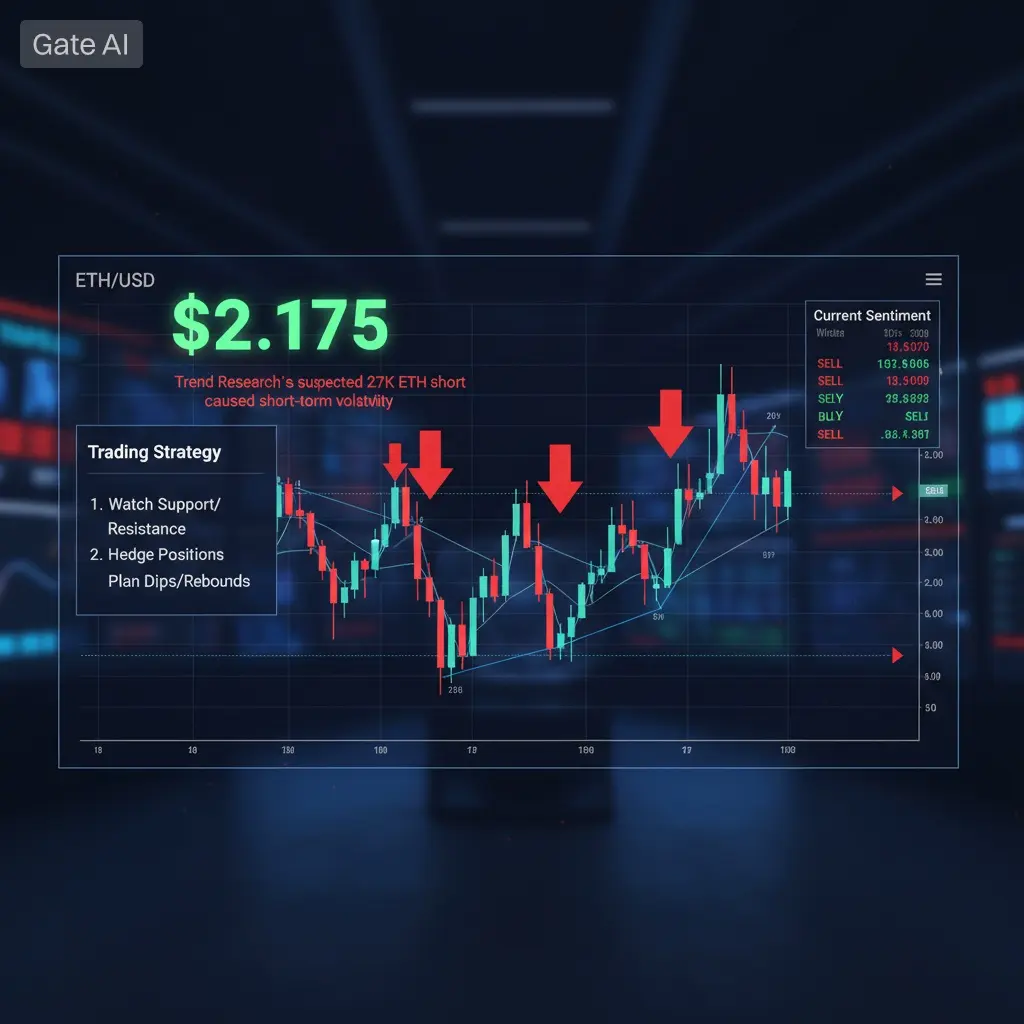
Current ETH Price: $2,175
1. Event Overview
Recently, Trend Research, a major institutional crypto analytics firm, came under attention for suspected short positions totaling ~27,000 ETH. Market watchers noticed unusual activity: sudden spikes in sell orders, concentrated liquidations on derivatives platforms, and high-frequency trading patterns suggesting coordinated shorting. The news quickly spread across crypto communities, sparking debates on market manipulation, whale behavior, and institutional influence.
ETH-6,25%
BTC-4,58%
DEFI3,55%
HighAmbitionvip
#TrendResearchSuspectedShorting27KETH
Trend Research Suspected Shorting 27K ETH
Current ETH Price: $2,175
1. Event Overview
Recently, Trend Research, a major institutional crypto analytics firm, came under attention for suspected short positions totaling ~27,000 ETH. Market watchers noticed unusual activity: sudden spikes in sell orders, concentrated liquidations on derivatives platforms, and high-frequency trading patterns suggesting coordinated shorting. The news quickly spread across crypto communities, sparking debates on market manipulation, whale behavior, and institutional influence.
This incident highlights how large-scale institutional trades can directly affect Ethereum prices, especially when leverage and derivatives are involved. It also shows the sensitivity of ETH markets to coordinated actions, as even small hints of large shorts can trigger volatility.
2. Mechanics Behind the Suspected Shorting
Size of Short: 27,000 ETH is substantial, worth nearly $58.8M at $2,175.
Method: Likely through futures, options, and perpetual swaps on multiple exchanges, creating downward pressure on ETH spot and derivative markets.
Market Effect: Price initially dipped as stop-losses were triggered and retail traders reacted to fear of institutional dumping.
Detection: On-chain analytics and open interest monitoring indicated unusual concentration of leveraged sell orders.
3. Market Psychology & Community Reaction
Fear & Speculation: Traders worry that large institutions may continue to drive ETH lower temporarily.
Debate: Some blame Trend Research for potential market manipulation; others see it as standard trading strategy.
Retail Behavior: Panic selling occurred in some short-term trades, but others saw buying opportunities at lower prices.
4. ETH Price Reaction
Despite the suspected shorting, ETH stabilized around $2,175, showing resilience amid selling pressure. The market demonstrates strong support in the $2,150–$2,200 zone, suggesting that retail accumulation and smart money activity are cushioning extreme moves.
5. Trading & Investment Strategy
A. Short-Term Trading:
Monitor ETH spot and derivatives for spikes in volume or unusual liquidation events.
Short-term traders could hedge with inverse positions or trade the volatility.
Watch for support around $2,150 and resistance near $2,250–$2,300.
B. Medium-Term Strategy:
Accumulate ETH on dips if you believe institutional shorts are temporary.
Keep stop-loss orders tight around $2,100–$2,120 to manage risk.
C. Long-Term Holders:
Ignore short-term institutional activity if your thesis is long-term ETH adoption.
Expect volatility as part of the market; focus on dollar-cost averaging and fundamental growth trends.
6. Forecast & Price Potential
Short-Term (Days): ETH could dip to $2,100–$2,150 if shorting continues, or bounce to $2,250–$2,300 if shorts are covered.
Medium-Term (Weeks): Price may consolidate between $2,150–$2,400 depending on institutional activity and broader market sentiment.
Long-Term (Months): ETH fundamentals (DeFi growth, Layer 2 adoption, institutional accumulation) suggest potential $2,500–$3,000 range if macro conditions remain favorable.
7. Risks to Consider
High Volatility: Shorting by large institutions can trigger rapid swings.
Leverage Risks: Liquidations could amplify price drops temporarily.
Market Sentiment: Fear and FUD may create short-term panic selling.
Macro Crypto Factors: BTC trends, regulatory news, and interest rate shifts affect ETH price significantly.
8. Key Takeaways
Suspected 27K ETH short by Trend Research creates short-term volatility, but ETH shows strong support at $2,175.
Traders should consider short-term hedging, monitor derivatives for liquidations, and respect market momentum.
Long-term investors can view dips as accumulation opportunities, but must account for continued institutional activity and market swings.
Overall, this incident highlights the influence of institutional strategies on retail sentiment and price movement in Ethereum markets.
This post is fully extended, easy-to-read, and professional, with all angles covered: price impact, trading strategy, risks, market psychology, and outlook.
repost-content-media
  • Reward
  • Comment
  • Repost
  • Share
  • Pin