GateUser-df796f3c

vip
Age 1.4 Yıl
Peak Tier 0
No content yet
The move wasn’t the rally.
The move was the confirmation.
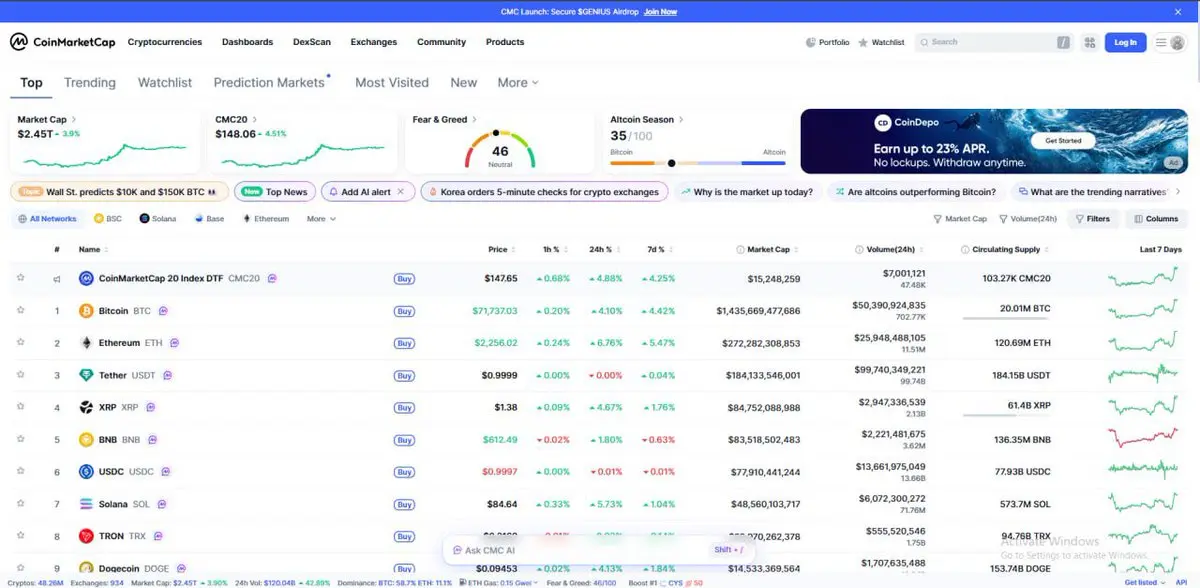
BTC pushed to $72.7K following the US Iran ceasefire headline.
ETH followed with +7.4%.
Risk assets broadly bid.
On the surface, this looks like a standard risk-on reaction.
But price wasn’t the signal.
Flows were.
$471M moved into spot Bitcoin ETFs on Monday.
That reverses nearly a month of stagnation.
This is the part that matters.
Price can move on positioning.
Flows confirm intent.
For weeks, institutional capital stayed sidelined.
Not because BTC lacked upside,
but because macro conditions were unstable.
Higher oil.
Sticky inflatio
BTC5,28%
ETH8,4%
post-image
  • Reward
  • Comment
  • Repost
  • Share
DeFi lending looks diversified. It isn’t.
On the surface, lending markets support dozens of assets. In practice, most of the system is backed by a very narrow base. And that base defines how risk propagates.
DeFi lending remains one of the largest sectors in crypto, with roughly $30B–$35B in total TVL, dominated by @Aave, @compoundfinance, and @SkyEcosystem. But the key question isn’t size. It’s what actually backs the loans.
Across protocols, collateral clusters into a few categories:
$ETH and $ETH derivatives
➝ Stablecoins
➝ Liquid staking tokens (LSTs)
That’s effectively the entire system
AAVE9,39%
ETH8,4%
STETH7,79%
  • Reward
  • Comment
  • Repost
  • Share
Two different types of Bitcoin demand are quietly building.
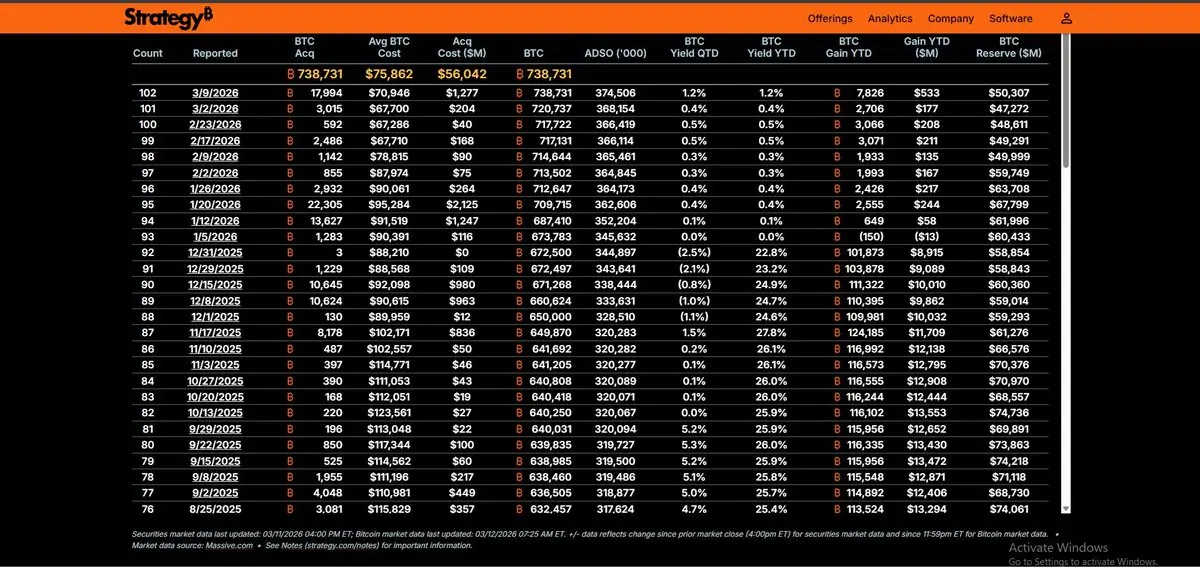
Strategy purchased 17,994 $BTC ($1.28B) between March 2–8 at an average price of $70,946, bringing total holdings to 738,731 $BTC.
That’s not trading activity.
It’s supply compression through corporate treasury accumulation.
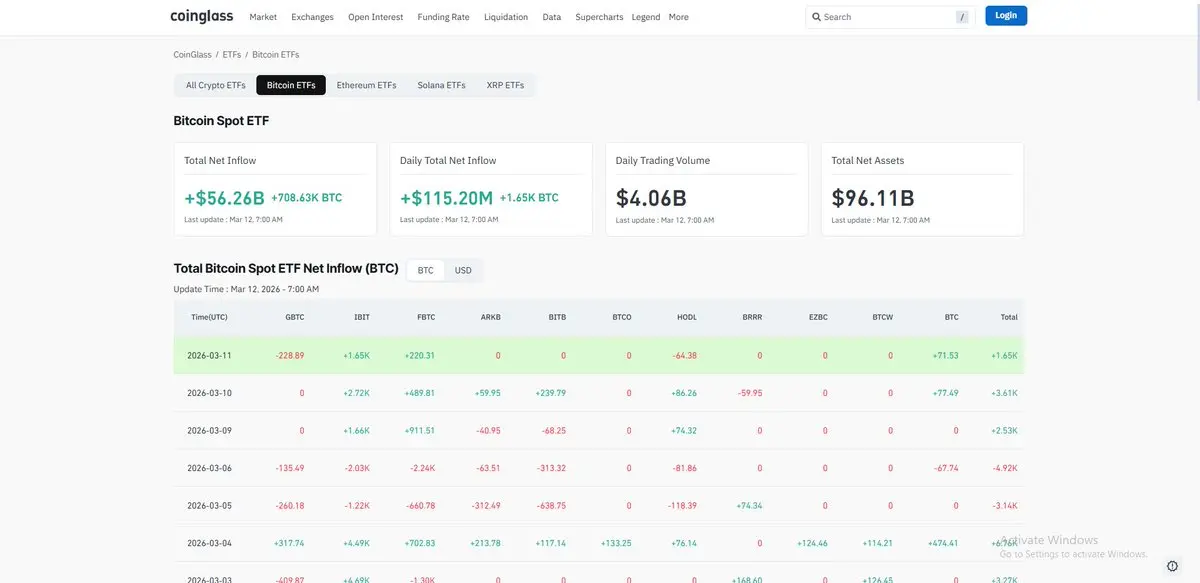
Meanwhile, Bitcoin ETFs recorded $251M of inflows on March 11, pushing March inflows to $1.56B after a rough start to the month.
Different mechanisms.
• Strategy accumulates via equity dilution, forcing long-duration conviction.
• ETF holders are institutional allocators operating within redemption windows.
The in
BTC5,28%
post-image
post-image
  • Reward
  • Comment
  • Repost
  • Share
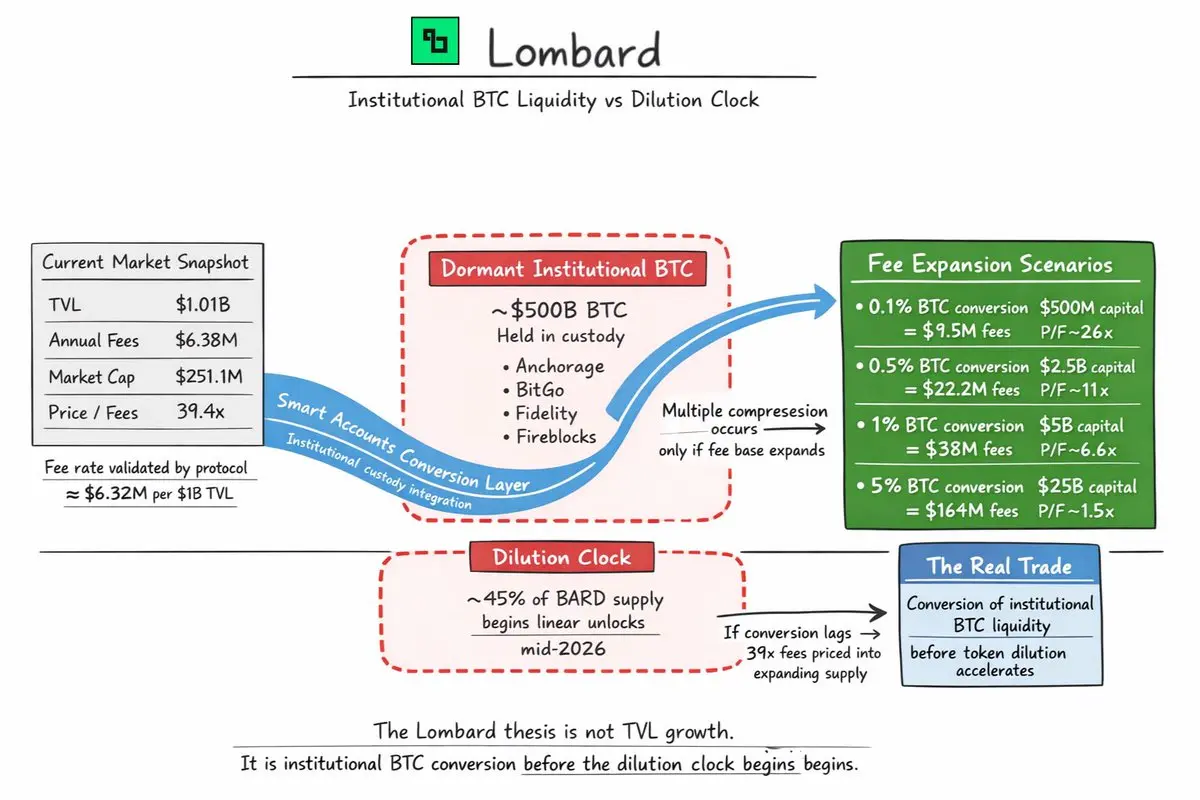
The market is pricing @Lombard_Finance like a $1B TVL protocol.
The thesis assumes something much bigger.
Current Data Snapshot:
• TVL: $1.01B
• Annual fees: $6.38M
• Market cap: $251.1M
• P/F: 39.4x
At first glance, that multiple doesn’t screen cheap.
But the more relevant variable is the fee rate Lombard has already validated.
At $1.01B TVL, the protocol is generating roughly $6.32M in fees per $1B of capital deployed.
That number becomes the anchor for every forward scenario.
Now look at the addressable pool.
Roughly $500B of Bitcoin sits in institutional custody, legally ring-fenced and l
BARD2,39%
BTC5,28%
post-image
  • Reward
  • Comment
  • Repost
  • Share
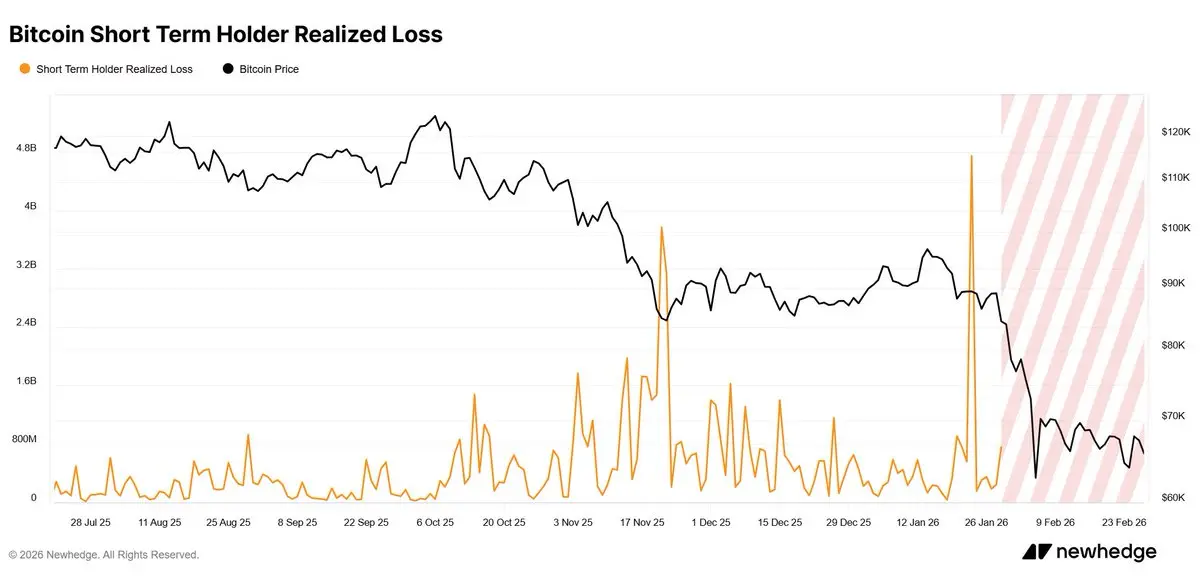
30-day realized vol is back near 0.83 as price trades around $65k.
- Short-term holder losses: $1.2B/day
- One-day STH exchange inflows: 23k $BTC at a loss
- Open interest: contracting
- Heavy cost basis: $65k–$70k
- Larger holders: still accumulating
This is not aggressive selling from strength.
It’s weak positioning being forced out as liquidity thins.
BTC5,28%
post-image
  • Reward
  • Comment
  • Repost
  • Share
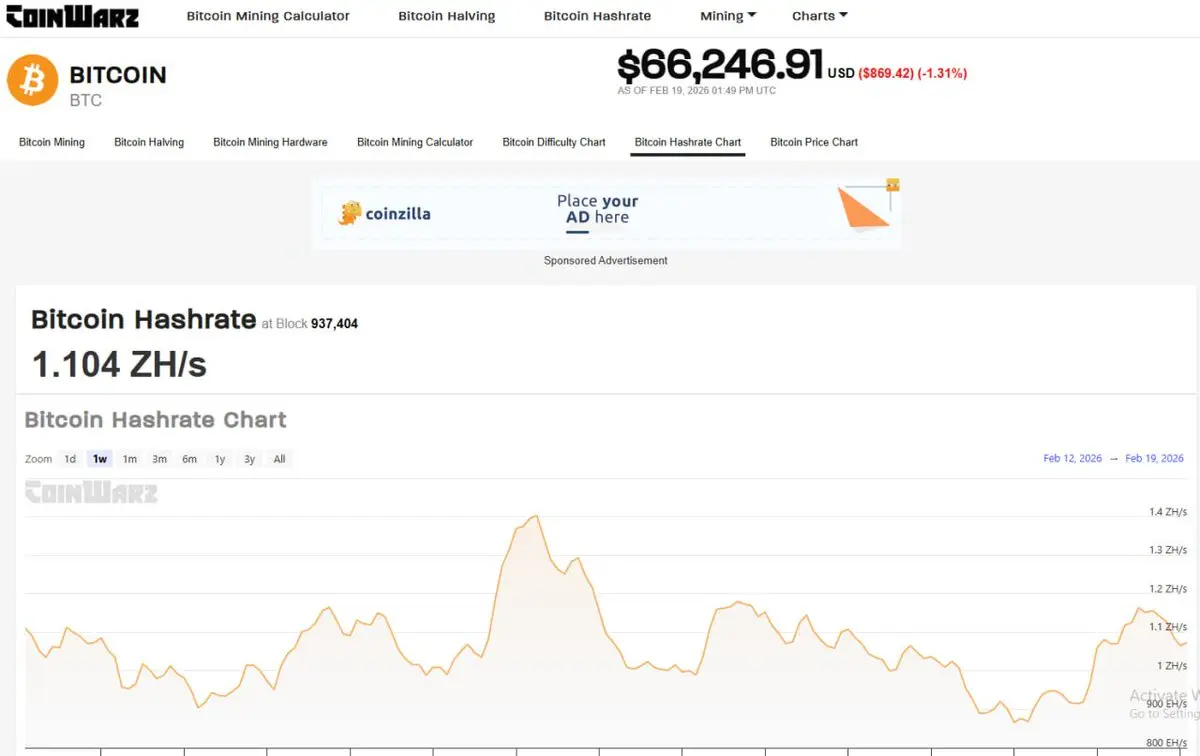
Bitcoin Network Hash Rate just hit 1 Zettahash/sec ($1 ZH/s) on the 7-day Moving Average.
Forget the "spikes" from 2025. This is different.
Despite the January "Winter Storm" liquidations and US energy curtailment, the floor didn't just hold, it rose.
The Macro Impact:
$1 ZH/s, the cost to attack the network now exceeds the kinetic budget of a G7 nation. We have moved from:
1. "Magic Internet Money" (2010s)
2. "Digital Gold" (2020s)
3. "Unassailable Sovereign Infrastructure" (2026)
Hash rate is a lead indicator for institutional safety.
Price is the lag indicator for institutional FOMO.
The ad
BTC5,28%
post-image
  • Reward
  • Comment
  • Repost
  • Share
As the casino fades, the backbone remains.
If you're betting on the next decade of on-chain growth, these 3 pillars are the non-negotiables:
1. $AAVE (The Global Liquidity Protocol)
• The "Lindy Effect" winner of DeFi.
• Now acting as a back-end for fintech apps globally.
• Institutional GHO adoption is the flywheel to watch.
2. $TAO (The Intelligence Layer)
• AI is the biggest buyer of blockspace in 2026.
• BitTensor decentralizes the "brain" of the internet.
• Incentivizing intelligence, not just hash power.
3. $LINK (The Verifiable Truth)
• Oracles are no longer just price feeds.
• They are
AAVE9,39%
TAO10,64%
LINK6,42%
post-image
  • Reward
  • Comment
  • Repost
  • Share
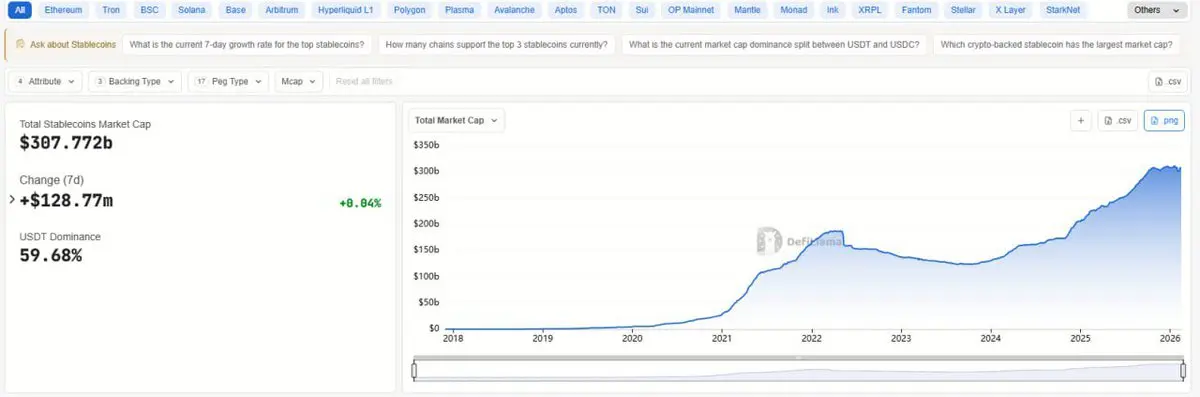
Mainstream media calling for $BTC to $40k while stablecoin mcap is literally at all-time highs and on-chain volume is doubling every week.
They’re trying to trick you out of the best entry of the year.
If you can't bid the blood you don't deserve the 10x.
BTC5,28%
post-image
  • Reward
  • Comment
  • Repost
  • Share
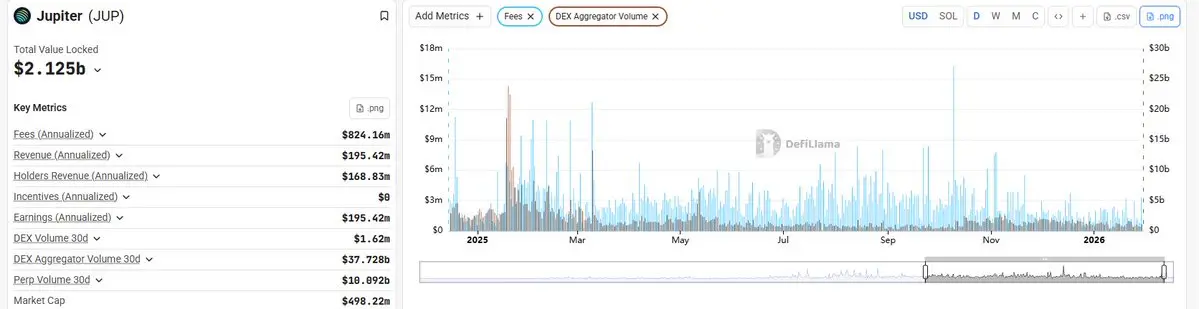
The DEX vs Aggregator argument is fading.
The real shift is pool ownership → order-flow ownership.
- @JupiterExchange is routing ~$37B/month in volume.
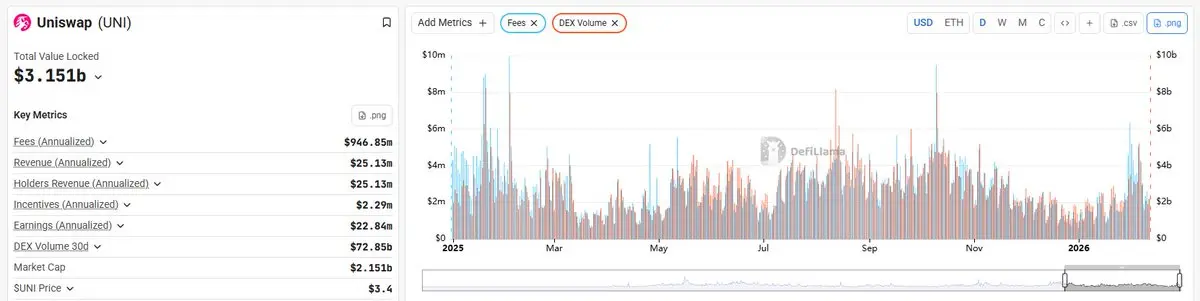
- @Uniswap earnings are exploding.
Different positions in the stack. Same conclusion:
Control the flow, capture the value.
Liquidity is becoming a commodity.
Distribution and routing are becoming the moat.
UNI5,69%
post-image
post-image
  • Reward
  • Comment
  • Repost
  • Share
Bitcoin fell 13% over the past week.
Spot ETFs added $311M in the same window.
That divergence is the signal.
Historically, crypto flows were pro-cyclical. Price up → inflows. Price down → redemptions. Reflexivity drove both directions.
That reflex is breaking.
Last week saw $318M in ETF outflows.
This week has already brought $311M back.
Three sessions of inflows into weakness.
That is not momentum behavior.
That is capital averaging into volatility.
It tells us something about the buyer.
ETF capital is not trading breakouts. It expresses allocation views.
When allocators add into drawdowns,
BTC5,28%
  • Reward
  • Comment
  • Repost
  • Share
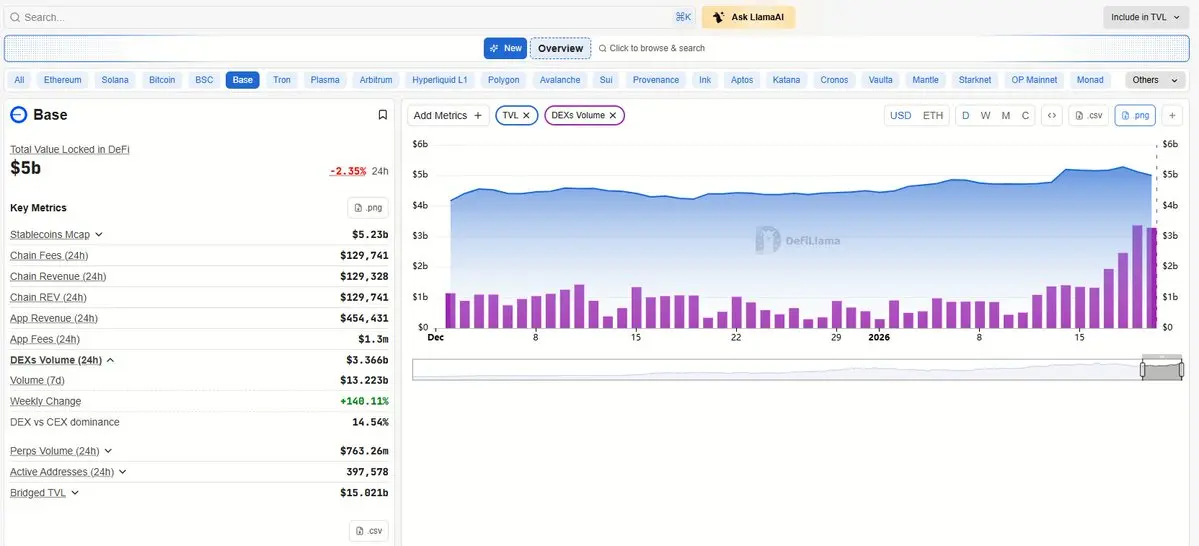
Base DEX volume doubled without capital following. That’s the anomaly.
Over the past 7 days, Base cleared $13.22B in DEX volume (+140% WoW) while TVL stayed flat near $5B, and chain revenue remained largely unchanged. Volume moved. Balance sheets didn’t.
This was not liquidity migration.
It was an execution re-routing.
— Volume Without Capital Expansion
When DEX growth is driven by incentives or capital rotation, three variables usually move together:
• TVL expands
• Fee density reprices upward
• Capital remains parked
Base showed none of these.
Instead, volume accelerated sharply while TVL re
post-image
  • Reward
  • Comment
  • Repost
  • Share
  • Pin