BudgetDeFi

vip
Age 0.1 Yıl
Peak Tier 0
No content yet
I'm more concerned about whether the broken structure can be recovered; otherwise, TP2/TP3 is not impossible.
View Original
LedgerBull
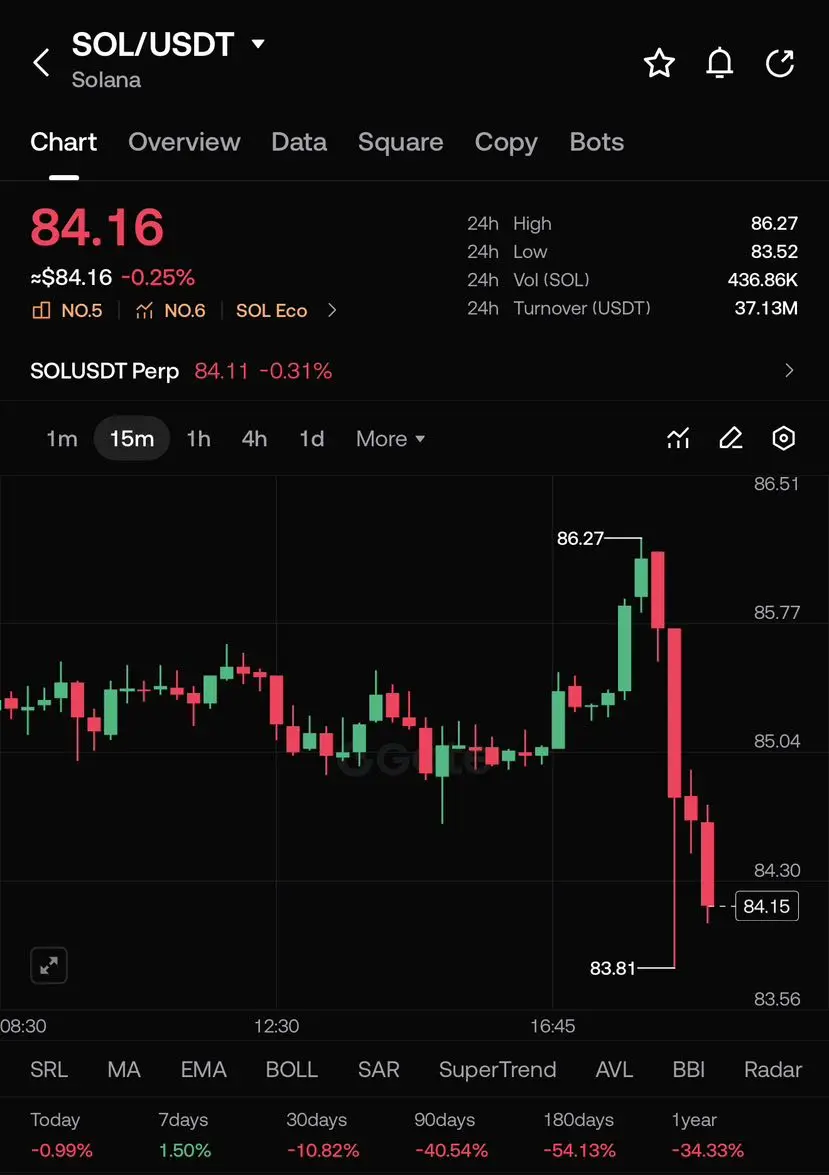
$SOL showing rejection from local highs with momentum turning bearish.
Sellers in control as structure breaks down on lower timeframes.
EP
84.50 - 85.20
TP
TP1 83.50
TP2 82.00
TP3 80.00
SL
86.50
Liquidity above 86 was swept before a sharp sell-off, confirming distribution. Weak bounce attempts and continued lower highs suggest downside continuation unless price reclaims the broken structure.
Let’s go $SOL ‌
repost-content-media
  • Reward
  • Comment
  • Repost
  • Share
I later realized that holding spot positions and getting liquidated on futures contracts are not fundamentally about lacking skills; it's about being too greedy with leverage. To put it simply: don't bet all your "hopes of making money" on the possibility of "losing money." My approach is layered: keep the core position as savings and don't touch it, use small positions for trading, and treat leverage as a seasoning—so even if I lose it all, it doesn't affect my sleep. Recently, seeing some regions tighten taxes and compliance measures, sometimes increasing and sometimes relaxing, causing depo
View Original
  • Reward
  • Comment
  • Repost
  • Share
Recently, I came across a few blockchain game pools again. A few days ago, it was quite lively, but in a couple of weeks, everyone dispersed. Basically, it's because inflation is too fierce, and there's nowhere for the output to be absorbed. People just take their earnings and sell, leaving only selling pressure and increasingly thin liquidity in the pool. The effect is even more obvious with small funds entering; it feels less like "playing" and more like passing the baton to early entrants. Conversely, those with fewer outputs and more consumption scenarios tend to last longer. Now, looking
View Original
  • Reward
  • Comment
  • Repost
  • Share
Recently, someone asked me again about yield aggregators and whether that APY looks attractive enough to go for... I usually don't look at the numbers first; I check which contracts the money is being sent into: whether it's simply reinvesting for you, or layered with one on top of another, possibly involving lending, derivatives, and other counterparty risks. To put it plainly, APY isn't something that falls from the sky; most likely, you're bearing some risk for others, just packaged more smoothly.
And contract risk isn't just something "hackers" encounter; small funds can't withstand a sing
View Original
  • Reward
  • Comment
  • Repost
  • Share
Japan's move to include crypto assets under the Financial Instruments and Exchange Act, with insider trading + mandatory disclosures + severe penalties, increases compliance costs but also benefits long-term institutional entry.
View Original
CryptoNewcomersAreHere22222
(The FSA) Previously regulated cryptocurrency assets under the "Funds Clearing Law," using payment methods as the basis for supervision. As the investment purposes for cryptocurrency assets continue to expand, the proportion of users holding assets for profit has significantly increased, and the current regulatory framework has become insufficient to effectively protect investors' rights. Based on this background, the Financial Services Agency has decided to transfer the regulatory framework to the "Financial Instruments and Exchange Act," placing cryptocurrency assets on equal legal footing with stocks, bonds, and other traditional financial products, and related industry players will also face compliance standards similar to traditional financial institutions. This transition further aligns Japan's cryptocurrency regulatory structure with the mainstream financial regulations of major G7 economies. Core provisions of the amendment: strengthened obligations and upgraded penalties.
Main changes in the amendment:
Insider trading ban: Explicitly prohibits trading cryptocurrency assets using material non-public information, filling gaps in current law.
Annual disclosure obligations: Cryptocurrency issuers must regularly disclose financial and business information to regulators and investors.
Change of operator name: Registered operators are officially renamed from "cryptocurrency exchange operators" to "cryptocurrency trading operators."
Increased criminal penalties: The maximum prison sentence for unlicensed operators is increased from 3 years to 10 years, and the fine cap is raised from 3 million yen to 10 million yen.
  • Reward
  • Comment
  • Repost
  • Share
  • Pin