Individuals transacting cryptocurrency on offshore platforms or independently must now report their movements when the amount of crypto transacted surpasses $5,000 per year. Users must now deliver sensitive data, including the purpose of each transaction, hashes, and destination addresses.
Paraguay Ramps Up Crypto Reporting Requirements For VASPs and Individuals
The government of Paraguay is ramping up the scrutiny of the cryptocurrency market.
The National Directorate of Tax Revenue (DNIT), Paraguay’s tax watchdog, has issued a resolution creating a new figure, a sworn cryptoassets statement, to obtain a more granular control and oversight of the crypto movements in the country.
Resolution No. 47 establishes that both operators of virtual asset service providers (VASPs) and individuals making crypto transactions with volumes going over $5,000 per year, even if transacting using offshore accounts or outside exchange platforms, must issue this detailed statement.
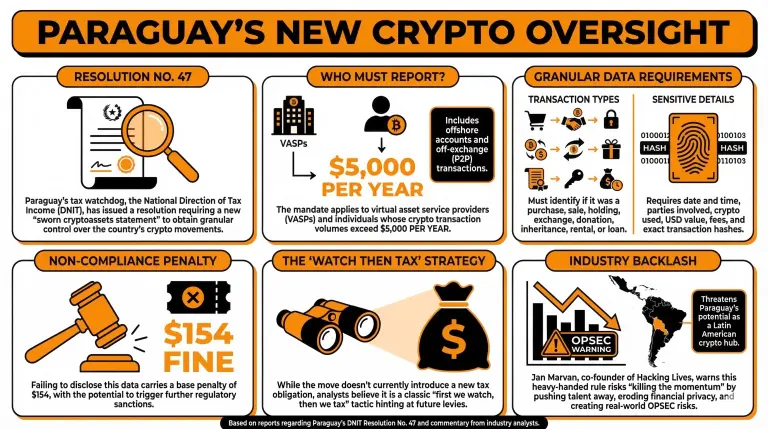
The document must identify, at the very minimum, the class of transaction completed -purchases and sales, holding or possession, exchanges between different crypto assets, donations, inheritances, temporary assignments, rentals, or loans, among others.
In the same way, for each transaction, the user must include sensitive data, such as date and time, the parties involved, the cryptocurrency used, the amount traded, the value transacted in U.S. dollars, fees, and transaction hashes.
The penalty for failing to disclose this data during the expected period is $154, and it could result in other penalties.
While this move doesn’t introduce a tax obligation, analysts believe this might be a classic “first we watch, then we tax” move, hinting at future moves to leverage this information via new levies.
Jan Marvan, co-founder of Hacking Lives, stressed that this was a troubling development for the nation’s crypto scene, as it could affect its possibilities of becoming a crypto hub in Latin America.
“This kind of heavy-handed rule risks killing that momentum. It will push talent away, slow down everyday adoption, erode financial privacy, and in the worst cases create real-world OPSEC risks for users,” he concluded.
FAQ
- What recent action has the government of Paraguay taken regarding cryptocurrencies?
Paraguay is increasing scrutiny of the crypto market by implementing a sworn cryptoassets statement for enhanced oversight of crypto transactions.
- What does Resolution No. 47 require from virtual asset service providers and individuals?
Operators and individuals engaging in crypto transactions over $5,000 per year must issue a detailed statement identifying transaction types and sensitive data.
- What details must be included in the sworn statement?
The statement must include transaction specifics such as date, time, parties involved, cryptocurrency used, and amount traded, along with the transaction hash.
- What implications does this resolution have for Paraguay’s crypto market?
Analysts warn that while it doesn’t introduce new taxes now, it may lead to future taxation, potentially hindering Paraguay’s growth as a crypto hub in Latin America.
Avertissement : Les informations contenues dans cette page peuvent provenir de tiers et ne représentent pas les points de vue ou les opinions de Gate. Le contenu de cette page est fourni à titre de référence uniquement et ne constitue pas un conseil financier, d'investissement ou juridique. Gate ne garantit pas l'exactitude ou l'exhaustivité des informations et n'est pas responsable des pertes résultant de l'utilisation de ces informations. Les investissements en actifs virtuels comportent des risques élevés et sont soumis à une forte volatilité des prix. Vous pouvez perdre la totalité du capital investi. Veuillez comprendre pleinement les risques pertinents et prendre des décisions prudentes en fonction de votre propre situation financière et de votre tolérance au risque. Pour plus de détails, veuillez consulter l'
avertissement.


