#Web3SecurityGuide
The rapid expansion of the Web3 ecosystem has created one of the most important technological revolutions of the modern digital era. From decentralized finance and blockchain gaming to tokenized assets and on-chain social platforms, Web3 is transforming the way people interact with finance, ownership, and digital identity. However, as innovation accelerates across the crypto industry, security has become one of the most critical pillars for long-term sustainability. Every market cycle introduces new participants into the ecosystem, but many users still underestimate the importance of protecting their wallets, assets, and private information in an environment where transactions are irreversible and attackers continuously evolve their methods.
Unlike traditional banking systems where fraudulent transactions can sometimes be reversed through centralized institutions, blockchain transactions operate on decentralized networks where responsibility ultimately falls on the user. This creates both freedom and risk at the same time. While Web3 gives users full ownership over their digital assets, it also requires individuals to understand security practices at a much deeper level. A single mistake such as connecting to a malicious website, signing an unsafe smart contract, or exposing a seed phrase can result in permanent financial loss. That reality is exactly why security education is becoming one of the most valuable skills in the entire crypto space.
One of the biggest security mistakes made by new participants is misunderstanding the importance of private keys and seed phrases. In the blockchain ecosystem, the seed phrase acts as the master access key to an entire wallet. Anyone who gains access to it can fully control all associated assets. Legitimate platforms, exchanges, wallets, or developers will never ask users to reveal their seed phrases under any circumstances. Yet social engineering attacks continue to exploit inexperienced users through fake support messages, phishing websites, impersonation accounts, and fraudulent giveaways. Attackers often create urgency and emotional pressure to manipulate victims into making impulsive decisions. The best defense against these tactics is patience, verification, and maintaining strict control over sensitive wallet credentials.
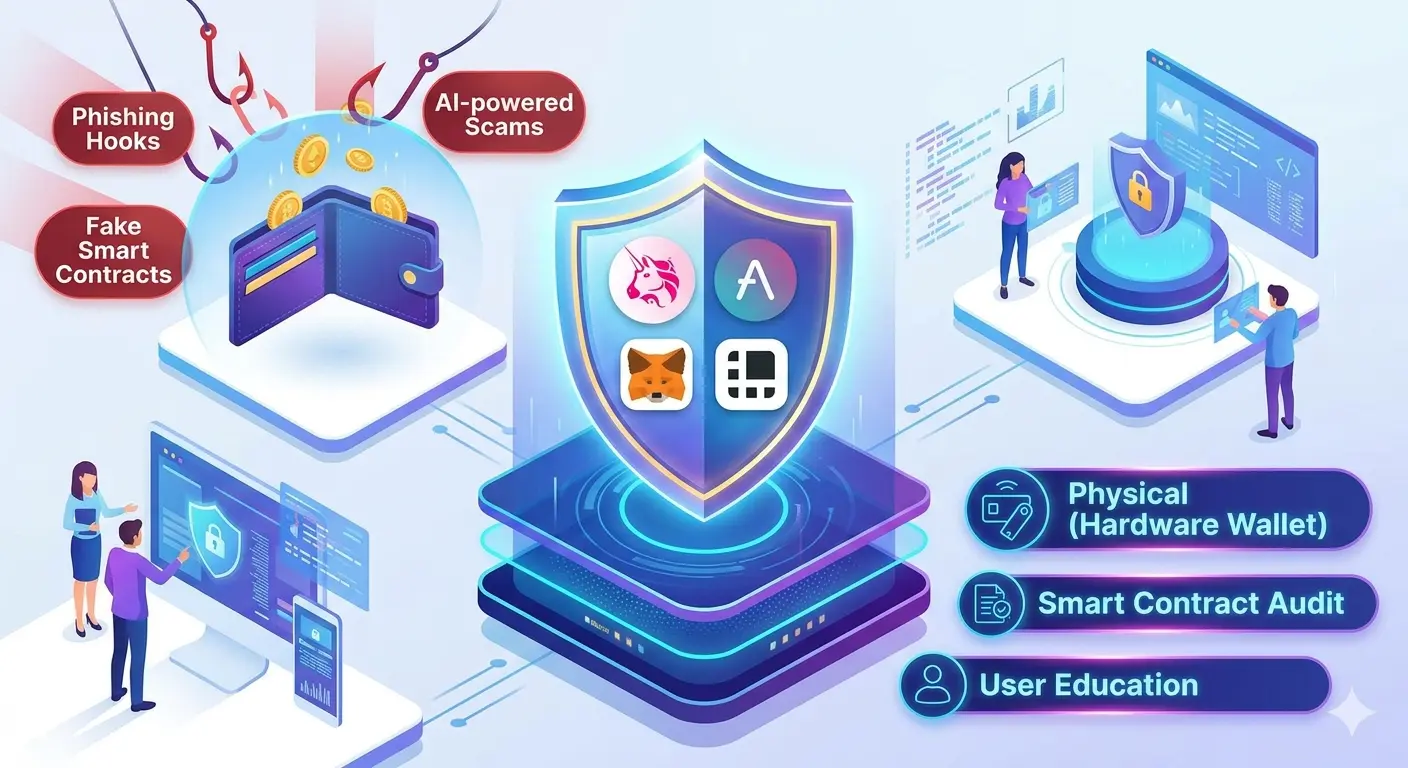
Hardware wallets have increasingly become one of the strongest defensive tools for long-term crypto holders. Unlike software wallets connected continuously to internet-enabled devices, hardware wallets isolate private keys offline, dramatically reducing exposure to malware and remote attacks. While no security method is completely perfect, cold storage solutions significantly improve protection against common threats targeting active internet users. Many experienced market participants divide their assets between multiple wallets, using separate wallets for long-term holdings, daily trading, NFT activity, and decentralized application interactions. This layered approach helps reduce the overall risk exposure if one wallet becomes compromised.
Another major security challenge in Web3 involves malicious smart contracts and wallet approvals. Many decentralized applications require users to grant token permissions in order to interact with protocols, staking systems, NFT marketplaces, or liquidity pools. However, users often approve unlimited token access without fully understanding the consequences. If a malicious contract gains excessive permissions, attackers may potentially drain assets from affected wallets. Reviewing wallet permissions regularly and revoking unnecessary approvals has become a critical habit for responsible blockchain participants. Security in Web3 is not a one-time action but an ongoing process of monitoring, reviewing, and adapting to new threats.
Phishing attacks continue to dominate the crypto threat landscape because they target human psychology rather than technical weaknesses. Fake airdrops, cloned websites, fraudulent browser extensions, and fake social media accounts are specifically designed to imitate trusted brands and communities. Many attackers exploit hype cycles surrounding major token launches, NFT mint events, or trending meme coins to lure users into unsafe interactions. This demonstrates why emotional discipline is just as important as technical knowledge in the crypto industry. Fear of missing out frequently leads individuals toward rushed decisions without proper verification. In many cases, attackers succeed not because systems are weak, but because users abandon caution during emotionally charged market moments.
The growth of artificial intelligence has also introduced a new generation of sophisticated scams across the digital asset industry. Deepfake videos, AI-generated voices, fake livestreams, and manipulated interviews have become increasingly convincing. Fraudsters can now imitate public figures, influencers, project founders, and even exchange representatives with alarming realism. As technology advances, the need for independent verification becomes even more important. Users should always verify announcements through official project channels, cross-check information across multiple trusted sources, and avoid relying solely on viral social media posts for financial decisions.
Decentralized finance platforms have unlocked enormous innovation across lending, staking, yield generation, and cross-chain interoperability. However, DeFi also introduces smart contract risks, liquidity vulnerabilities, oracle manipulation threats, and protocol exploits. Even audited protocols can face unexpected vulnerabilities because blockchain technology continues evolving rapidly. This does not mean decentralized finance should be avoided, but rather approached with proper risk management. Diversification, position sizing, research, and understanding protocol mechanics are essential parts of responsible participation. Smart investors focus not only on potential rewards but also on evaluating worst-case scenarios before allocating capital.
Cybersecurity in Web3 extends beyond wallets and tokens. Device security plays an equally important role. Using strong passwords, enabling two-factor authentication, maintaining updated software, avoiding suspicious downloads, and separating crypto-related activity from everyday browsing can significantly reduce exposure to attacks. Public Wi-Fi networks, unofficial applications, and unverified browser plugins can create hidden vulnerabilities that many users overlook. In a decentralized ecosystem, personal operational security becomes the digital equivalent of financial self-defense.
The broader Web3 industry is gradually moving toward stronger infrastructure standards as adoption grows. Security audits, bug bounty programs, multi-signature treasury systems, and advanced monitoring tools are becoming more common across professional blockchain projects. Institutional participants entering the market are also pushing for higher compliance standards, stronger custody solutions, and improved transparency mechanisms. This evolution is helping mature the industry from a speculative frontier into a more structured financial ecosystem capable of supporting global-scale adoption.
Despite the risks, the future of Web3 security remains highly promising. Innovation in decentralized identity systems, zero-knowledge technology, AI-powered threat detection, and account abstraction could significantly improve user safety over the coming years. The industry is learning from each cycle, and security awareness is becoming increasingly integrated into mainstream blockchain education. Long-term success in crypto will not only depend on identifying profitable opportunities but also on surviving market cycles through disciplined security practices and informed decision-making.
Ultimately, Web3 security is not just about protecting assets. It is about protecting digital freedom, ownership, and trust within a decentralized future. The strongest participants in the blockchain industry are not always those who chase the fastest profits, but those who consistently prioritize education, patience, verification, and risk management. In an ecosystem built around self-custody and decentralization, security awareness is no longer optional. It is the foundation upon which sustainable participation in the future digital economy will be built.
The rapid expansion of the Web3 ecosystem has created one of the most important technological revolutions of the modern digital era. From decentralized finance and blockchain gaming to tokenized assets and on-chain social platforms, Web3 is transforming the way people interact with finance, ownership, and digital identity. However, as innovation accelerates across the crypto industry, security has become one of the most critical pillars for long-term sustainability. Every market cycle introduces new participants into the ecosystem, but many users still underestimate the importance of protecting their wallets, assets, and private information in an environment where transactions are irreversible and attackers continuously evolve their methods.
Unlike traditional banking systems where fraudulent transactions can sometimes be reversed through centralized institutions, blockchain transactions operate on decentralized networks where responsibility ultimately falls on the user. This creates both freedom and risk at the same time. While Web3 gives users full ownership over their digital assets, it also requires individuals to understand security practices at a much deeper level. A single mistake such as connecting to a malicious website, signing an unsafe smart contract, or exposing a seed phrase can result in permanent financial loss. That reality is exactly why security education is becoming one of the most valuable skills in the entire crypto space.
One of the biggest security mistakes made by new participants is misunderstanding the importance of private keys and seed phrases. In the blockchain ecosystem, the seed phrase acts as the master access key to an entire wallet. Anyone who gains access to it can fully control all associated assets. Legitimate platforms, exchanges, wallets, or developers will never ask users to reveal their seed phrases under any circumstances. Yet social engineering attacks continue to exploit inexperienced users through fake support messages, phishing websites, impersonation accounts, and fraudulent giveaways. Attackers often create urgency and emotional pressure to manipulate victims into making impulsive decisions. The best defense against these tactics is patience, verification, and maintaining strict control over sensitive wallet credentials.
Hardware wallets have increasingly become one of the strongest defensive tools for long-term crypto holders. Unlike software wallets connected continuously to internet-enabled devices, hardware wallets isolate private keys offline, dramatically reducing exposure to malware and remote attacks. While no security method is completely perfect, cold storage solutions significantly improve protection against common threats targeting active internet users. Many experienced market participants divide their assets between multiple wallets, using separate wallets for long-term holdings, daily trading, NFT activity, and decentralized application interactions. This layered approach helps reduce the overall risk exposure if one wallet becomes compromised.
Another major security challenge in Web3 involves malicious smart contracts and wallet approvals. Many decentralized applications require users to grant token permissions in order to interact with protocols, staking systems, NFT marketplaces, or liquidity pools. However, users often approve unlimited token access without fully understanding the consequences. If a malicious contract gains excessive permissions, attackers may potentially drain assets from affected wallets. Reviewing wallet permissions regularly and revoking unnecessary approvals has become a critical habit for responsible blockchain participants. Security in Web3 is not a one-time action but an ongoing process of monitoring, reviewing, and adapting to new threats.
Phishing attacks continue to dominate the crypto threat landscape because they target human psychology rather than technical weaknesses. Fake airdrops, cloned websites, fraudulent browser extensions, and fake social media accounts are specifically designed to imitate trusted brands and communities. Many attackers exploit hype cycles surrounding major token launches, NFT mint events, or trending meme coins to lure users into unsafe interactions. This demonstrates why emotional discipline is just as important as technical knowledge in the crypto industry. Fear of missing out frequently leads individuals toward rushed decisions without proper verification. In many cases, attackers succeed not because systems are weak, but because users abandon caution during emotionally charged market moments.
The growth of artificial intelligence has also introduced a new generation of sophisticated scams across the digital asset industry. Deepfake videos, AI-generated voices, fake livestreams, and manipulated interviews have become increasingly convincing. Fraudsters can now imitate public figures, influencers, project founders, and even exchange representatives with alarming realism. As technology advances, the need for independent verification becomes even more important. Users should always verify announcements through official project channels, cross-check information across multiple trusted sources, and avoid relying solely on viral social media posts for financial decisions.
Decentralized finance platforms have unlocked enormous innovation across lending, staking, yield generation, and cross-chain interoperability. However, DeFi also introduces smart contract risks, liquidity vulnerabilities, oracle manipulation threats, and protocol exploits. Even audited protocols can face unexpected vulnerabilities because blockchain technology continues evolving rapidly. This does not mean decentralized finance should be avoided, but rather approached with proper risk management. Diversification, position sizing, research, and understanding protocol mechanics are essential parts of responsible participation. Smart investors focus not only on potential rewards but also on evaluating worst-case scenarios before allocating capital.
Cybersecurity in Web3 extends beyond wallets and tokens. Device security plays an equally important role. Using strong passwords, enabling two-factor authentication, maintaining updated software, avoiding suspicious downloads, and separating crypto-related activity from everyday browsing can significantly reduce exposure to attacks. Public Wi-Fi networks, unofficial applications, and unverified browser plugins can create hidden vulnerabilities that many users overlook. In a decentralized ecosystem, personal operational security becomes the digital equivalent of financial self-defense.
The broader Web3 industry is gradually moving toward stronger infrastructure standards as adoption grows. Security audits, bug bounty programs, multi-signature treasury systems, and advanced monitoring tools are becoming more common across professional blockchain projects. Institutional participants entering the market are also pushing for higher compliance standards, stronger custody solutions, and improved transparency mechanisms. This evolution is helping mature the industry from a speculative frontier into a more structured financial ecosystem capable of supporting global-scale adoption.
Despite the risks, the future of Web3 security remains highly promising. Innovation in decentralized identity systems, zero-knowledge technology, AI-powered threat detection, and account abstraction could significantly improve user safety over the coming years. The industry is learning from each cycle, and security awareness is becoming increasingly integrated into mainstream blockchain education. Long-term success in crypto will not only depend on identifying profitable opportunities but also on surviving market cycles through disciplined security practices and informed decision-making.
Ultimately, Web3 security is not just about protecting assets. It is about protecting digital freedom, ownership, and trust within a decentralized future. The strongest participants in the blockchain industry are not always those who chase the fastest profits, but those who consistently prioritize education, patience, verification, and risk management. In an ecosystem built around self-custody and decentralization, security awareness is no longer optional. It is the foundation upon which sustainable participation in the future digital economy will be built.