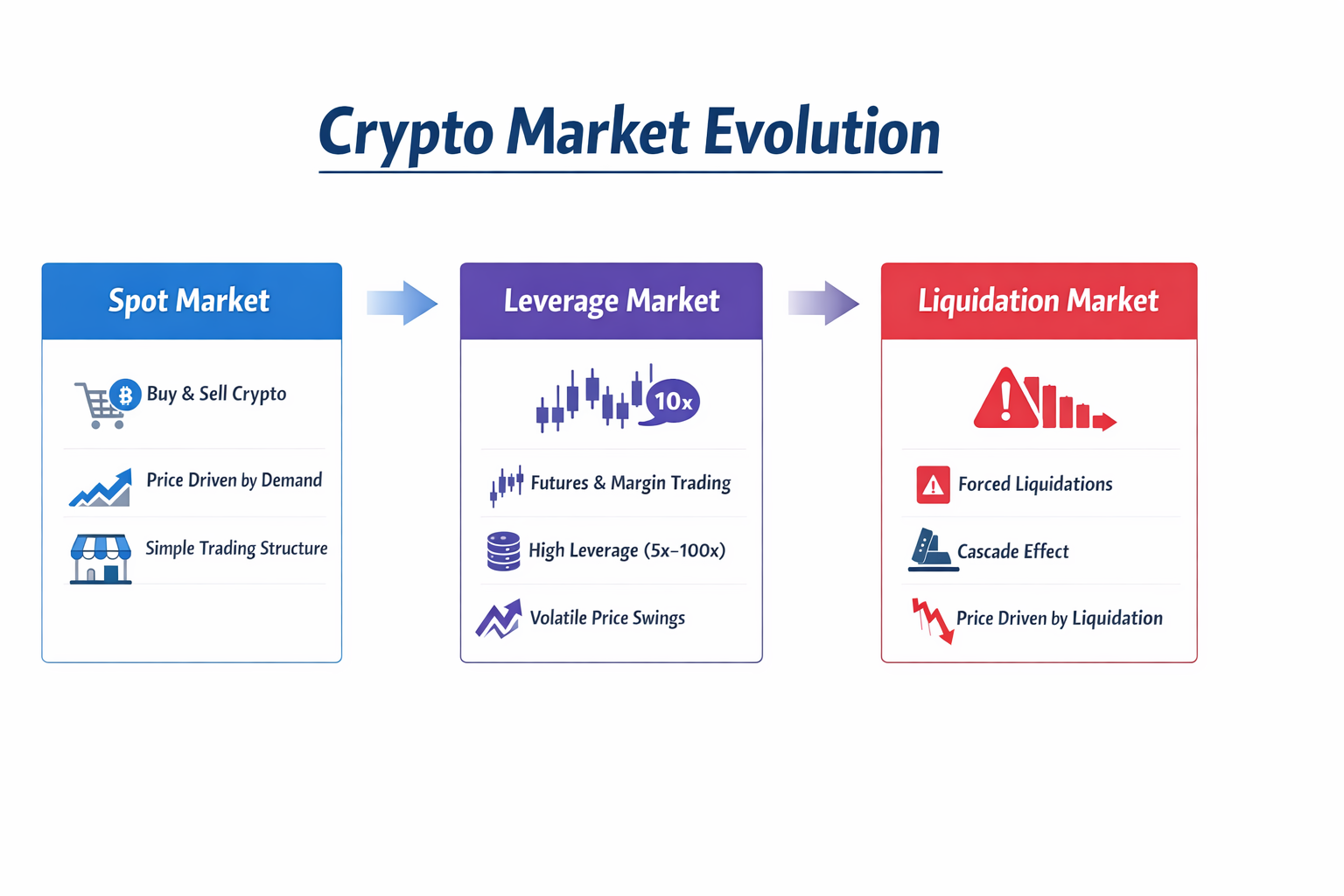
I. Early Crypto Market: The Era Dominated by Spot Trading
In the early stages of cryptocurrency development, the market structure was relatively simple. Traders mainly bought and sold spot assets on exchanges, directly purchasing or selling digital assets.
Taking Bitcoin as an example, early trading logic was very straightforward:
- Investors bought BTC and sold for profit when the price rose
- If bearish on the market, the only option was often to sell their assets and exit
At this stage, market prices were primarily determined by two factors:
- Capital inflows and outflows
- Changes in market sentiment
When a large amount of capital entered the market, prices usually rose; when investors collectively sold off, prices dropped. In other words, price fluctuations were mainly driven by genuine buying and selling demand. This market structure was typical in the early crypto market from 2013 to 2017. Exchange functions were simple, the derivatives market barely existed, and most trading volume came from spot trading.
In this environment, although the market was highly volatile, the fluctuations were closely related to news events, capital flows, or macro sentiment.
However, as the market expanded, this simple structure began to change.
II. The Emergence of the Derivatives Market
As more institutions and professional traders entered the crypto market, investors gradually sought more complex trading tools. Derivatives trading models from traditional financial markets began to be introduced into crypto.
The earliest derivatives included:
- Futures contracts
- Leveraged trading
- Margin trading
These tools allowed traders to increase their trading size by borrowing funds or using margin without fully owning the assets.
For example, a trader with $10,000 could only buy $10,000 worth of assets without leverage. With 10x leverage, they could control a position worth $100,000. This mechanism greatly improved capital efficiency and enabled traders to express their market views more flexibly.
Additionally, derivatives introduced an important function: shorting the market. In traditional spot markets, investors could only manage risk by selling assets; derivatives allowed traders to profit from price declines without holding assets. This made trading strategies much richer.
As these tools matured, the crypto market entered a new phase.
III. Perpetual Contracts: The Key Innovation Changing Market Structure
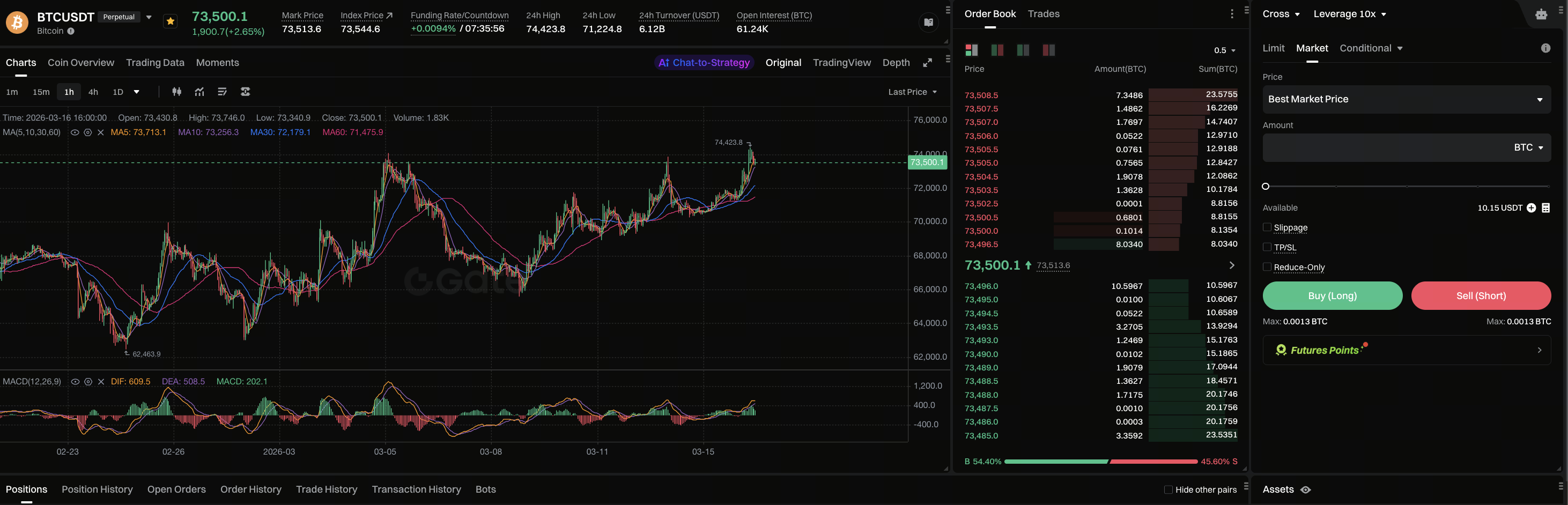
Image source: Gate contract trading page
Among all derivatives, the most influential product is the perpetual contract (Perpetual Futures). First launched by exchanges, perpetual contracts quickly became the core product of the crypto derivatives market. Unlike traditional futures, perpetual contracts have no fixed expiration date; traders can hold positions indefinitely.
To keep contract prices close to spot prices, perpetual contracts introduced a special mechanism: Funding Rate.
The funding rate settles periodically between longs and shorts. When bullish sentiment is too strong, longs pay funding fees to shorts; when bearish sentiment dominates, shorts pay fees to longs.
This mechanism effectively maintains balance between contract prices and spot prices.
The emergence of perpetual contracts greatly increased trading activity in the market due to:
- High leverage: Some platforms offer leverage dozens of times or even higher
- Long/short trading: Investors can flexibly express bullish or bearish views
- Capital efficiency: Larger positions can be controlled with less capital
- Hedging tool: Miners and institutions can hedge price risk with contracts
For these reasons, perpetual contracts quickly became one of the largest products by trading volume in the crypto market.
IV. Rapid Growth in Derivatives Trading Volume
With the development of the derivatives market, transaction structure in crypto changed significantly.
In the early stages, spot trading accounted for almost all trading volume. After derivatives matured, a large portion shifted to futures and perpetual contracts.
Today, on many major trading platforms, derivatives trading volume often far exceeds that of spot markets. At certain times, derivatives volume may reach five to twenty times that of spot trading.
This shift means that the mechanism for price formation has also changed.
In the era dominated by spot markets, prices were mainly driven by real buying and selling demand; in derivative-led markets, prices are increasingly influenced by factors such as:
- Size of leveraged positions
- Balance between long and short forces
- Market funding rates
- Liquidation risk
In other words, market prices are not just the result of buying and selling—they are also affected by position structure.
V. How Contract Trading Changes Market Volatility
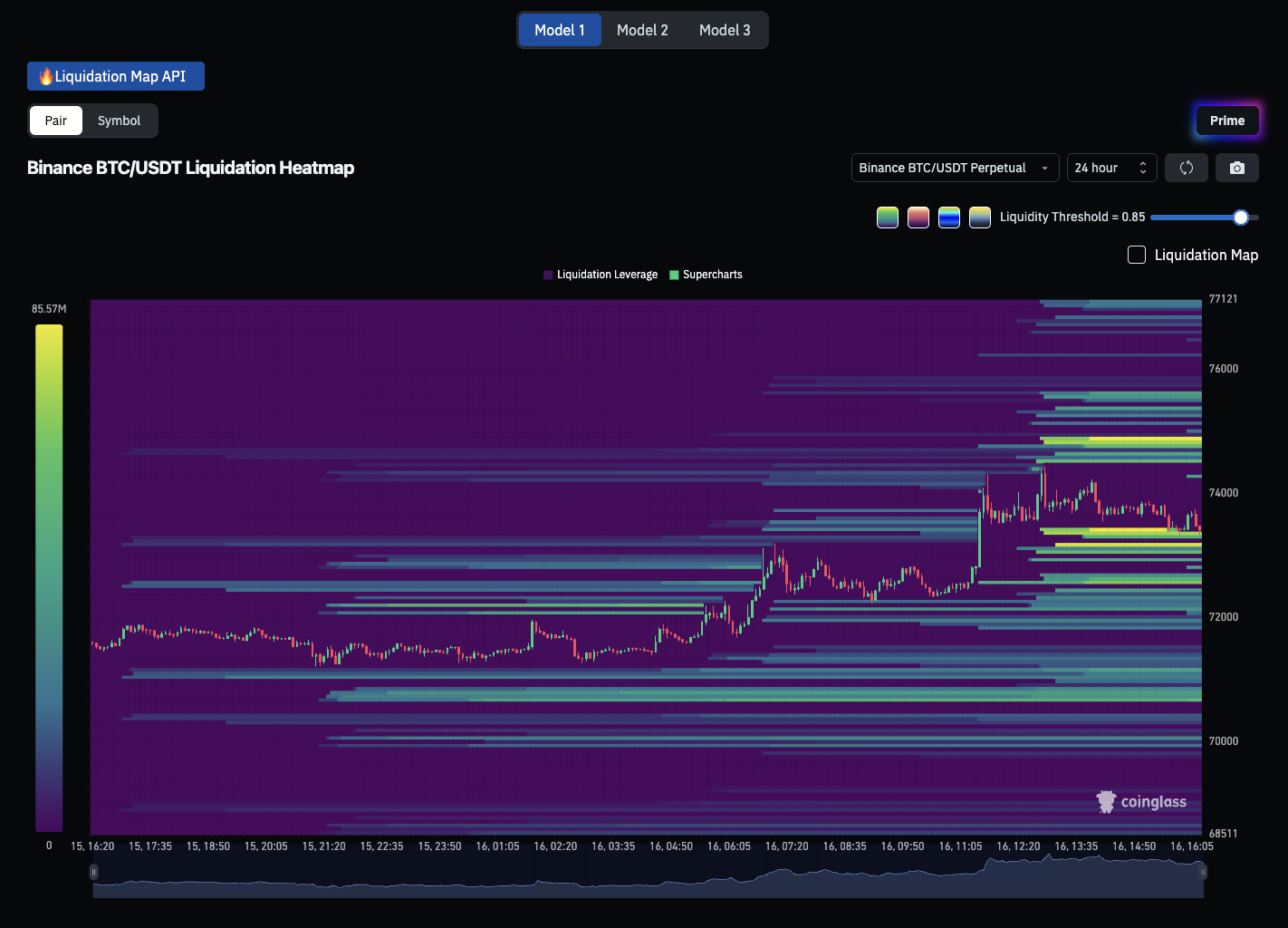
Image source: BTC/USDT liquidation heatmap
The rise of leveraged trading has markedly changed characteristics of market volatility. In non-leveraged markets, price changes are usually relatively smooth because investors must actually buy or sell assets to impact prices. In leveraged markets, small price fluctuations can trigger large-scale position changes.
For example, if a trader uses 20x leverage and the market drops about 5%, their position may face forced liquidation risk.
When many traders use high leverage, a chain reaction can form:
Price drops → Some longs are forced to liquidate → More sell orders appear → Price drops further → More positions are liquidated
This phenomenon is known as a liquidation cascade.
Under these circumstances, volatility can be quickly amplified and prices may experience dramatic changes in a short time frame.
Thus, in leveraged markets, price volatility is no longer driven purely by fundamentals or news but is increasingly influenced by position structure and liquidation mechanisms.
VI. Fundamental Changes in Market Structure
As the derivatives market continues to develop, crypto trading structures are gradually aligning with traditional financial markets. In traditional finance, derivatives trading volume usually far exceeds spot; for example, stock index futures and options account for a large portion of activity over time.
Crypto markets are now undergoing a similar transformation. More traders no longer rely solely on spot trading but participate through contracts, leveraged products, and structured tools.
This means that price formation mechanisms are becoming more complex. Investors must pay attention not only to capital flows but also understand leverage structures, funding rates, and potential liquidation risks.
Course Summary
In this session, we reviewed the evolution of the crypto market from early spot-dominated trading to derivative-led structures. With the rise of futures, leveraged trading, and perpetual contracts, market transaction structures have changed significantly. Today, derivatives trading volume often far exceeds spot trading, making prices increasingly influenced by leveraged positions and transaction structures. Understanding these structural changes is fundamental for analyzing crypto market volatility.
In the next session, we will introduce common leveraged trading tools in crypto markets—including margin trading, perpetual contracts, and leveraged ETFs—and explain how these tools amplify market volatility.