I. What Is Leverage Trading
Leverage trading refers to a trading method where you borrow funds or use margin to control a larger trading position with a relatively small amount of capital.
Without leverage, traders can only use their own funds for trading. For example, if your account has $10,000, you can buy assets worth up to $10,000.
With leverage, the trading scale can be amplified. For example:
- 5x leverage: $10,000 can control a $50,000 position
- 10x leverage: $10,000 can control a $100,000 position
The core purpose of leverage is to increase capital efficiency. When prices fluctuate slightly, leverage can amplify trading returns.
For example, when asset prices rise by 1%:
| Trading Method |
Profit |
| No Leverage |
$100 |
| 10x Leverage |
$1,000 |
However, leverage also amplifies losses. If the price drops by 1%, losses will be magnified by the same factor. Therefore, leverage is both a tool to boost returns and a significant source of market risk.
II. Why Leverage Trading Quickly Spread in the Crypto Market
Compared to traditional financial markets, leverage trading is used much more extensively in the crypto market. This phenomenon is closely tied to the characteristics of the crypto market.
High market volatility
Crypto assets typically have higher price volatility. Compared to many traditional assets, Bitcoin and other digital assets often experience greater short-term price swings.
In highly volatile markets, leverage trading allows traders to capture greater returns from small price movements.
Capital efficiency demands
Without leverage, significant capital is usually needed to achieve noticeable returns. Leverage trading amplifies capital size, enabling smaller funds to participate in larger-scale trades.
This feature is especially important for short-term and high-frequency traders.
Introduction of short-selling mechanisms
Spot markets usually only support buying and selling assets, but leverage trading allows for the establishment of short positions.
When traders expect market prices to fall, they can profit through short-selling. This creates a more complete long-short competition structure in the market.
Participation by professional traders
As institutional investors, market makers, and professional trading teams enter the crypto market, demand for derivatives trading has surged. Derivative tools not only improve trading efficiency but are also used for risk management and hedging strategies.
The involvement of these participants further drives the development of leverage trading.
III. Three Main Leverage Tools in the Crypto Market
Currently, the most common leverage tools in the crypto market include the following three types:
| Leverage Instrument |
Key Features |
| Margin Trading |
Amplifies trading scale by borrowing assets |
| Perpetual Futures |
Futures contract with no expiration date |
| Leveraged ETF |
Tokenized product with automatically managed leverage |
Different tools have clear differences in risk structure, operation method, and applicable scenarios.
IV. Margin Trading
Margin trading is one of the earliest forms of leverage trading. Its basic principle is to borrow funds or assets for trading.
In margin trading, traders must provide a portion of funds as margin and then borrow additional funds from the trading platform to expand their trade size.
For example:
Suppose an account provides $5,000 as margin and uses 3x leverage; the actual position size controlled would be:
$15,000
If prices rise, profits are calculated based on the position size; if prices fall, losses are proportionally magnified.
Key features of margin trading include:
- Usually lower leverage multiples
- Requires payment of borrowing interest
- Trading method is close to spot markets
With the development of the derivatives market, margin trading’s share in the crypto market has gradually declined but remains an important foundational trading tool.
V. Perpetual Contracts: The Core Leverage Product in Today’s Market
Among all leverage tools, perpetual contracts are the most traded products in the crypto market. Perpetual contracts are a special type of futures contract with no fixed expiration date. Traders can hold positions for extended periods without settlement.
To keep contract prices close to spot prices, perpetual contracts introduce a funding rate mechanism.
The funding rate is periodically settled between longs and shorts:
- When the market has strong long sentiment, longs pay fees to shorts
- When short sentiment prevails, shorts pay fees to longs
This mechanism helps maintain market balance.
Perpetual contracts have become mainstream mainly due to:
- Support for higher leverage
- Ability to go long or short simultaneously
- High trading liquidity
- Suitable for hedging and arbitrage strategies
- No expiry date or settlement required
On most major platforms, perpetual contract volumes are usually far higher than spot markets.
VI. Leveraged ETFs: Automated Leverage Products
In addition to margin trading and perpetual contracts, some platforms offer leveraged ETFs or leveraged tokens.
These products are essentially tokenized trading tools with fixed leverage multiples.
For example:
| Product Name |
Meaning |
| BTC3L |
BTC 3x Long |
| BTC3S |
BTC 3x Short |
| ETH3L | ETH 3x Long |
If BTC price rises by 1%, BTC3L’s theoretical gain is about 3%.
Unlike contract trading, leveraged ETF ratios are managed automatically by the system; traders do not need to adjust margin or leverage themselves.
VII. Key Differences Between Leveraged ETFs and Perpetual Contracts
While both tools provide leverage effects, their operating mechanisms differ significantly.
| Feature |
Leveraged ETF |
Perpetual Futures |
| Risk of Liquidation |
No |
Yes |
| Margin Requirement |
Not required |
Required |
| Leverage Management |
Automatically adjusted |
User-controlled |
| Trading Method |
Similar to spot trading |
Similar to futures trading |
Without liquidation mechanisms, leveraged ETFs offer an experience closer to spot trading and are therefore easier for some users to understand.
VIII. Potential Risks of Leveraged ETFs: Volatility Decay
Although leveraged ETFs do not get liquidated, they still carry a unique risk: volatility decay.
To maintain fixed leverage ratios, systems regularly rebalance positions. When markets experience frequent swings, this rebalancing can cause ETF net asset value to gradually decline.
In trending markets, leveraged ETFs typically perform close to their theoretical leverage multiples. But in choppy conditions, long-term returns may fall well below expectations.
Thus, these products are more suited for short-term trading rather than long-term holding.
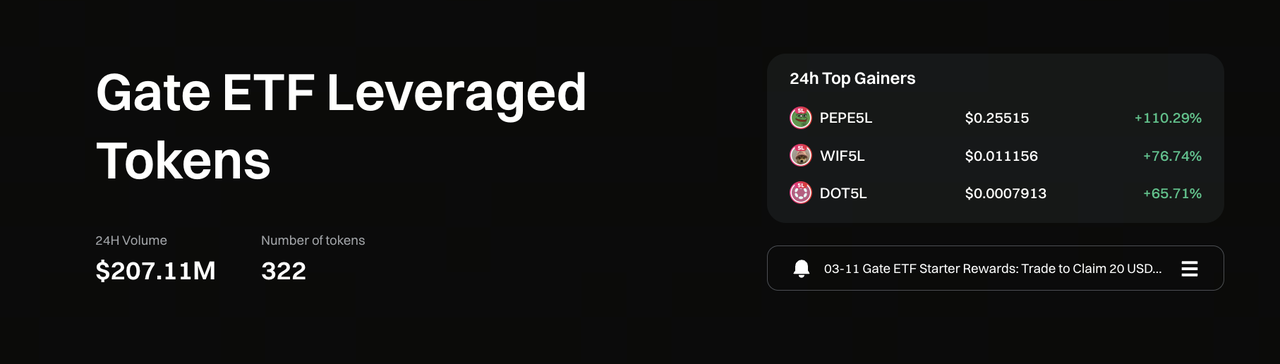
IX. Introduction to Gate ETF
Source: Gate ETF Page
Product definition
Leveraged ETF (also known as leveraged token or ETF Leveraged Token) is a platform-managed tokenized leverage product that can be traded in spot markets. The goal is to provide holders with fixed multiple long/short exposure (e.g., 3x or 5x) without directly holding or operating contracts.
Operation mechanism
- These products correspond to strategic positions established by the platform in perpetual contract markets. The fund manager dynamically adjusts contract positions via programmatic strategies to maintain target leverage multiples (including expanding positions during gains and shrinking during losses).
- Position holders do not need to open contracts themselves, add margin, or bear liquidation risk directly; the product maintains leveraged exposure through automatic rebalancing.
Fees and settlement
- Trading resembles spot matching—simply buy or sell tokens to enter or exit positions; platforms typically charge management/maintenance fees (some documents show daily rates such as a 0.1% daily management fee—actual rates per platform announcements).
Advantages (why adopted)
- No need for margin or forced liquidation allows market participants unfamiliar with contract operations to easily gain leveraged exposure; trading experience is similar to spot markets.
- Centralized management and automatic hedging by the platform reduce users’ complexity and operational risk in managing leverage.
Main risks and considerations
- Volatility decay: In highly volatile or choppy markets, daily rebalancing causes net asset value to diverge from theoretical leverage multiples. Long-term holding may result in significant tracking errors or net value erosion. This makes leveraged ETFs more suitable for short-term speculation or hedging rather than long-term investment.
- Although there is no “liquidation” mechanism, rebalancing/hedging costs, management fees, and slippage still erode returns. In extreme conditions, rebalancing operations may increase short-term volatility in underlying markets (the product itself may exert buy/sell pressure on spot/contract markets).
Labeling and naming conventions
Common names like BTC3L / BTC3S—prefix indicates underlying asset (BTC), numbers and suffixes indicate target leverage multiple and direction (L = long, S = short). They can be seen as “leveraged spot tokens,” but their net value behavior depends on daily or trigger-based rebalancing.
Applicable scenarios
- Short-term amplification of a specific view (short-term speculation or hedging)
- Accounts wanting leveraged exposure without contract operation or unfamiliarity with contracts
Should not be used as long-term buy-and-hold tools.
Course Summary
With the development of derivatives markets, multiple leveraged trading tools have emerged in the crypto space—including margin trading, perpetual contracts, and leveraged ETFs. These tools amplify capital scale and improve market efficiency while also intensifying market volatility.
Different leverage tools have distinct operation methods and risk structures. Among them, perpetual contracts have become the most important trading product in today’s crypto market; leveraged ETFs offer traders a more automated leverage tool.
The next lesson will further analyze a key mechanism in the crypto market—liquidation mechanism. This mechanism plays a crucial role in leveraged trading environments and has far-reaching effects on market price fluctuations.