This comprehensive guide evaluates whether HumidiFi (WET), Solana's largest decentralized exchange by volume, represents a viable investment opportunity. As of January 2026, WET trades at $0.11505 with a $26.46 million market capitalization, processing over $1 billion daily trading volume representing 35% of Solana's spot DEX activity. The analysis examines WET's price history, revealing a peak of $0.34 in December 2025 followed by significant correction to $0.105. Core investment factors include fixed tokenomics (1 billion max supply with 23% circulating), proprietary AMM technology delivering institutional-grade execution, and strong ecosystem integration. Price forecasts range from conservative ($0.1071-$0.1140 in 2026) to optimistic scenarios ($0.1829-$0.2147 by 2031). The guide provides tailored investment strategies for conservative to professional investors, comprehensive risk management frameworks, and addresses regulatory, technical, and market risks. Suitable for investors seeking DEX token exposure
Introduction: HumidiFi (WET) Investment Position and Market Outlook
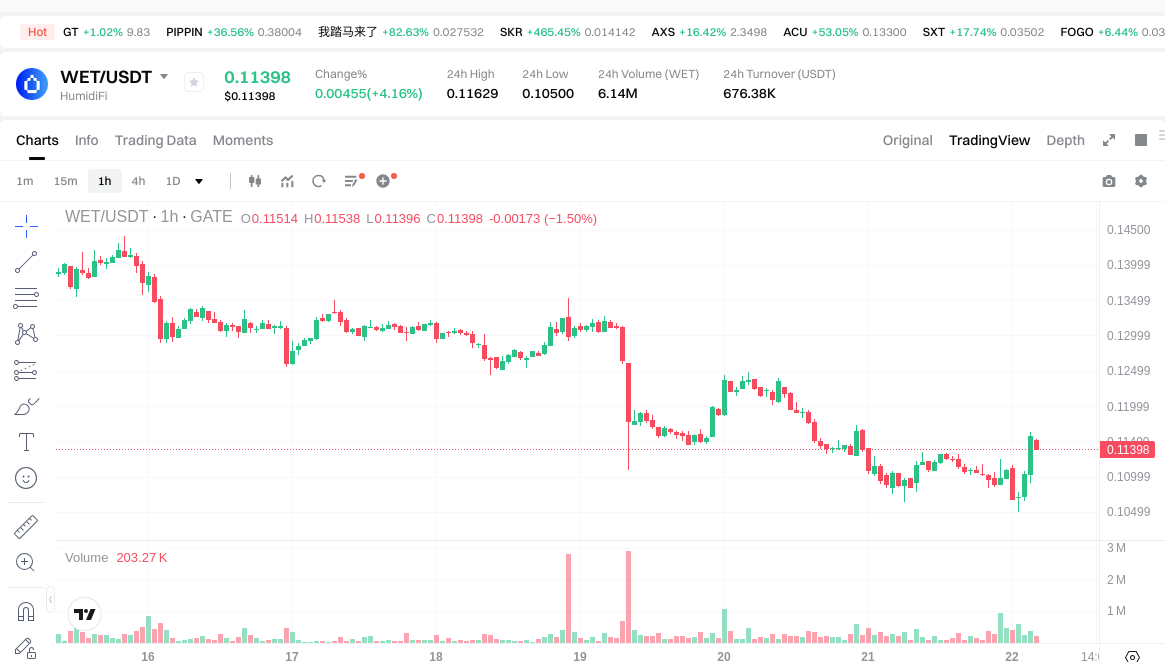
WET is a notable asset in the cryptocurrency sector. As of January 22, 2026, HumidiFi holds a market capitalization of approximately $26.46 million, with a circulating supply of around 230 million tokens. The current price stands at approximately $0.11505. Positioned as Solana's largest decentralized exchange (DEX) by volume, processing over $1 billion in daily trading volume—representing roughly 35% of all spot DEX activity on the chain—HumidiFi has drawn attention from investors evaluating "Is HumidiFi (WET) a good investment?" This article provides a comprehensive analysis of WET's investment characteristics, historical performance, future price considerations, and associated investment risks to serve as a reference for investors.
I. WET Price History Review and Investment Value Status
Based on available data, HumidiFi (WET) was published in January 2025. The token reached a peak price of $0.34 on December 10, 2025, before experiencing a significant decline to $0.105 on January 21, 2026, representing a substantial price correction during this period.
Current WET Investment Market Status (January 2026)
- WET current price: $0.11505
- 24-hour trading volume: $668,708.37
- 24-hour price change: +6.45%
- 7-day price change: -17.91%
- 30-day price change: -52.90%
- Circulating supply: 230,000,000 WET (23% of total supply)
- Market capitalization: $26,461,500
- Fully diluted valuation: $115,050,000
- Market dominance: 0.0036%
- Number of holders: 6,102
- Listed on 25 exchanges
Click to view real-time WET market price
II. Core Factors Affecting Whether WET is a Good Investment (Is HumidiFi(WET) a Good Investment)
Supply Mechanism and Scarcity (WET investment scarcity)
-
Fixed Supply Mechanism → Impacts Price and Investment Value
HumidiFi (WET) has a maximum supply of 1,000,000,000 tokens, with a current circulating supply of 230,000,000 tokens, representing 23% of the total supply. This fixed supply model creates potential scarcity dynamics, though the low circulating ratio indicates a significant portion of tokens remains to be released, which could influence future price movements.
-
Historical Price Patterns
WET has experienced notable price volatility since its launch in December 2025. The token reached a price peak of $0.34 on December 10, 2025, before declining to a low of $0.105 on January 21, 2026. As of January 22, 2026, the token trades at $0.11505, showing a recovery of 6.45% in the past 24 hours. These price fluctuations reflect market response to supply dynamics and overall market conditions.
-
Investment Significance
The gradual release of the remaining 77% of WET tokens will be a critical factor for investors to monitor. While scarcity can support long-term value, the pace and manner of future token unlocks will significantly impact supply-demand equilibrium and price stability.
Institutional Investment and Mainstream Adoption (Institutional investment in WET)
-
Market Position and Trading Volume
HumidiFi has established itself as a significant player in the Solana ecosystem, processing over $1 billion in daily trading volume, which accounts for approximately 35% of all spot DEX activity on the Solana network. This substantial market share indicates strong user adoption and liquidity, though specific institutional holding data is not available in the reference materials.
-
Exchange Listings and Accessibility
WET is currently listed on 25 exchanges, with trading support on major platforms. This broad accessibility enhances its potential for institutional and retail participation, providing multiple entry points for different types of investors.
-
Policy and Regulatory Considerations
As a decentralized exchange token operating within the broader cryptocurrency regulatory landscape, WET's investment outlook may be influenced by evolving regulations affecting DeFi protocols and digital assets. Investors should monitor regulatory developments that could impact decentralized trading platforms.
Macroeconomic Environment's Impact on WET Investment
-
Monetary Policy Sensitivity
As a crypto asset, WET's performance may be affected by broader macroeconomic conditions, including changes in monetary policy and interest rates. During periods of tightening monetary policy, risk assets like cryptocurrencies may face headwinds, while accommodative policies could support investment flows into the crypto sector.
-
Risk Asset Correlation
WET's recent performance shows significant volatility, with a 30-day decline of 52.90%, suggesting sensitivity to broader market sentiment and risk appetite. Investors should consider WET's correlation with traditional risk assets and the overall cryptocurrency market when assessing its role in portfolio allocation.
-
Market Uncertainty Response
During periods of heightened market uncertainty, investor appetite for higher-risk assets like WET may fluctuate. The token's performance across different timeframes (1H: +5.06%, 7D: -17.91%, 30D: -52.90%) demonstrates responsiveness to changing market conditions and investor sentiment.
Technology and Ecosystem Development (Technology & Ecosystem for WET investment)
-
Proprietary AMM Innovation
HumidiFi distinguishes itself through its "proprietary AMM" (prop AMM) model, which combines on-chain execution with institutional-grade market-making logic. This technological approach aims to deliver tighter spreads, deeper liquidity, and superior execution compared to traditional automated market makers and competing exchanges, potentially enhancing the platform's competitive position and long-term value proposition.
-
Solana Ecosystem Integration
Operating on the Solana blockchain, HumidiFi benefits from the network's high-speed, low-cost transaction capabilities. The token follows the SPL standard and has attracted 6,102 holders as of the latest data. The platform's deep integration within the Solana DeFi ecosystem positions it to capitalize on the growth of decentralized finance applications on this blockchain.
-
Platform Performance and Competitive Position
HumidiFi's ability to capture 35% of Solana's spot DEX trading volume demonstrates strong product-market fit and user preference for its trading infrastructure. The platform's focus on execution quality and liquidity provision represents key differentiators that could support sustained ecosystem growth and token utility, though investors should assess how these technological advantages translate into long-term investment value.
III. WET Future Investment Forecast and Price Outlook (Is HumidiFi(WET) worth investing in 2026-2031)
Short-term Investment Forecast (2026, short-term WET investment outlook)
- Conservative Forecast: $0.1071 - $0.1140
- Neutral Forecast: $0.1140 - $0.1219
- Optimistic Forecast: $0.1219 - $0.1280
Mid-term Investment Outlook (2027-2029, mid-term HumidiFi(WET) investment forecast)
-
Market Phase Expectation: WET may experience gradual growth as HumidiFi continues to maintain its position as a leading DEX on Solana. The proprietary AMM model could attract more institutional participants seeking improved execution quality.
-
Investment Return Forecast:
- 2027: $0.0956 - $0.1640
- 2028: $0.0945 - $0.1804
- 2029: $0.0996 - $0.2234
-
Key Catalysts: Expansion of DEX market share on Solana, adoption of institutional-grade trading infrastructure, evolution of DeFi protocols, and broader ecosystem development.
Long-term Investment Outlook (Is HumidiFi a good long-term investment?)
- Base Scenario: $0.1133 - $0.2055 (assuming steady protocol adoption and sustained market presence through 2030)
- Optimistic Scenario: $0.1829 - $0.2147 (assuming increased institutional adoption and favorable regulatory environment through 2031)
- Risk Scenario: Below $0.0945 (under conditions of intensified competition, technological challenges, or adverse market conditions)
View WET long-term investment and price prediction: Price Prediction
2026-2031 Long-term Outlook
- Base Scenario: $0.1133 - $0.2055 (corresponding to steady progress and stable mainstream application growth)
- Optimistic Scenario: $0.1829 - $0.2147 (corresponding to large-scale adoption and favorable market environment)
- Transformative Scenario: Above $0.2234 (assuming breakthrough ecosystem developments and mainstream adoption)
- 2031-12-31 Predicted High: $0.2147 (based on optimistic development assumptions)
Disclaimer: Price predictions are based on historical data analysis and market modeling. Cryptocurrency investments carry significant risks. Past performance does not guarantee future results. This information is for reference purposes only and should not be considered investment advice.
| Year |
Predicted High Price |
Predicted Average Price |
Predicted Low Price |
Price Change |
| 2026 |
0.1219586 |
0.11398 |
0.1071412 |
0 |
| 2027 |
0.163977327 |
0.1179693 |
0.095555133 |
2 |
| 2028 |
0.18044584128 |
0.1409733135 |
0.094452120045 |
22 |
| 2029 |
0.2233863125721 |
0.16070957739 |
0.0996399379818 |
39 |
| 2030 |
0.205491301129723 |
0.19204794498105 |
0.113308287538819 |
66 |
| 2031 |
0.214671192899817 |
0.198769623055386 |
0.182868053210955 |
72 |
IV. HumidiFi Investment Strategy and Risk Management (How to invest in DEX tokens)
Investment Methodology (HumidiFi investment strategy)
-
Long-term Holding (HODL WET): Suitable for conservative investors
Long-term holders may consider accumulating WET tokens during market corrections, focusing on the protocol's fundamental growth metrics such as daily trading volume, total value locked (TVL), and ecosystem adoption. Given HumidiFi's reported position as a leading DEX on Solana with substantial daily volumes, steady accumulation could align with the platform's long-term development trajectory.
-
Active Trading: Relying on technical analysis and swing trading
Active traders can leverage WET's price volatility for short-term opportunities. Technical indicators, support and resistance levels, and market sentiment analysis may inform entry and exit points. Traders should monitor liquidity conditions, trading volumes, and broader Solana ecosystem trends to optimize timing.
Risk Management (Risk management for WET investment)
-
Asset Allocation Ratio: Conservative / Aggressive / Professional investors
- Conservative investors: Allocate 1-5% of portfolio to WET, prioritizing capital preservation
- Aggressive investors: May allocate 5-15%, accepting higher volatility for potential returns
- Professional investors: Could consider 10-20% allocation with active hedging strategies
-
Risk Hedging Solutions: Multi-asset portfolios + hedging instruments
Diversification across multiple blockchain ecosystems (Ethereum, Solana, Layer 2 solutions) can mitigate protocol-specific risks. Investors may also consider stablecoin positions or derivatives to hedge against adverse price movements.
-
Secure Storage: Hot and cold wallets + hardware wallet recommendations
- Cold storage: Hardware wallets (Ledger, Trezor) for long-term holdings
- Hot wallets: Reputable software wallets for active trading needs
- Multi-signature solutions: For institutional or large holdings
Always verify contract addresses before transactions and enable two-factor authentication on exchange accounts.
V. HumidiFi Investment Risks and Challenges (Risks of investing in DEX tokens)
-
Market Risks: High volatility and potential price manipulation
WET has experienced notable price fluctuations, with reported 30-day changes showing significant downward movement. The token market remains subject to sudden liquidity shifts, whale activities, and broader crypto market sentiment. Investors should be prepared for substantial short-term price swings.
-
Regulatory Risks: Policy uncertainty across different jurisdictions
Decentralized exchanges and associated tokens face evolving regulatory frameworks globally. Changes in securities classification, tax treatment, or operational restrictions could impact WET's utility and valuation. Investors should stay informed about regulatory developments in their jurisdictions and where the protocol operates.
-
Technical Risks: Network security vulnerabilities and upgrade failures
As a Solana-based protocol, HumidiFi depends on the underlying blockchain's security and performance. Potential risks include smart contract vulnerabilities, network congestion, validator issues, or failed protocol upgrades. The proprietary AMM model, while offering potential advantages, may carry implementation risks that differ from battle-tested traditional AMM designs.
VI. Conclusion: Is DEX token a Good Investment?
-
Investment Value Summary: WET presents potential opportunities tied to HumidiFi's reported position as a leading Solana DEX, but faces considerable short-term price volatility and multiple risk factors.
-
Investor Recommendations:
✅ Beginners: Dollar-cost averaging approach + secure wallet storage, starting with small allocations to understand market dynamics
✅ Experienced investors: Swing trading strategies + diversified portfolio allocation, actively monitoring protocol metrics and market conditions
✅ Institutional investors: Strategic long-term positioning with comprehensive due diligence and risk management frameworks
⚠️ Disclaimer: Cryptocurrency investments carry substantial risk, including potential loss of principal. This content is for informational purposes only and does not constitute investment advice. Conduct thorough research and consult qualified financial advisors before making investment decisions.
VII. FAQ
Q1: What is HumidiFi (WET) and what makes it different from other DEX tokens?
HumidiFi (WET) is the native token of Solana's largest decentralized exchange by volume, processing over $1 billion in daily trading volume—representing approximately 35% of all spot DEX activity on the Solana network. What distinguishes HumidiFi from other DEX protocols is its proprietary AMM (automated market maker) model, which combines on-chain execution with institutional-grade market-making logic to deliver tighter spreads, deeper liquidity, and superior execution quality compared to traditional AMMs. As of January 22, 2026, WET has a market capitalization of approximately $26.46 million with 230 million tokens in circulation (23% of total supply), and is listed on 25 exchanges with 6,102 holders.
Q2: What are the main risks associated with investing in WET?
The primary risks include: (I) Market Risk – WET has experienced significant volatility, declining 52.90% over 30 days and reaching a low of $0.105 on January 21, 2026, after peaking at $0.34 in December 2025; (II) Supply Risk – with only 23% of tokens currently in circulation, the remaining 77% token unlock schedule could create substantial selling pressure; (III) Regulatory Risk – evolving DeFi regulations could impact DEX operations and token utility; (IV) Technical Risk – dependencies on Solana network performance and potential smart contract vulnerabilities in the proprietary AMM model. Investors should allocate only capital they can afford to lose and implement proper risk management strategies.
Q3: How should different types of investors approach WET investment?
Investment approaches vary by investor profile: Conservative investors should consider allocating 1-5% of their portfolio to WET, employing dollar-cost averaging strategies and focusing on long-term holding in secure cold storage (hardware wallets). Aggressive investors may allocate 5-15%, utilizing active trading strategies based on technical analysis and market sentiment, while maintaining positions in hot wallets for flexibility. Professional investors could consider 10-20% allocation with comprehensive hedging strategies, multi-signature security solutions, and active monitoring of protocol metrics such as daily trading volume, TVL, and ecosystem adoption rates. All investors should diversify across multiple blockchain ecosystems to mitigate protocol-specific risks.
Q4: What is the price outlook for WET in the short-term and long-term?
Short-term (2026) forecasts range from conservative ($0.1071-$0.1140) to optimistic ($0.1219-$0.1280) scenarios. Mid-term projections show: 2027 ($0.0956-$0.1640), 2028 ($0.0945-$0.1804), and 2029 ($0.0996-$0.2234). Long-term outlook through 2031 presents a base scenario of $0.1133-$0.2055 assuming steady protocol adoption, and an optimistic scenario of $0.1829-$0.2147 under favorable conditions including increased institutional adoption. The 2031 predicted high is $0.2147. However, these forecasts are based on historical data modeling and carry significant uncertainty. Cryptocurrency markets are highly volatile, and past performance does not guarantee future results. Investors should not rely solely on price predictions when making investment decisions.
Q5: What factors could drive WET's value appreciation?
Several key catalysts could support WET's value: (I) Market Position Expansion – maintaining or growing HumidiFi's 35% share of Solana DEX volume; (II) Institutional Adoption – the proprietary AMM's institutional-grade execution quality may attract professional trading firms and larger capital deployments; (III) Ecosystem Growth – expansion of Solana's DeFi ecosystem and increased DEX activity; (IV) Technological Advantages – successful demonstration of superior execution quality and liquidity provision compared to competitors; (V) Macroeconomic Environment – accommodative monetary policies and increased risk appetite could drive capital flows into DeFi tokens. Conversely, investors should monitor competition from other DEXs, potential technological challenges, and broader market sentiment shifts that could negatively impact valuation.
Q6: How can investors securely store and manage their WET holdings?
Proper security practices are essential for WET storage: For long-term holdings, use cold storage solutions such as hardware wallets (Ledger or Trezor) to minimize exposure to online threats. For active trading, utilize reputable software wallets that support SPL tokens (Solana's token standard), ensuring two-factor authentication is enabled. For institutional or large holdings, implement multi-signature wallet solutions requiring multiple approvals for transactions. Always verify the official WET contract address before executing transactions to avoid scams. When using exchanges, enable all available security features including withdrawal whitelisting and anti-phishing codes. Never share private keys or seed phrases, and maintain backups in secure, separate physical locations. Regularly review wallet activity and update security software to protect against emerging threats.
Q7: What metrics should investors monitor when evaluating WET investment?
Key performance indicators include: (I) Trading Metrics – daily trading volume relative to the $1 billion baseline, market share percentage of Solana DEX activity, and 24-hour volume trends; (II) Token Economics – circulating supply changes, token unlock schedules, holder count progression (currently 6,102), and distribution patterns; (III) Protocol Health – total value locked (TVL), liquidity depth, execution quality metrics, and user retention rates; (IV) Market Position – exchange listings (currently 25), market capitalization ranking, and competitive positioning versus other Solana DEXs; (V) Ecosystem Indicators – Solana network activity, broader DeFi growth trends, and institutional participation signals. Combining on-chain data, protocol metrics, and market sentiment analysis provides a comprehensive view for informed investment decisions.
Q8: Is WET suitable for beginners in cryptocurrency investment?
WET carries characteristics that make it challenging for beginners. As a DEX token with significant volatility (52.90% decline over 30 days), limited price history (launched in January 2025), and relatively low market capitalization ($26.46 million), it presents higher risks compared to established cryptocurrencies. However, beginners interested in WET should: (I) Start Small – allocate only 1-3% of investment capital they can afford to lose entirely; (II) Educate First – understand DEX mechanics, Solana ecosystem, and token economics before investing; (III) Use Dollar-Cost Averaging – spread purchases over time rather than lump-sum investment to reduce timing risk; (IV) Secure Storage – immediately transfer tokens to personal wallets rather than keeping on exchanges; (V) Monitor Regularly – stay informed about protocol developments and market conditions. Beginners should prioritize learning and risk management over potential returns, and consider consulting financial advisors before entering this investment category.
* The information is not intended to be and does not constitute financial advice or any other recommendation of any sort offered or endorsed by Gate.