Mantle (MNT) serves as a Layer 2 scaling solution with substantial ecosystem backing, trading at $0.9633 as of January 2026 with a $3.13 billion market capitalization. The project's $4.3 billion treasury funds core products—Mantle Network, mETH Protocol, and FBTC—positioning it as an on-chain banking infrastructure. Key investment factors include controlled token supply (52.3% circulation rate), institutional partnerships with stablecoin providers, and strategic treasury management supporting ecosystem growth. Current market data shows mixed signals: 24-hour trading volume of $3.74 million indicates moderate activity, while recent price changes (-14.14% over 7 days, -26.77% over 30 days) reflect volatility. This analysis examines MNT's investment potential across conservative to optimistic scenarios, comprehensive risk management strategies including asset allocation guidance, and primary challenges encompassing market volatility, regulatory uncertainty, and technical execution risks. Investors should evaluat
Introduction: Mantle (MNT) Investment Position and Market Outlook
MNT is a significant asset in the cryptocurrency sector, launched in July 2023, and has achieved notable progress in building a sustainable hub for on-chain finance. As of January 2026, Mantle holds a market capitalization of approximately $3.13 billion, with a circulating supply of around 3.25 billion tokens, and the current price stands at approximately $0.9633. Positioned as a blockchain-powered platform for next-generation banking through its core products—Mantle Network, mETH Protocol, and FBTC—Mantle has gradually become a focal point for investors discussing "Is Mantle (MNT) a good investment?" The project is anchored by the Mantle Treasury, which holds over $4.3 billion in assets and supports core product development alongside asset partners such as Agora AUSD, Ethena USDe, Ondo USDY, and EigenLayer restaking. This article will comprehensively analyze Mantle's investment value, historical price trends, future price predictions, and investment risks to provide reference for investors.
I. Mantle (MNT) Price History Review and Current Investment Value Status
- 2023: Token launch in July → Initial trading price at $0.25, with early investors experiencing fluctuations as the market established price discovery
- 2025: Market expansion phase → MNT price movements reflected broader ecosystem developments, with notable activity in the Mantle Network infrastructure
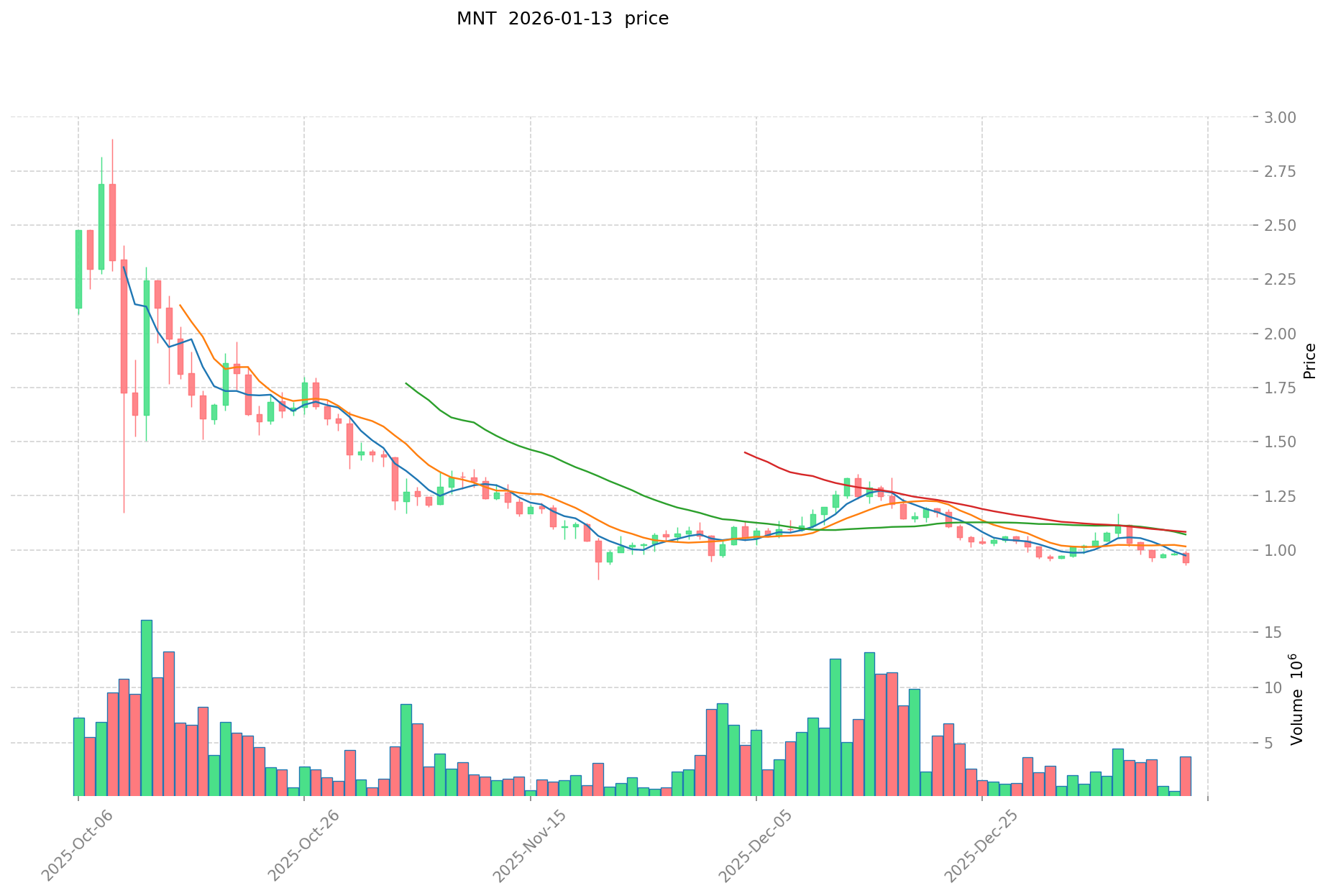
- Historical range: Price movements observed between lower levels around $0.0658 and upper ranges near $2.9
Current MNT Investment Market Status (January 2026)
- MNT current price: $0.9633
- Market sentiment (Fear & Greed Index): Data shows mixed sentiment indicators as the token navigates current market conditions
- 24-hour trading volume: $3.74 million, indicating moderate trading activity
- Institutional investor positions: Market participants continue monitoring Mantle Treasury holdings, which comprise over $4.3 billion in ecosystem assets
Click to view real-time MNT market price
II. Core Factors Affecting Whether MNT is a Good Investment (Is Mantle(MNT) a Good Investment)
Supply Mechanism and Scarcity (MNT investment scarcity)
- Supply Structure → Influences price and investment value
- Total supply: 6,219,316,794.89 MNT
- Circulating supply: 3,252,944,055.636841 MNT (approximately 52.30% of total supply)
- Market cap to fully diluted valuation ratio: 52.3%, indicating a moderate level of token circulation
- Investment Significance: The controlled supply structure and circulation ratio may provide fundamental support for long-term investment considerations, though market dynamics remain subject to broader ecosystem developments
Institutional Investment and Mainstream Adoption (Institutional investment in MNT)
- Treasury-Backed Liquidity: Mantle Treasury, described as the largest community-owned treasury in the ecosystem, holds over $4.3 billion in assets, which actively funds core product development
- Strategic Partnerships: Collaboration with asset partners including Agora AUSD, Ethena USDe, Ondo USDY, and EigenLayer restaking enhances sustainable yield, liquidity depth, and financial utility on the Mantle Network
- Ecosystem Positioning: Building the on-chain finance hub through core products (Mantle Network, mETH Protocol, and FBTC) aims to bridge traditional finance and decentralized finance
Macroeconomic Environment Impact on MNT Investment
- Market Performance Context: As of January 13, 2026, MNT trades at $0.9633, representing a 1.79% increase over 24 hours, though showing declines of 14.14% over 7 days and 26.77% over 30 days
- Broader Market Dynamics: Cryptocurrency investment attractiveness may fluctuate with changes in monetary policy, interest rate adjustments, and global economic uncertainty
- Risk Considerations: Price volatility patterns suggest sensitivity to market-wide trends and macroeconomic conditions
Technology and Ecosystem Development (Technology & Ecosystem for MNT investment)
- Core Products: Development focus on Mantle Network, mETH Protocol, and FBTC aims to leverage blockchain's transformative capabilities for next-generation banking solutions
- Financial Infrastructure: Integration of asset partners and treasury-backed development funding seeks to enhance network utility and liquidity depth
- Ecosystem Growth: The expansion into real-world assets (RWA) and partnerships with various financial protocols may contribute to long-term value propositions, though actual outcomes depend on adoption rates and execution
III. MNT Future Investment Forecast and Price Outlook (Is Mantle(MNT) worth investing in 2026-2031)
Short-term Investment Forecast (2026, short-term MNT investment outlook)
- Conservative Forecast: $0.69 - $0.79
- Neutral Forecast: $0.88 - $0.97
- Optimistic Forecast: $1.04 - $1.17
Mid-term Investment Outlook (2027-2028, mid-term Mantle(MNT) investment forecast)
-
Market Phase Expectation: MNT may experience moderate volatility as the Layer 2 ecosystem continues to evolve. The token's performance could be influenced by network adoption rates, transaction volume growth, and competitive positioning within the Ethereum scaling solutions landscape.
-
Investment Return Forecast:
- 2027: $0.75 - $1.45
- 2028: $1.06 - $1.33
-
Key Catalysts: Network upgrade implementations, expansion of DeFi protocols on Mantle Network, growth in mETH Protocol adoption, strategic partnerships with asset providers, and overall market sentiment toward Layer 2 solutions.
Long-term Investment Outlook (Is MNT a good long-term investment?)
- Base Scenario: $1.03 - $1.66 (assuming steady ecosystem development and moderate market conditions)
- Optimistic Scenario: $1.49 - $2.14 (assuming accelerated adoption and favorable regulatory environment)
- Risk Scenario: $0.96 - $1.34 (under challenging market conditions or intensified competition)
Click to view MNT long-term investment and price forecast: Price Prediction
2026-2031 Long-term Outlook
- Base Scenario: $0.95 - $1.57 USD (corresponding to steady progress and gradual mainstream application growth)
- Optimistic Scenario: $1.29 - $2.14 USD (corresponding to large-scale adoption and favorable market environment)
- Transformative Scenario: Above $2.14 USD (if the ecosystem achieves breakthrough developments and mainstream adoption)
- 2031-12-31 Forecast High: $2.14 USD (based on optimistic development assumptions)
Disclaimer: Cryptocurrency markets are highly volatile and unpredictable. These forecasts are based on historical data patterns and statistical models, which do not guarantee future performance. Market conditions, technological developments, regulatory changes, and competitive dynamics may significantly impact actual outcomes. Investors should conduct thorough research and consider their risk tolerance before making investment decisions.
| Year |
Predicted High Price |
Predicted Average Price |
Predicted Low Price |
Price Change |
| 2026 |
1.167287 |
0.9647 |
0.694584 |
0 |
| 2027 |
1.44975116 |
1.0659935 |
0.74619545 |
10 |
| 2028 |
1.3333446698 |
1.25787233 |
1.0566127572 |
30 |
| 2029 |
1.68429104987 |
1.2956084999 |
0.958750289926 |
34 |
| 2030 |
1.65384425012235 |
1.489949774885 |
1.02806534467065 |
54 |
| 2031 |
2.137779937004998 |
1.571897012503675 |
1.336112460628123 |
63 |
IV. Mantle Investment Strategy and Risk Management (How to invest in crypto assets)
Investment Methodology (Mantle investment strategy)
Long-term Holding (HODL Mantle)
For conservative investors seeking steady exposure to the Mantle ecosystem, a long-term holding strategy may be considered. This approach involves accumulating MNT tokens during market corrections and maintaining positions through market cycles. Given Mantle's focus on building sustainable on-chain financial infrastructure through its core products—Mantle Network, mETH Protocol, and FBTC—investors following this strategy typically evaluate the project's fundamental development progress, ecosystem growth metrics, and treasury management effectiveness. The Mantle Treasury, holding over $4.3 billion in assets, provides a foundational layer of financial stability that may support long-term value proposition.
Active Trading Strategy
Active traders may employ technical analysis and swing trading approaches to capitalize on MNT's price movements. Historical data shows the token has experienced significant volatility, with an all-time high of $2.9 (October 2025) and an all-time low of $0.0658 (July 2023). Current price action indicates a 24-hour change of 1.79%, with trading volume reaching approximately $3.74 million. Technical traders typically monitor key support and resistance levels, moving averages, and trading volume patterns to identify entry and exit points. The token's circulating supply represents approximately 52.3% of the maximum supply, which may influence supply-side dynamics.
Risk Management (Risk management for Mantle investment)
Asset Allocation Ratios
Conservative Investors: May consider allocating 2-5% of their crypto portfolio to MNT, maintaining majority positions in established assets while gaining measured exposure to Layer 2 infrastructure projects.
Moderate Investors: Could allocate 5-10% to MNT as part of a diversified crypto portfolio, balancing between established networks and emerging infrastructure plays.
Aggressive Investors: Might allocate 10-20% or higher to MNT, accepting increased volatility in pursuit of potentially higher returns from ecosystem growth.
Risk Hedging Approaches
Multi-asset portfolio construction remains fundamental to managing crypto-specific risks. Investors may consider:
- Diversifying across different blockchain ecosystems and Layer 2 solutions
- Maintaining positions in stablecoins for liquidity management
- Utilizing derivatives or hedging instruments where available on supporting platforms
- Regular portfolio rebalancing based on market conditions and risk tolerance adjustments
Secure Storage Solutions
Cold Storage: Hardware wallets such as Ledger or Trezor offer offline storage solutions for long-term holdings, minimizing exposure to online security threats.
Hot Wallets: For active traders requiring frequent access, reputable exchange wallets or software wallets with multi-factor authentication may be utilized, though with awareness of increased security considerations.
Hybrid Approach: Many investors maintain majority holdings in cold storage while keeping a smaller portion in hot wallets for trading flexibility.
MNT tokens are deployed on the Ethereum network (contract address: 0x3c3a81e81dc49a522a592e7622a7e711c06bf354), requiring compatible wallet solutions that support ERC-20 tokens.
V. Mantle Investment Risks and Challenges (Risks of investing in crypto assets)
Market Risk
MNT has demonstrated substantial price volatility, characteristic of crypto assets. Recent performance data indicates:
- 7-day price change: -14.14%
- 30-day price change: -26.77%
- 1-year price change: -15.49%
- 24-hour price range: $0.9385 - $0.9672
This volatility exposes investors to significant short-term price fluctuations. Market capitalization of approximately $3.13 billion and a market dominance of 0.18% suggests the token remains susceptible to broader crypto market movements and potential liquidity constraints during periods of market stress. The relatively modest 24-hour trading volume compared to market cap may present challenges for larger position entries or exits.
Regulatory Risk
Crypto assets face evolving regulatory frameworks across jurisdictions. Projects building financial infrastructure, such as Mantle's banking-focused approach and integration with asset partners including stablecoins (Agora AUSD, Ethena USDe, Ondo USDY), may encounter regulatory scrutiny regarding:
- Classification of digital assets and securities regulations
- Compliance requirements for decentralized finance protocols
- Cross-border transaction regulations and reporting obligations
- Evolving tax treatment of crypto transactions and holdings
Regulatory developments in major markets could materially impact project operations, token utility, and market valuation.
Technical Risk
As a blockchain infrastructure project, Mantle faces technical considerations including:
Network Security: Smart contract vulnerabilities, protocol exploits, or security breaches could compromise user funds and project credibility. The complexity of Layer 2 solutions and integration with multiple asset partners increases the attack surface.
Upgrade Execution: Protocol upgrades, network transitions, or technical roadmap delays may affect ecosystem development and user confidence. Integration risks exist when coordinating with external protocols and asset partners.
Operational Dependencies: The project's reliance on Ethereum as the base layer introduces dependencies on Ethereum network performance, security, and upgrade paths.
VI. Conclusion: Is Crypto Asset Investment Suitable?
Investment Value Summary
Mantle presents a multi-faceted infrastructure project focused on building sustainable on-chain financial systems through its network, staking protocol, and Bitcoin-backed asset. The project benefits from substantial treasury resources exceeding $4.3 billion, providing financial runway for development and ecosystem partnerships. However, recent price performance shows significant volatility, with declines across multiple timeframes (7-day: -14.14%, 30-day: -26.77%, 1-year: -15.49%), reflecting broader market conditions and potential project-specific factors.
The token's market position, with a circulating supply representing 52.3% of maximum supply and market dominance of 0.18%, suggests ongoing distribution dynamics that may influence price behavior. Trading activity across 31 exchanges provides reasonable liquidity for most retail investors, though institutional-scale positions may require careful execution.
Investor Recommendations
✅ Beginners: Consider dollar-cost averaging (DCA) strategies to mitigate timing risk, focusing on secure storage solutions such as hardware wallets for holdings. Prioritize education on crypto fundamentals and risk management before establishing positions.
✅ Experienced Investors: May employ swing trading tactics during volatility, maintaining diversified positions across multiple Layer 2 solutions and infrastructure projects. Active monitoring of ecosystem metrics, partnership developments, and technical indicators can inform tactical allocation adjustments.
✅ Institutional Investors: Could evaluate strategic allocations within broader crypto infrastructure themes, considering Mantle's treasury strength, ecosystem partnerships, and roadmap execution. Due diligence on regulatory positioning, technical architecture, and competitive landscape remains essential.
⚠️ Disclaimer: Cryptocurrency investments carry substantial risk, including potential loss of principal. Market volatility, regulatory uncertainty, and technical risks may materially impact investment outcomes. This content provides informational analysis only and does not constitute investment advice, financial guidance, or recommendations to buy, sell, or hold any asset. Investors should conduct independent research, assess personal risk tolerance, and consult qualified financial advisors before making investment decisions.
VII. FAQ
Q1: Is Mantle (MNT) a good investment for beginners in 2026?
Mantle may be suitable for beginners who understand crypto risks and employ proper risk management strategies. As a Layer 2 infrastructure project with substantial treasury backing ($4.3 billion in assets), it presents both opportunities and challenges. The current price of $0.9633 shows significant recent volatility (-14.14% over 7 days, -26.77% over 30 days), which requires careful consideration. Beginners should start with small allocations (2-5% of crypto portfolio), utilize dollar-cost averaging to mitigate timing risks, and prioritize secure storage solutions like hardware wallets. Understanding that MNT's market dominance of 0.18% and circulating supply representing 52.3% of maximum supply indicates an evolving distribution phase is crucial before establishing positions.
Q2: What is the realistic price prediction for MNT by the end of 2026?
Based on statistical modeling and ecosystem development trajectories, MNT price forecasts for 2026 range from conservative ($0.69-$0.79), neutral ($0.88-$0.97), to optimistic ($1.04-$1.17) scenarios. The predicted high reaches approximately $1.17, with an average around $0.96. These projections factor in Mantle's core product development (Mantle Network, mETH Protocol, FBTC), treasury-backed ecosystem growth, and strategic partnerships with asset providers like Agora AUSD and EigenLayer. However, actual outcomes depend heavily on network adoption rates, broader crypto market conditions, regulatory developments, and competitive positioning within the Layer 2 landscape. Investors should note that historical volatility and recent price declines suggest significant uncertainty remains.
Q3: How does Mantle's treasury affect its investment value?
Mantle Treasury, holding over $4.3 billion in assets, represents a significant differentiator in the project's investment thesis. This substantial capital base actively funds core product development and ecosystem expansion, providing financial stability that many crypto projects lack. The treasury collaborates with asset partners including Agora AUSD, Ethena USDe, Ondo USDY, and EigenLayer restaking, enhancing sustainable yield generation, liquidity depth, and financial utility across the Mantle Network. This financial foundation may provide downside protection during market volatility and enables long-term strategic planning without immediate funding pressures. However, treasury management effectiveness, capital deployment strategies, and governance decisions regarding asset allocation remain critical factors that investors should monitor when evaluating long-term investment potential.
Q4: What are the primary risks of investing in Mantle (MNT)?
MNT investment carries three primary risk categories. First, market risk manifests through substantial price volatility, with recent performance showing -14.14% (7-day) and -26.77% (30-day) declines, alongside historical price ranges from $0.0658 to $2.9. The relatively modest 24-hour trading volume ($3.74 million) compared to market cap may create liquidity challenges for larger positions. Second, regulatory risk stems from Mantle's banking-focused approach and integration with stablecoin partners, potentially facing scrutiny regarding asset classification, DeFi compliance, cross-border regulations, and tax treatment across jurisdictions. Third, technical risk includes smart contract vulnerabilities, protocol upgrade execution challenges, security breach possibilities, and operational dependencies on Ethereum network performance. The complexity of Layer 2 solutions and multiple asset partner integrations increases the overall attack surface and coordination risks.
Q5: Should I hold MNT long-term or trade it actively?
The optimal strategy depends on individual risk tolerance, investment goals, and market analysis capabilities. Long-term holding (HODL) suits conservative investors focusing on Mantle's fundamental ecosystem development, treasury-backed stability, and infrastructure growth potential. This approach benefits from reduced transaction costs, tax efficiency in certain jurisdictions, and exposure to potential multi-year value appreciation if the project achieves mainstream adoption. Forecasts suggest possible ranges of $1.29-$2.14 by 2031 under optimistic scenarios. Conversely, active trading may suit experienced investors comfortable with technical analysis, given MNT's demonstrated volatility and price ranges. Recent 24-hour changes of 1.79% and historical fluctuations provide swing trading opportunities. However, active trading incurs higher transaction costs, tax implications, and requires continuous market monitoring. A hybrid approach—maintaining core long-term holdings while trading a smaller position—may balance exposure to both strategies.
Q6: How does MNT compare to other Layer 2 investment opportunities?
Mantle distinguishes itself through several unique characteristics within the Layer 2 ecosystem. Its $4.3 billion treasury represents the largest community-owned treasury in the space, providing exceptional financial resources for development and partnerships. The project's focus on building sustainable on-chain banking infrastructure through integrated products (Mantle Network, mETH Protocol, FBTC) differentiates it from pure scaling solutions. Strategic partnerships with established asset providers (Agora AUSD, Ethena USDe, Ondo USDY, EigenLayer) enhance financial utility and liquidity depth. However, MNT's market dominance of 0.18% and recent price performance (-15.49% over 1 year) suggest competitive challenges exist. Investors evaluating Layer 2 opportunities should compare technology maturity, adoption metrics, transaction volumes, developer activity, ecosystem diversity, and token economics across competing solutions. Diversification across multiple Layer 2 projects may provide balanced exposure to this infrastructure category.
Q7: What security measures should MNT investors implement?
MNT investors should implement multi-layered security protocols appropriate to their holding size and trading frequency. For long-term holdings, hardware wallets (Ledger, Trezor) provide offline cold storage, minimizing exposure to online threats and exchange risks. These devices should be purchased directly from manufacturers, with recovery phrases stored securely across multiple physical locations, never digitally. For active traders requiring frequent access, reputable exchange wallets with mandatory two-factor authentication (2FA), withdrawal whitelist settings, and anti-phishing codes offer enhanced protection. A hybrid approach—maintaining 70-90% of holdings in cold storage while keeping 10-30% in hot wallets for trading—balances security with operational flexibility. Given MNT's deployment on Ethereum (contract address: 0x3c3a81e81dc49a522a592e7622a7e711c06bf354), investors must use ERC-20 compatible wallets and verify contract addresses before transactions. Regular security audits of wallet software, avoiding public WiFi for transactions, and maintaining updated antivirus protection constitute essential practices.
Q8: When is the best time to invest in Mantle (MNT)?
Determining optimal entry timing requires analyzing multiple factors across technical, fundamental, and market sentiment dimensions. From a technical perspective, current price levels ($0.9633) represent substantial declines from the October 2025 all-time high ($2.9), potentially offering value opportunities for long-term investors. However, recent negative momentum (-14.14% over 7 days) suggests caution regarding immediate entries. Dollar-cost averaging strategies may prove optimal for beginners, systematically accumulating positions across various price levels to mitigate timing risk. Fundamental catalysts such as network upgrades, major partnership announcements, significant treasury deployment decisions, or ecosystem adoption milestones may create strategic entry points. Macroeconomic factors including regulatory clarity improvements, broader crypto market sentiment shifts, or institutional investment trends can influence timing decisions. Monitoring circulating supply changes (currently 52.3% of maximum supply) and exchange listing developments across the 31 platforms trading MNT provides additional context. Rather than attempting to time perfect entry points, establishing position-sizing rules aligned with risk tolerance and maintaining disciplined rebalancing schedules typically produces more consistent long-term outcomes.
* The information is not intended to be and does not constitute financial advice or any other recommendation of any sort offered or endorsed by Gate.