POL is the native token of Polygon 2.0, a leading Layer 2 scaling solution addressing Ethereum's scalability challenges through zero-knowledge technology and multi-layered architecture. This comprehensive guide examines POL's technical foundation, market dynamics, and ecosystem role. POL enables fast, low-cost transactions while maintaining Ethereum security, supporting DeFi, NFTs, and Web3 applications. As of January 2026, POL trades at $0.16011 with a market cap of $1.69 billion, demonstrating active trading volumes and community engagement. The article explores POL's decentralized consensus mechanisms, Proof of Stake validation, and cryptographic security features. It analyzes ecosystem partnerships, current challenges including regulatory risks and competitive pressures, and highlights community sentiment across social platforms. Users can purchase POL on Gate and participate in staking and governance. Despite market volatility, POL's innovative technology roadmap and strategic positioning establish it as
Polygon Ecosystem Token's Positioning and Significance
In 2021, Polygon launched Polygon Ecosystem Token (POL), aiming to address scalability limitations and high transaction costs on the Ethereum network.
As a key infrastructure token for Ethereum scaling solutions, Polygon Ecosystem Token plays a critical role in DeFi, NFT, and Web3 applications.
As of 2026, Polygon Ecosystem Token has become a prominent asset in the Layer 2 ecosystem, with an active developer community and widespread adoption across decentralized applications.
This article will provide an in-depth analysis of its technical architecture, market performance, and future potential.
Origin and Development History
Background
Polygon Ecosystem Token was created by the Polygon team in 2021, aiming to solve Ethereum's scalability challenges, including slow transaction speeds and high gas fees.
It emerged during the rapid expansion of decentralized finance and NFT markets, with the goal of providing fast, low-cost transactions while maintaining Ethereum security to transform the user experience.
The launch of Polygon Ecosystem Token brought new possibilities for developers and users seeking efficient blockchain solutions.
Key Milestones
- 2021: Initial launch as MATIC, establishing the foundation for Ethereum scaling infrastructure.
- 2024: Polygon 2.0 protocol proposal introduced, combining zero-knowledge (ZK) technology with existing protocols to create a unified Value Layer.
- 2024: Token upgrade initiative announced, transitioning from MATIC to POL to support the evolved ecosystem architecture.
- 2024: Price reached $1.5711 on April 22, marking a significant market milestone.
- 2025-2026: Continued ecosystem expansion with multi-layered network architecture and enhanced community governance mechanisms.
With support from the Polygon Foundation and its global community, Polygon Ecosystem Token continues to optimize its technology, security features, and real-world applications.
How Polygon Ecosystem Token Works
Decentralized Control
Polygon Ecosystem Token operates on a decentralized network of nodes distributed globally, independent of centralized banking or governmental control.
These nodes collaborate to validate transactions, ensuring system transparency and attack resistance, granting users greater autonomy and enhancing network resilience.
Blockchain Foundation
Polygon Ecosystem Token's blockchain is a public, immutable digital ledger that records every transaction.
Transactions are grouped into blocks and linked through cryptographic hashing to form a secure chain.
Anyone can view the records, establishing trust without intermediaries.
The protocol utilizes advanced zero-knowledge (ZK) technology and a multi-layered architecture to further enhance performance and scalability.
Ensuring Fairness
Polygon Ecosystem Token employs Proof of Stake (PoS) to validate transactions and prevent fraudulent activities such as double-spending.
Validators maintain network security by staking POL tokens and validating transactions, earning POL rewards for their contributions.
Its innovative features include energy-efficient consensus mechanisms and high transaction throughput.
Secure Transactions
Polygon Ecosystem Token uses public-private key cryptography to protect transactions:
- Private keys (similar to secret passwords) are used to sign transactions
- Public keys (similar to account numbers) are used to verify ownership
This mechanism ensures fund security while maintaining pseudonymous transaction privacy.
The system incorporates additional security features through its integration with Ethereum's security model and ZK-proof technology.
Circulating Supply Overview
As of January 14, 2026, POL has a circulating supply of 10,573,562,387.29 tokens, with a total supply of 10,573,562,387.29 tokens. The circulating supply represents approximately 102.11% of the total supply, indicating a fully circulating token model. New tokens enter the market through the protocol's ecosystem distribution mechanism, which impacts supply and demand dynamics. The token distribution follows a structured allocation scheme designed to support network development and community participation.
Price Volatility
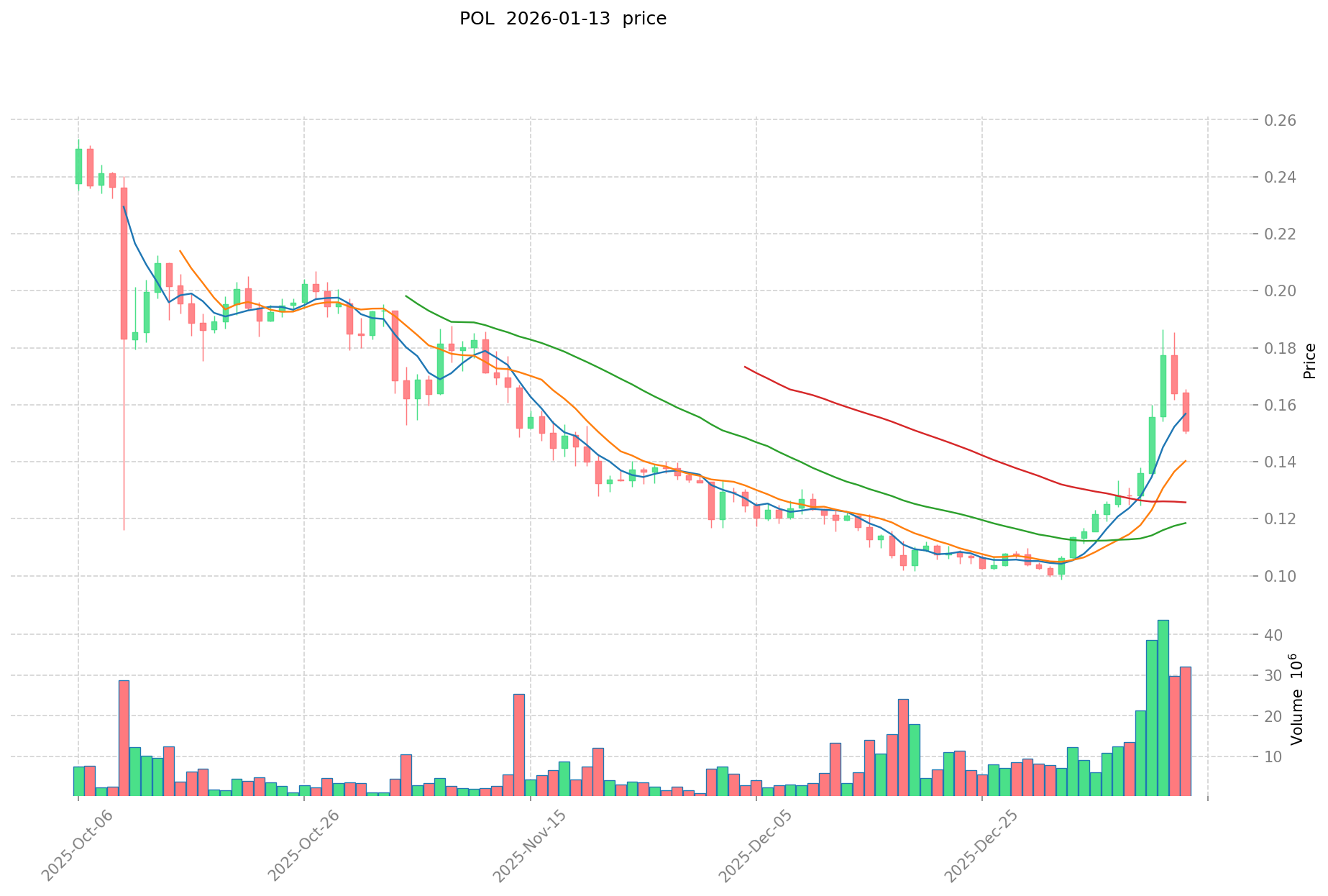
POL reached its highest price of $1.5711 on April 22, 2024, driven by favorable market conditions and increased adoption of Polygon 2.0's zero-knowledge technology solutions. The token experienced its lowest price of $0.0921 on November 16, 2023, during a period of broader market volatility. As of January 14, 2026, POL is trading at $0.16011, showing a 24-hour increase of 4.24% and a 7-day gain of 27.49%. Over the past 30 days, the token has demonstrated significant growth of 36.59%, though it has experienced a 64.32% decline over the one-year period. These price movements reflect evolving market sentiment, adoption trends of Polygon's Layer 2 scaling solutions, and the broader cryptocurrency market environment.
Click to view the current POL market price
On-Chain Metrics
- 24-Hour Trading Volume: $4,582,922.35 (indicating active market participation)
- Market Capitalization: $1,692,933,073.83 (ranking #57 among cryptocurrencies)
- Market Dominance: 0.050% (representing POL's share of the total cryptocurrency market)
- Fully Diluted Valuation: $1,692,933,073.83 (equal to current market cap due to full circulation)
Polygon Ecosystem Token Ecosystem Applications and Partners
Core Use Cases
Polygon Ecosystem Token's ecosystem supports multiple applications:
- DeFi: Projects like Uniswap and Aave operate on Polygon, providing decentralized trading and lending services.
- NFT and GameFi: Various NFT marketplaces and blockchain games leverage Polygon's infrastructure, driving innovation in digital collectibles and gaming experiences.
Strategic Partnerships
Polygon Ecosystem Token has established collaborations with various technology providers and blockchain projects, enhancing its technical capabilities and market influence.
These partnerships provide a solid foundation for POL's ecosystem expansion.
Controversies and Challenges
Polygon Ecosystem Token faces the following challenges:
- Technical Difficulties: Scalability optimization and network performance enhancement remain ongoing priorities
- Regulatory Risks: Evolving cryptocurrency regulations across different jurisdictions
- Competitive Pressure: Competition from other Layer 2 solutions and scaling technologies
These issues have sparked discussions within the community and market, while also driving POL's continuous innovation.
Polygon Ecosystem Token's community demonstrates significant activity, with growing wallet addresses and daily transaction volumes.
On X platform, related posts and hashtags (such as #POL and #Polygon) frequently gain attention.
Technical upgrades and ecosystem developments ignite community enthusiasm.
Sentiment on X shows diverse perspectives:
- Supporters praise POL's scalability improvements, zero-knowledge technology integration, and multi-layered network architecture, considering it as a key infrastructure for Ethereum scaling.
- Critics focus on price volatility, ecosystem maturity, and competition from other scaling solutions.
Recent trends show mixed sentiment with increasing interest in Polygon 2.0 developments.
Hot Topics
X users actively discuss POL's zero-knowledge technology implementation, token economics upgrade, and decentralized governance,
showcasing both its transformative potential and the challenges in achieving mainstream adoption.
- Official Website: Visit Polygon's official website for features, use cases, and latest developments.
- X Updates: On X platform, Polygon uses @0xPolygon as its official handle,
with posts covering technical upgrades, community events, and partnership announcements, generating substantial engagement from the community.
Polygon Ecosystem Token Future Roadmap
- Ongoing Development: Implementation of Polygon 2.0 architecture, enhancing network performance and scalability
- Ecosystem Goals: Expanding the range of decentralized applications and increasing user adoption
- Long-term Vision: Becoming a key value layer for Ethereum scaling and internet-scale blockchain infrastructure
How to Participate in Polygon Ecosystem Token?
- Purchase Channels: Purchase POL on Gate.com and other major exchanges
- Storage Solutions: Use hardware wallets or software wallets supporting Ethereum standards for secure storage
- Participate in Governance: Engage in community decision-making through Polygon's governance mechanisms
- Build Ecosystem: Visit developer documentation to develop DApps or contribute to the codebase
Summary
Polygon Ecosystem Token redefines blockchain scaling through innovative technology, providing enhanced scalability, zero-knowledge proofs, and seamless network integration.
Its active community, rich resources, and strong market presence make it distinctive in the cryptocurrency field.
Despite facing regulatory uncertainties and competitive pressures, POL's innovative spirit and clear roadmap position it prominently in the future of decentralized technology.
Whether you are a newcomer or an experienced participant, Polygon Ecosystem Token deserves attention and engagement.
FAQ
What is POL token and what are its main uses?
POL is the core token of Polygon 2.0, used for network transactions, staking rewards, and re-staking incentives across the multi-chain ecosystem. POL holders have governance voting rights to participate in ecosystem decisions and protocol upgrades.
How to buy and store POL tokens? Which exchanges are supported?
POL tokens can be purchased through major cryptocurrency exchanges and decentralized platforms. Store them in secure wallets like MetaMask, Ledger, or Trezor for optimal security. Always use official channels and enable two-factor authentication for account protection.
POL与其他加密货币相比有什么区别和优势?
POL is Polygon's native token with superior scalability and lower transaction costs compared to other cryptocurrencies. It offers fast transactions, strong security through smart contracts, and supports cross-chain interoperability. POL enables staking rewards and governance participation within the Polygon ecosystem.
What are the risks to pay attention to when investing in POL tokens?
POL token investments carry market volatility risks and potential for significant losses. Contract trading involves leverage that can amplify both gains and losses. Requires strong market knowledge and disciplined risk management strategies for successful trading.
POL的发行总量是多少?当前市值和流通情况如何?
POL's total supply is 10.564 billion tokens. Current market cap stands at $187.287 million with circulating supply of 10.564 billion POL, trading at $0.17729 per token.
* The information is not intended to be and does not constitute financial advice or any other recommendation of any sort offered or endorsed by Gate.