RSS3 is a decentralized content and social protocol launched by Natural Selection Labs in 2022, designed to revolutionize Web3 information distribution and social infrastructure. As of 2026, RSS3 operates through a global network of decentralized nodes, leveraging blockchain technology to enable transparent, immutable, and user-controlled content aggregation without central control. The protocol features over 22,725 token holders and maintains a market capitalization of approximately $9.9 million, with trading available on Gate and other exchanges. RSS3 addresses critical challenges in decentralized information standardization, Web3 social applications, and efficient content distribution across emerging platforms. The ecosystem encompasses strategic partnerships and multiple use cases including decentralized content indexing and social graph services. Despite facing adoption barriers and market competition, RSS3's innovative architecture and active developer community position it as a foundational layer for W
RSS3's Positioning and Significance
In 2022, Natural Selection Labs launched RSS3 (RSS3), aiming to address inefficient information aggregation and the lack of decentralized content distribution mechanisms.
As a decentralized content and social protocol, RSS3 plays a key role in information distribution and Web3 social ecosystems.
As of 2026, RSS3 has become a protocol serving decentralized information flow, with over 22,000 token holders and an active developer community.
This article will provide an in-depth analysis of its technical architecture, market performance, and future potential.
Origin and Development History
Birth Background
RSS3 was created by Natural Selection Labs in 2022, aiming to solve the challenges of information aggregation standardization and decentralized content distribution.
It emerged during the rapid expansion of Web3 infrastructure, with the goal of becoming an efficient distribution layer that handles information aggregation, storage, and rendering to transform the status quo.
The launch of RSS3 brought new possibilities to developers and users seeking decentralized information protocols.
Key Milestones
- 2022: Mainnet launch on February 11, implementing decentralized information distribution functionality.
- 2022-2024: Protocol iterations introduced enhanced information aggregation capabilities and improved standardization.
- 2024: Ecosystem expansion, with growing adoption in decentralized social and content distribution applications.
With the support of its community and Natural Selection Labs, RSS3 continues to optimize its technology, security, and real-world applications.
No Central Control
RSS3 operates on a decentralized network of nodes distributed globally, free from control by centralized entities.
These nodes collaborate to process and distribute information, ensuring system transparency and attack resistance, granting users greater autonomy and enhancing network resilience.
Blockchain Core
RSS3's architecture leverages blockchain technology as a foundation for transparent and immutable information recording.
Information flows are organized into standardized formats, cryptographically linked to ensure data integrity.
Anyone can verify records without intermediaries, establishing trust through transparency.
The protocol's design focuses on efficient information aggregation and distribution layer functionality, further enhancing performance.
Ensuring Fairness
RSS3 operates through a decentralized node network that validates information flows and maintains protocol integrity.
Node operators participate by running infrastructure and processing information distribution tasks, contributing to network security.
Its innovation includes specialized focus on information aggregation standardization and efficient content distribution.
Secure Transactions
RSS3 utilizes cryptographic technologies to protect information integrity:
- Private keys are used to authenticate data submissions
- Public verification mechanisms ensure data provenance and authenticity
This framework ensures information security while maintaining transparent and verifiable data flows.
The protocol's architecture supports standardized information processing across decentralized applications.
Circulation Overview
As of January 26, 2026, RSS3 has a circulating supply of 900,612,488.77 tokens, with a total supply of 1,026,765,267.30 tokens. The maximum supply is capped at 1,000,000,000 tokens, representing a fixed supply model. The current circulation ratio stands at approximately 90.06% of the total supply, indicating that the majority of tokens have already entered the market. The token economics influence supply and demand dynamics as new tokens gradually release into circulation through the predefined distribution mechanism.
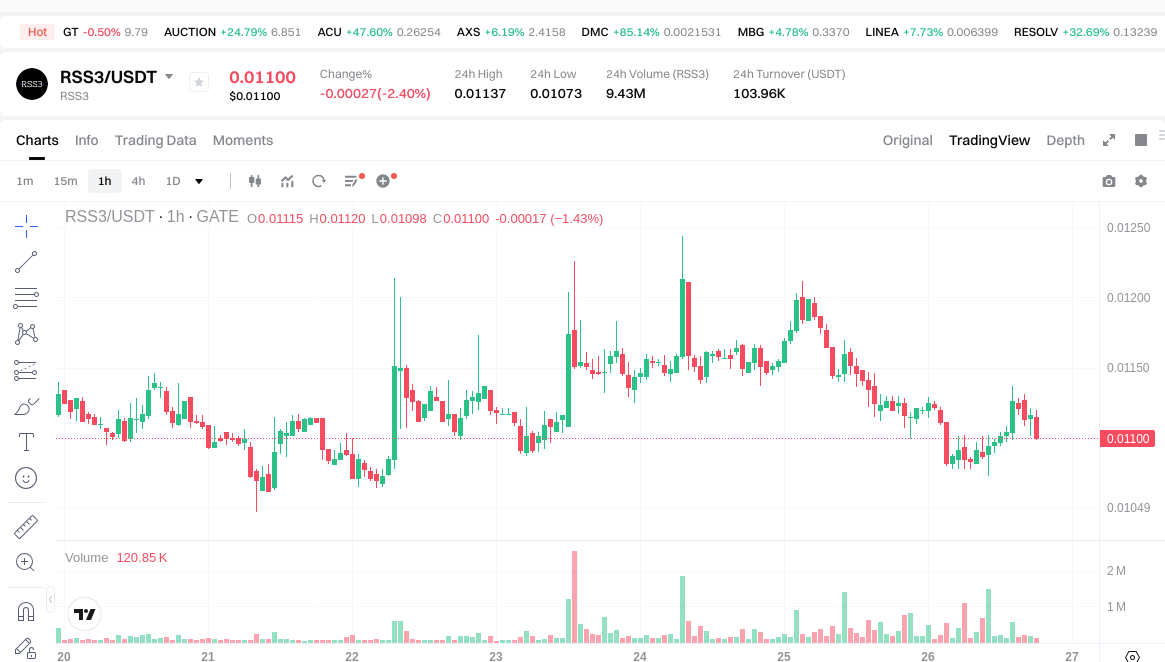
Price Volatility
RSS3 reached a notable price level of $0.687355 on February 15, 2022, driven by favorable market conditions during that period. The lowest price recorded was $0.00993351 on January 1, 2026, reflecting challenging market circumstances. As of January 26, 2026, the token trades at $0.01103, showing a -88.58% change over the past year. Recent price movements indicate a -2.48% change in the last 24 hours, with a slight positive trend of 0.91% over the past 7 days and 2.71% over the past 30 days. These fluctuations reflect evolving market sentiment, adoption trends, and external factors affecting the broader cryptocurrency ecosystem.
Click to view the current RSS3 market price
On-Chain Metrics
- 24-Hour Trading Volume: The trading volume over the past 24 hours reached $103,981.70, indicating current market activity levels for RSS3.
- Token Holders: The network has approximately 22,725 holders, reflecting the distribution and adoption of the token among users.
- Market Capitalization: The current market capitalization stands at $9,933,755.75, with a fully diluted market cap of $11,325,220.90, showing a market cap to FDV ratio of 90.06%.
RSS3 Ecosystem Applications and Partners
Core Use Cases
RSS3's ecosystem supports multiple applications:
- Decentralized Information Distribution: As a distribution layer dealing with information aggregation and standardization, RSS3 provides decentralized content indexing and social graph services.
- Web3 Social Protocol: RSS3 enables developers to build decentralized social applications with efficient information flow processing.
Strategic Partnerships
RSS3 has established collaborations to enhance its technical capabilities and market influence.
These partnerships provide a solid foundation for RSS3's ecosystem expansion.
Controversies and Challenges
RSS3 faces the following challenges:
- Technical Complexity: Maintaining efficient information aggregation and standardization across decentralized networks
- Market Competition: Competition from other Web3 social protocols and decentralized content distribution platforms
- Adoption Barriers: Encouraging developers and users to transition from traditional centralized platforms
These issues have sparked discussions within the community and market, while also driving RSS3's continuous innovation.
RSS3's community demonstrates notable activity, with 22,725 token holders as of January 26, 2026.
On X platform, related posts and hashtags (such as #RSS3) generate regular engagement.
Protocol updates and ecosystem developments fuel community enthusiasm.
Sentiment on X shows varied perspectives:
- Supporters praise RSS3's decentralized architecture and innovative approach to content distribution, viewing it as "the future of Web3 social infrastructure".
- Critics focus on market volatility and adoption challenges.
Recent trends indicate mixed sentiment reflecting broader market conditions.
Hot Topics
X users actively discuss RSS3's decentralization benefits, protocol development, and potential for mainstream Web3 adoption,
showcasing both its transformative potential and the obstacles toward widespread implementation.
- Official Website: Visit RSS3 Official Site for features, use cases, and latest updates.
- White Paper: Technical documentation detailing RSS3's architecture, objectives, and vision.
- X Updates: On X platform, RSS3 maintains an active presence through @rss3_,
with posts covering protocol upgrades, community events, and partnership announcements, generating regular engagement from the community.
RSS3 continues to develop its decentralized content and social protocol infrastructure, focusing on:
- Enhanced information aggregation capabilities and protocol optimization
- Ecosystem expansion: Supporting more decentralized applications and developers
- Long-term vision: Becoming a foundational layer for Web3 content distribution and social networking
- Purchase Options: Buy RSS3 on Gate.com and other supporting exchanges
- Storage Solutions: Use compatible wallets to securely store RSS3 tokens (contract address: 0xc98d64da73a6616c42117b582e832812e7b8d57f on Ethereum)
- Ecosystem Engagement: Explore RSS3 protocol documentation to understand its decentralized information distribution capabilities
- Development Opportunities: Visit RSS3 GitHub to contribute code or build applications
Summary
RSS3 leverages blockchain technology to redefine decentralized content and social protocols, providing transparency, decentralization, and efficient information distribution.
Its active community, available resources, and market presence make it a notable player in the Web3 infrastructure space.
Despite facing adoption challenges and market competition, RSS3's innovative approach and clear development direction position it as a significant component in the future of decentralized technology.
Whether you're new to Web3 or an experienced participant, RSS3 presents opportunities worth exploring and engaging with.
FAQ
What is RSS3 and what role does it play in Web3?
RSS3 is a decentralized information distribution protocol designed for Web3. It enables users to aggregate, own, and control their digital content across decentralized platforms. RSS3 serves as a bridge connecting Web3 applications, facilitating seamless content distribution and data interoperability while empowering users with ownership of their information.
What are the uses of RSS3 tokens and how to obtain them?
RSS3 tokens power the decentralized RSS3 network, enabling content distribution, governance participation, and staking rewards. Obtain RSS3 tokens through mining, staking, or purchasing from markets. The token's value continues appreciating as adoption grows.
What is the difference between RSS3 and traditional RSS? How does it achieve decentralized content distribution?
RSS3 replaces centralized RSS servers with blockchain and decentralized networks. Unlike traditional RSS relying on central feeds, RSS3 enables users to own and control their content through smart contracts, allowing direct peer-to-peer content distribution without intermediaries while maintaining transparency and user sovereignty.
What are the main application scenarios for RSS3?
RSS3 enables decentralized content distribution, Web3 social networks, digital asset management, and creator monetization. It powers open information feeds, cross-chain data indexing, and decentralized identity protocols for users to own and control their digital presence.
RSS3 operates on blockchain infrastructure with smart contract audits ensuring security. Like all crypto assets, it faces market volatility and regulatory changes. The protocol's decentralized architecture reduces centralized failure points, while community governance enhances long-term stability.
RSS3 is positioned to revolutionize decentralized information distribution. With growing Web3 adoption, RSS3's open protocol for content feeds and social graphs has immense potential. We anticipate significant expansion in user base, developer ecosystem, and integration with emerging dApps, positioning RSS3 as a cornerstone infrastructure layer in Web3.
* The information is not intended to be and does not constitute financial advice or any other recommendation of any sort offered or endorsed by Gate.