On traditional Web2 sports platforms, actions like browsing, liking, or sharing rarely generate measurable returns. OneFootball changes this by introducing on-chain data and token-based incentives, turning these actions into meaningful inputs for value distribution. This approach not only reshapes the significance of user participation but also offers a practical model for building a Web3 fan economy.
OneFootball’s system can be understood as a closed-loop model, following a core path: user behavior → data recording → points (BALLS) → OFC distribution → ecosystem usage.
Within this flow, every user interaction is recorded and used to assess engagement levels. The platform quantifies these actions through its points system, then distributes OFC tokens periodically based on each user’s proportional contribution.
The key lies in transforming user behavior into comparable and distributable value metrics, forming a participation-driven economic cycle.
Users typically begin by registering and creating an account. This process may combine a traditional account system with a blockchain address, effectively bridging Web2 and Web3.
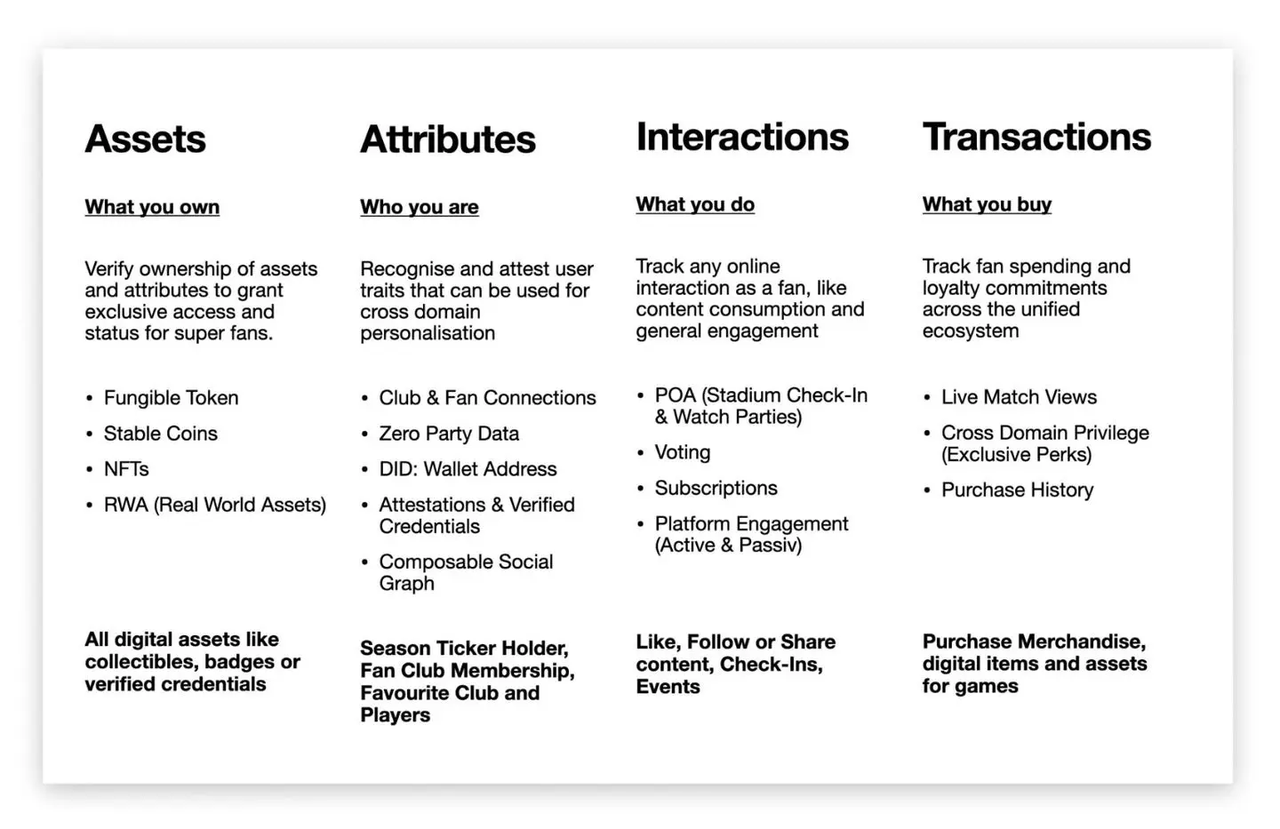
Participation takes many forms. Users can browse match information, read news, like content, comment, or join platform activities. These actions form the foundation of user engagement.
In addition, the platform often introduces task systems or gamified activities, allowing users to earn more engagement opportunities by completing specific goals. This design helps increase activity levels while providing data for the incentive system.

How User Behavior Is Recorded
Within OneFootball Club, user actions are first captured as data. This typically follows a hybrid model of off-chain recording with on-chain confirmation.
High-frequency actions such as clicks and views are processed off-chain to ensure efficiency and a smooth user experience. Key data, such as identity or asset ownership, is recorded on-chain to ensure verifiability and ownership.
This approach allows the platform to maintain performance while linking important data to user identity, giving user actions long-term value and traceability.
How the BALLS Points System Works
BALLS is the internal points system used to measure user engagement. It acts as an intermediate layer connecting user behavior with token distribution.
Users earn BALLS through daily interactions, task completion, or participation in activities. Different actions may carry different weights, reflecting the level of contribution to the platform.
It is important to note that BALLS is not a blockchain token. It is an internal unit used solely to determine OFC allocation, not for trading or circulation. This design allows the platform to continuously track and evaluate user behavior without directly distributing tokens.
How BALLS Converts into OFC Tokens
Within OneFootball Club, BALLS does not convert into OFC at a fixed rate. Instead, it serves as the basis for proportional distribution.
During each distribution cycle, the platform allocates tokens from the OFC reward pool according to each user’s share of total BALLS. This means rewards depend on relative contribution rather than absolute point totals.
This model has two major advantages. First, it avoids inflation pressure caused by fixed conversions. Second, it keeps incentives dynamic and aligned with overall ecosystem activity.
Through this mechanism, the platform can adjust reward intensity across different stages while maintaining fairness.
How OFC Tokens Are Used in the Ecosystem
Once users receive OFC, they can use it in various ways within the OneFootball ecosystem.
At the content and interaction level, OFC can be used to access digital assets or participate in specific activities, such as football-related collectibles or interactive experiences. At the platform level, it may unlock membership benefits or premium content.
OFC may also play a role in community governance, allowing users to participate in certain platform decisions. This further strengthens their sense of involvement. Through these use cases, OFC functions not only as an incentive but also as a medium for value circulation within the ecosystem.
OneFootball’s incentive system can be understood across multiple layers.
First, it incorporates gamification through tasks and interactions, encouraging continuous engagement with regular feedback. Second, it quantifies user behavior through a points system, providing a clear basis for reward distribution.
At the token level, OFC allocation is tied to user contribution, aligning platform growth with user participation. This stands in contrast to traditional platforms, where value created by users is largely captured by the platform itself. Here, users share in that value.
Overall, the system is designed to create a positive feedback loop: the more users participate, the more rewards they receive, which in turn encourages further participation.
Conclusion
At its core, OneFootball’s mechanism transforms user behavior into on-chain value. Through the pathway of behavior → data → points → tokens → application, the platform builds a participation-driven economy.
In this system, users are not just content consumers but active contributors to value creation and distribution. Compared to traditional platforms, this model redefines the user’s role, shifting the fan economy from one-way consumption to two-way participation.
FAQs
Rewards are typically distributed based on a user’s share of points such as BALLS, rather than fixed payouts.
What is the difference between BALLS and OFC?
BALLS is an internal points system used to measure engagement, while OFC is a blockchain token used for incentives and utility.
Do users need a wallet to participate?
Users can usually start with a standard account, though some features may require a blockchain wallet.
Are all user actions recorded on-chain?
No. High-frequency actions are recorded off-chain, while key data is stored on-chain.
Both include incentive mechanisms, but OneFootball focuses more on content engagement rather than profit-driven gameplay.