Gate Precious Metals Perpetual Contracts: When Safe-Haven Assets Enter the Era of Real-Time Trading

Beginner
Quick Reads
Last Updated 2026-03-25 07:47:25
Reading Time: 1m
This article examines how accelerating global market dynamics are driving structural changes in risk-hedging strategies. It further details how Gate Precious Metals Perpetual Contracts leverage a 24/7 trading mechanism to convert gold and silver from passive allocation assets into actionable instruments for immediate market engagement.

Eliminating Time Lags in Risk—Hedging Strategies Must Evolve in Real Time

In today’s highly interconnected global markets, risk events are no longer limited to specific time windows. Policy statements, geopolitical conflicts, and macroeconomic data releases can trigger sharp market swings at any hour, compressing price reactions to minutes or even seconds.

With markets now operating around the clock, relying on hedging tools restricted to fixed trading hours can actually increase risk. If hedging strategies can’t keep pace with market dynamics, they may themselves become sources of uncertainty within the broader strategy.

Perpetual Contracts Bring Precious Metals to the 24/7 Market
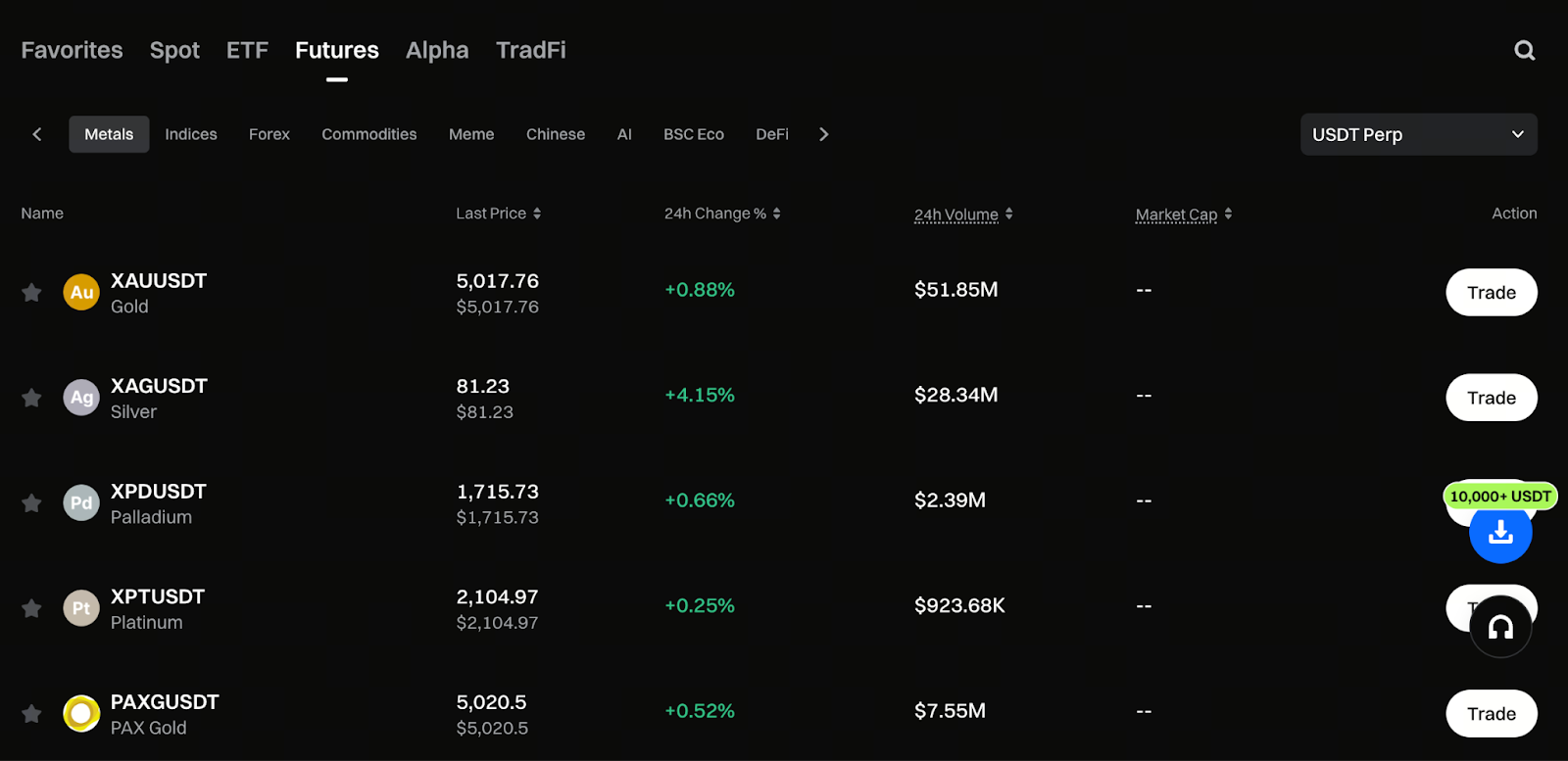
Gate’s gold (XAU) and silver (XAG) USDT-margined perpetual contracts are designed to address this structural challenge. Through the perpetual contract model, precious metals are now fully integrated into a seamless, 24/7 trading system—no longer bound by the opening and closing hours of traditional financial markets.

This allows traders to adjust positions instantly, even when major events occur outside standard trading sessions. Hedging shifts from a reactive process to a real-time decision embedded within ongoing market operations.

Start trading now in the Gate Precious Metals section: https://www.gate.com/price/futures/category-metals/usdt

Seamless Trading Logic—Minimizing Strategy Transition Costs

Operationally, Gate has not created a standalone system for precious metals contracts. Instead, these contracts are directly integrated into the existing derivatives trading framework. XAU and XAG perpetual contracts use the same order process, leverage settings, and risk management tools, so users with prior derivatives trading experience need little to no retraining.

This design means precious metals are no longer a separate market requiring extra research. They become natural additions to existing strategy portfolios, offering price behaviors distinct from crypto assets.

From Passive Allocation to Tradable Assets

In recent market environments, capital has increasingly flowed to assets with hedging properties, driving greater price flexibility in precious metals. Gold and silver are no longer just long-term allocation tools—they have become active assets for swing trading, hedging, and portfolio rebalancing. For traders, this means precious metals can serve both as defensive holdings and as assets with real strategic participation value.

Multi-Source Index Pricing for Stable Quotes

In leveraged derivatives markets, price accuracy is integral to risk management. Gate’s precious metals perpetual contracts use a multi-source index as the pricing benchmark, aggregating quotes from multiple markets to prevent single-source bias. During periods of high volatility, this approach helps maintain fair pricing, ensuring that stop-losses, hedges, and strategy execution remain consistent with their original intent. This is especially important for traders who prioritize risk control and short-term trading.

Where TradFi and Crypto Intersect in Practice

From an asset allocation perspective, precious metals perpetual contracts occupy the intersection of traditional finance and crypto markets:

  • For traditional market traders, gold and silver are familiar benchmarks with significant reference value.
  • For crypto market participants, these contracts introduce asset types with volatility profiles distinct from cryptocurrencies, helping to reduce overall portfolio concentration risk.

Whether hedging against macro events or executing cross-asset hedges in volatile markets, precious metals contracts provide practical entry points for strategic implementation.

A Key Component of Multi-Asset Derivatives Strategy

Precious metals perpetual contracts are not just a product upgrade—they are a vital part of Gate’s ongoing expansion in the derivatives market. With established liquidity and risk control frameworks, the platform is well positioned to extend into additional traditional assets. This approach signals Gate’s shift from a single-asset crypto derivatives platform to an integrated trading venue for cross-market price action.

Summary

With gold and silver now available around the clock through perpetual contracts, the role of hedging assets is evolving. They are no longer merely passive allocation instruments, but can now respond instantly to market movements as strategic assets. Gate’s precious metals perpetual contracts offer traders greater flexibility for cross-asset trading, gradually redefining the practical boundaries between TradFi and crypto.

Author: Allen
Disclaimer
* The information is not intended to be and does not constitute financial advice or any other recommendation of any sort offered or endorsed by Gate.
* This article may not be reproduced, transmitted or copied without referencing Gate. Contravention is an infringement of Copyright Act and may be subject to legal action.

Related Articles

AI-Native Settlement Layers: How United Stables Is Building the Next Financial Rail
Beginner

AI-Native Settlement Layers: How United Stables Is Building the Next Financial Rail

Stablecoins were originally designed as dollar substitutes within exchanges, primarily used for asset pricing and trade settlement. As on-chain financial ecosystems have matured, their role has expanded beyond simple payments to include collateral assets, cross-chain liquidity mediums, and unified settlement units. In particular, as AI systems and automated agents begin to participate directly in economic activity, demand has risen sharply for programmable value units capable of instant settlement. This shift is pushing stablecoins toward the role of foundational financial infrastructure.
2026-03-25 03:16:17
DePIN Identity Network and Real World Applications: How Humanity Protocol Brings on-chain Identity Into the Physical World
Beginner

DePIN Identity Network and Real World Applications: How Humanity Protocol Brings on-chain Identity Into the Physical World

Most Web3 identity systems remain confined to on-chain environments and struggle to achieve meaningful adoption in real world settings. Through a DePIN architecture and physical verification hardware, Humanity Protocol aims to bring decentralized identity into access control systems, hospitality, public services, and offline events, allowing on-chain identity to function not just as a digital credential, but as foundational infrastructure for real world access.
2026-03-25 07:40:53
Gold Price Forecast for the Next Five Years: 2026–2030 Trend Outlook and Investment Implications, Could It Reach $6,000?
Beginner

Gold Price Forecast for the Next Five Years: 2026–2030 Trend Outlook and Investment Implications, Could It Reach $6,000?

Analyze current gold price trends alongside authoritative five-year forecasts, integrating an evaluation of market risks and opportunities. This gives investors insight into the potential trajectory of gold prices and the main drivers expected to shape the market over the next five years.
2026-03-25 18:13:30
Aster vs Hyperliquid: Which Perp DEX Will Prevail?
Beginner

Aster vs Hyperliquid: Which Perp DEX Will Prevail?

Aster and Hyperliquid are the two representative protocols of the "purpose-built L1 path" within the current decentralized perpetual exchange (Perp DEX) sector. As a pioneer in the field, Hyperliquid has built a deep liquidity moat through its highly mature order book architecture and strong community consensus. Conversely, Aster, as a rising challenger, seeks to leapfrog the competition in high-performance trading through more aggressive multi-chain aggregation logic, private transaction modules, and an underlying execution environment optimized for 2026 market demands.
2026-03-24 11:58:33
Aerodrome Tokenomics: How ve(3,3) Powers Base's Most Profitable DEX
Beginner

Aerodrome Tokenomics: How ve(3,3) Powers Base's Most Profitable DEX

AERO is the native token of Aerodrome Finance, a core decentralized exchange and liquidity protocol in the Base ecosystem. It is primarily used for liquidity incentives and ecosystem operations. veAERO is a governance NFT that users receive by locking AERO, representing both voting power and the right to share protocol revenue. Through a dual track structure of AERO as a utility token and veAERO as a governance credential, Aerodrome separates liquidity usage value from long term governance power, allowing participants to act as liquidity providers, governance decision makers, and revenue sharers within the same system.
2026-03-25 06:40:31
The ve(3,3) Flywheel Explained: How AERO Tokenomics Powers Aerodrome’s DeFi Economy
Beginner

The ve(3,3) Flywheel Explained: How AERO Tokenomics Powers Aerodrome’s DeFi Economy

In the competition for DeFi liquidity, high-inflation mining alone is no longer enough to build lasting advantages. Aerodrome applies the ve(3,3) economic model to redesign token emissions, voting mechanisms, and revenue distribution, creating a liquidity flywheel centered on governance and cash flow. This article examines AERO tokenomics, the veAERO locking mechanism, and protocol revenue models to explain how Aerodrome builds a sustainable DeFi economic system.
2026-03-25 06:41:58





