Risk Premium and Cost of Capital
In financial markets, investors do not take on risk for free. If an investment carries uncertainty, it must offer additional returns as compensation—this extra return is called the risk premium.
The most basic logical structure can be represented by the table below:
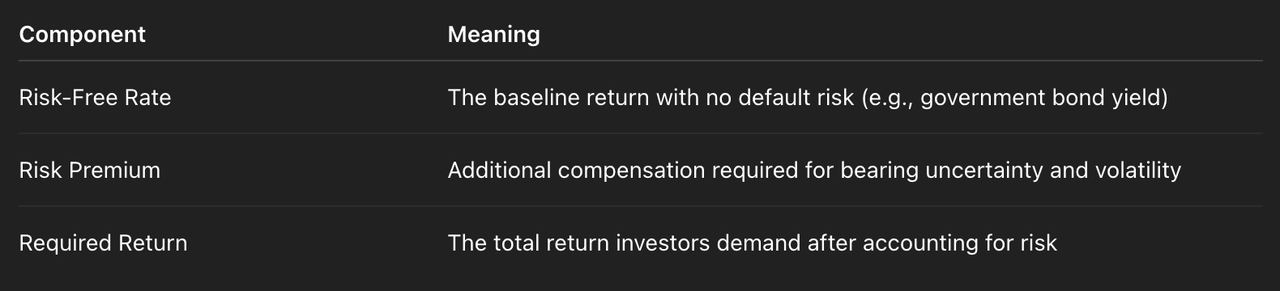
The formula is: Required Return = Risk-Free Rate + Risk Premium. The cost of capital is determined by this structure.
When a company raises funds, it must provide expected returns commensurate with the risk to attract investors. The higher the risk, the higher the cost of capital; the higher the cost of capital, the lower the company’s valuation.
From the investor’s perspective, sources of risk premium include:
- Credit risk (possibility of default)
- Market risk (systematic volatility)
- Liquidity risk (difficulty in liquidation)
- Policy and regulatory risk
- Information asymmetry risk
When market conditions are unstable, the risk premium rises; when market sentiment is optimistic and liquidity is abundant, the risk premium compresses. Therefore, asset price fluctuations are often not due to changes in the asset itself, but because market demands for risk compensation have changed.
Interest Rates, Discounting, and Time Value
If the risk premium explains how uncertainty is priced, then interest rates and discounting mechanisms explain how time is priced. A core principle in finance is that one dollar today is worth more than one dollar in the future. This is the time value of money.
In TradFi, asset valuation is essentially the discounting of future cash flows. Whether stocks, bonds, or real estate, their value can be understood as the sum of future cash flows discounted at a certain rate.
For example:
- Rising interest rates → higher discount rate → lower present value of future cash flows → lower asset prices
- Falling interest rates → lower discount rate → higher present value of future cash flows → higher asset prices
This is why central bank interest rate policies have broad impacts on all assets.
The discount rate typically includes two components:
- Risk-free rate
- Risk premium
Therefore, interest rates affect not only the bond market but also stock valuations and capital flows.
When the market expects future interest rates to rise, long-term assets are usually under pressure; when liquidity is expected to ease, growth assets often benefit. Time and risk are unified in the discounting model.
Volatility and the Formation Mechanism of Market Expectations
If interest rates price time and risk premium prices uncertainty, then volatility prices the market’s consensus on future uncertainty.
Volatility is not equivalent to risk itself but is the market’s expectation of future price fluctuations. In traditional financial markets, volatility is shaped by several key mechanisms:
- Divergence in macroeconomic expectations among market participants
- Changes in liquidity
- Leverage levels and margin pressures
- Uncertainty from major policies or events
- Hedging demand in derivatives markets
Volatility has a self-reinforcing characteristic:
- Market rises/falls → volatility increases → risk models tighten → passive deleveraging → further increase in volatility
- Market stabilizes → volatility decreases → leverage increases → higher risk appetite
Implied volatility in options markets directly reflects how the market prices future risk. For example, when investors buy large amounts of protective put options, implied volatility rises, indicating increased market risk expectations. Volatility itself has also become a tradable asset.