Welcome to Latam Insights, a compilation of the most relevant crypto news from Latin America over the past week. In this edition, a draft to repeal all online gambling has been introduced in Brazil, a proposal to include stablecoins to help curb currency restrictions rises in Venezuela, and Latam surges as an investment opportunity amidst war echoes.
Key Takeaways:
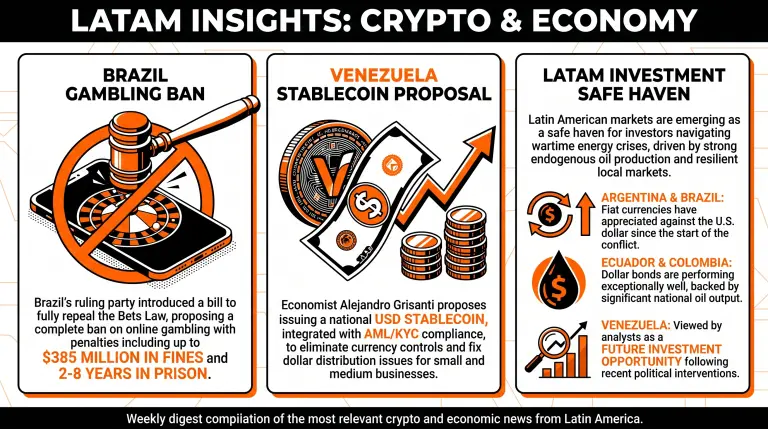
- 68 PT lawmakers filed PL-1808/2026 to ban Brazil’s betting industry, establishing fines of up to $385M for offending platforms.
- Ecoanalitica proposed a USD stablecoin to bypass Venezuelan currency controls and fix future SME trade.
- Following the Middle East conflict, Latam surges as Trump’s actions make it a top investment target.
Brazil’s Ruling Party Files Bill to Ban Online Gambling Entirely as President Lula Stays Silent
Deputy Pedro Uczai (PT-SC) submitted PL-1808/2026 to the Chamber of Deputies on Tuesday, backed by 68 PT lawmakers. The bill calls for the full repeal of all laws governing online betting introduced under Brazil’s Bets Law, the regulatory regime that took effect on January 1, 2025.
The proposed prohibition extends across the entire gambling framework. According to the bill text, it would ban “the exploitation, operation, offering, availability, promotion, advertising, intermediation and processing of transactions related to fixed-odds betting” throughout the national territory. Penalties would include fines of up to two billion Brazilian reais (approximately $385 million) and prison sentences of two to eight years, with aggravated penalties for cases involving minors or criminal organizations. Platforms with more than one million users would be required to remove gambling promotional content.
Read more.
Economist Proposes National USD Stablecoin to Eliminate Currency Controls in Venezuela
As the Venezuelan economy faces headwinds due to currency controls and the exclusion of small and medium enterprises from the dollar assignment system, cryptocurrencies can be part of the solution.
In a recent note, Alejandro Grisanti, founder and CEO of Ecoanalitica, an economic consulting firm, highlighted the advantages of issuing a stablecoin to help correct dollar distribution issues derived from the implementation of an auction system that allows different exchange rates for the greenback.
Grisanti proposes “the implementation of a system based on stablecoins integrated into the formal financial system, subject to strict regulation and featuring AML/KYC compliance mechanisms,” in addition to the controlled import of cash to allow small and medium-sized companies without banking accounts in the U.S. to operate using dollars in the local market.
Read more.
Latam Seen as Opportunity Land by Investors Navigating War
In wartime, investors adjust their portfolios to navigate the intricacies of war and maintain their performance accordingly.
In this situation, Latam markets, which have become a sort of safe haven for investors, are rising as alternatives that, in some ways, are isolated from the energy crisis caused by the ongoing conflict in the Middle East due to their endogenous oil production.
Argentina and Brazil’s fiat currencies are among the few that have appreciated against the dollar since the war started, and dollar bonds from Ecuador and Colombia, which have a significant oil output, have also performed well in their class. Analysts also signal Venezuela as a future opportunity, as the Trump Administration continues to push for changes after it intervened in the country in January.
Read more.
Disclaimer: The information on this page may come from third parties and does not represent the views or opinions of Gate. The content displayed on this page is for reference only and does not constitute any financial, investment, or legal advice. Gate does not guarantee the accuracy or completeness of the information and shall not be liable for any losses arising from the use of this information. Virtual asset investments carry high risks and are subject to significant price volatility. You may lose all of your invested principal. Please fully understand the relevant risks and make prudent decisions based on your own financial situation and risk tolerance. For details, please refer to
Disclaimer.
Related Articles
Fellowship PAC 獲 Cantor Fitzgerald 10M,Tether 高管任主席
Crypto Political Action Committee Fellowship PAC releases its first FEC donation disclosure, showing that Cantor Fitzgerald donated $10 million and has a business connection with Tether. Fellowship PAC supports six Republican candidates and paid $4.5 million to NXUM Group for advertising promotion.
MarketWhisper46m ago
U.S. military seizes an Iranian cargo ship in the Gulf of Oman, and Bitcoin plunges to $74k
A U.S. Navy destroyer destroyed and seized an Iranian cargo ship in the Gulf of Oman, driving up market risk-hedging sentiment, with Bitcoin down 2.5% and Brent crude soaring to $97. Iran vowed retaliation, and diplomatic negotiations face a highly uncertain situation. On Wednesday, the ceasefire deadline has become the focus of market attention.
MarketWhisper2h ago
Bitcoin falls below 74K; U.S. former defense secretary: A U.S.-Iran agreement may be difficult to reach before the deadline
With tensions rising in the Middle East geopolitical landscape, the Strait of Hormuz has become the focal point of military conflict between the U.S. and Iran. Attacks and seizures of cargo ships have been occurring frequently, and crude oil prices have risen. The U.S.-Iran ceasefire agreement is set to expire soon; peace talks have fallen into a stalemate due to irreconcilable positions, making it difficult to reach an agreement. As a result, the price of Bitcoin has dropped below 74K.
ChainNewsAbmedia3h ago
US Equity Futures Fall as Oil Surges on Escalating Iran Tensions
Oil prices rose sharply by over 7% amid escalating US-Iran tensions, causing a drop in US equity futures and a stronger US dollar against major currencies. Risk-sensitive assets faced significant losses.
GateNews4h ago
China's Financial Law Draft Consultation Ends; Digital Currency Legal Status, Crypto Asset Regulation Largely Absent
China's Financial Law Draft aims to unify financial legislation, granting regulators expansive investigative powers. While it strengthens oversight, it lacks focus on emerging sectors like AI and digital currencies, highlighting the need for balance between regulation and innovation.
GateNews14h ago
Iran's Foreign Ministry Spokesman Accuses U.S. of War Crimes Over Blockade
Iran's Foreign Ministry spokesman Baghaei condemned the US blockade of Iranian ports as a violation of ceasefire agreements and international law, labeling it collective punishment and potential war crimes against civilians.
GateNews14h ago


