


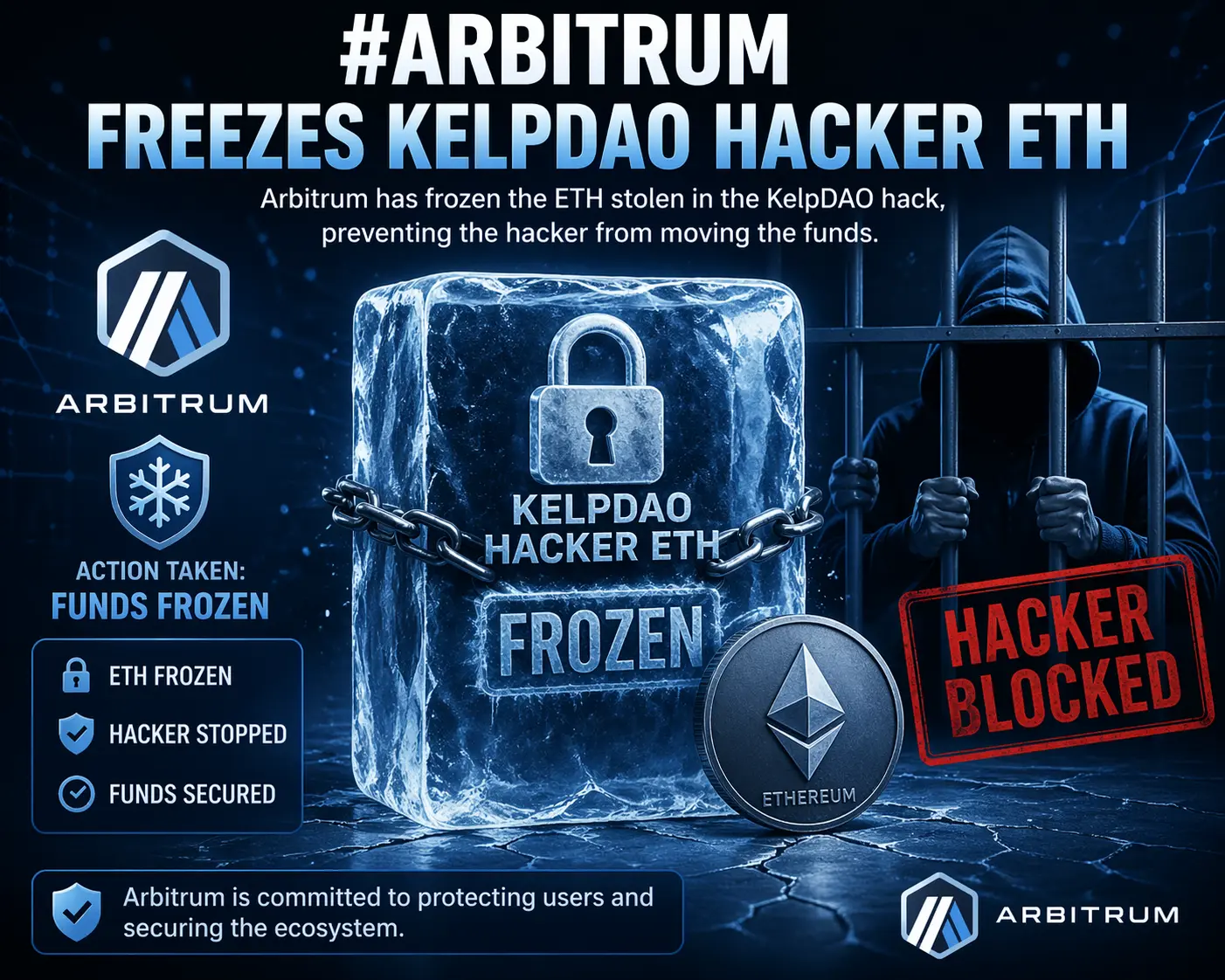





# ArbitrumFreezesKelpDAOHackerETH

35.39K
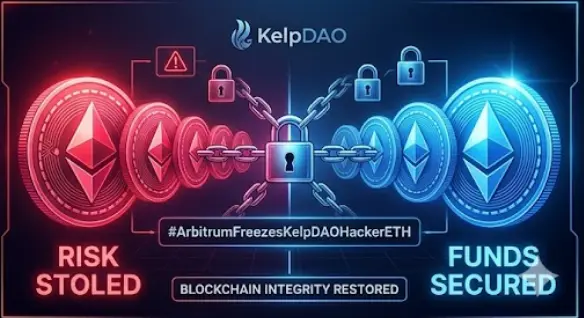
#ArbitrumFreezesKelpDAOHackerETH
Arbitrum Security Council Freezes $71 Million in ETH Linked to Kelp DAO Exploit
On April21,2026, the Arbitrum Security Council took unprecedented emergency action by freezing30,766 ETH worth approximately $71 million, marking a significant development in the aftermath of the massive Kelp DAO exploit that occurred just days earlier.
The Original Exploit
The incident began on April18,2026, when attackers successfully drained approximately116,500 rsETH (restaked ETH) from Kelp DAO, valued at roughly $292 million. This attack targeted Kelp DAO's LayerZero-powered
ETH2.88%
ARB1.21%
ZRO-1.87%
AAVE0.23%
post-image
  • Reward
  • 7
  • Repost
  • Share
Yajing:
To The Moon 🌕
View More
#ArbitrumFreezesKelpDAOHackerETH
ARBITRUM FREEZES KELPDAO HACKER ETH: A DEFINING MOMENT FOR L2 SECURITY AND DECENTRALIZATION
THE INCIDENT: LARGEST DEFI EXPLOIT OF 2026
On April 18, 2026, the DeFi ecosystem faced one of its biggest shocks when Kelp DAO’s cross-chain bridge was exploited, draining 116,500 rsETH worth around 292 million dollars. This accounted for nearly 18 percent of the total rsETH supply and became the largest DeFi exploit of 2026.
The attacker used a fake cross-chain message that appeared legitimate, triggering the bridge to release funds to a controlled wallet via LayerZero
ARB1.21%
ETH2.88%
STETH3.44%
ZRO-1.87%
post-image
  • Reward
  • 4
  • Repost
  • Share
Yajing:
2026 GOGOGO 👊
View More
#ArbitrumFreezesKelpDAOHackerETH #ArbitrumFreezesKelpDAOHackerETH
DeFi Just Got a Reality Check — And It’s Bigger Than One Exploit
The fallout from the Kelp DAO hack is still unfolding, and the implications are hitting deeper than price charts.
After a /$293M exploit, Arbitrum stepped in and froze **30,766 ETH (/$71M)** tied to the attacker — a rare but powerful move that’s now reigniting the decentralization debate.
Here’s what the market is digesting next:
• Only ~25% recovered → Majority of funds already laundered
• $200M+ bad debt on Aave → systemic DeFi stress
• $13B TVL wiped → confidenc
ETH2.88%
ARB1.21%
AAVE0.23%
  • Reward
  • Comment
  • Repost
  • Share
🚨 #ArbitrumFreezesKelpDAOHackerETH
Arbitrum has reportedly taken rapid action following the KelpDAO-related exploit, freezing assets linked to the suspected hacker wallet holding ETH.
This marks a significant moment for on-chain security response, where protocol-level coordination is being used to contain potential illicit funds movement.
🔍 Key Points:
• Suspected exploit funds identified on-chain
• Arbitrum intervenes to freeze hacker-linked ETH
• Rapid response highlights growing DeFi security enforcement
• Raises debate on decentralization vs emergency controls
---
📊 Market Imp
ARB1.21%
ETH2.88%
post-image
post-image
post-image
post-image
post-image
  • Reward
  • 4
  • Repost
  • Share
DragonFlyOfficial:
🔐 Strong signal for DeFi security evolution. Rapid response like this shows how on-chain monitoring and protocol coordination are becoming essential tools against exploits. It also raises important questions about balance between decentralization and emergency intervention. 🌐⚖️
View More
#ArbitrumFreezesKelpDAOHackerETH
In a major development for the crypto security space, Arbitrum has taken swift and decisive action by freezing the ETH linked to the recent KelpDAO exploit. This move has significantly disrupted the hacker’s ability to move or launder the stolen funds, marking a critical step forward in protecting decentralized finance (DeFi) ecosystems.
The KelpDAO incident initially raised serious concerns among investors and users, as exploits like these often lead to irreversible losses. However, Arbitrum’s rapid intervention demonstrates h
ARB1.21%
ETH2.88%
post-image
post-image
  • Reward
  • 4
  • Repost
  • Share
Yajing:
To The Moon 🌕
View More
#ArbitrumFreezesKelpDAOHackerETH
#ArbitrumFreezesKelpDAOHackerETH n a landmark move that underscores the growing power of decentralized governance and layer‑2 responsiveness, the Arbitrum community and core developers have successfully frozen a significant amount of Ethereum (ETH) allegedly stolen from the KelpDAO protocol. The incident, which sent shockwaves through the DeFi ecosystem, highlights both the vulnerabilities of cross‑chain liquidity mechanisms and the emerging tools that blockchain communities can deploy to combat malicious actors—without relying on traditional legal or centrali
ARB1.21%
ETH2.88%
post-image
  • Reward
  • 4
  • Repost
  • Share
Yajing:
2026 GOGOGO 👊
View More
#Gate13周年现场直击
The exploit occurred on April 18, 2026, at approximately 17:35 UTC, targeting KelpDAO's LayerZero-powered rsETH cross-chain bridge.
Total Stolen Amount
An attacker drained 116,500 rsETH representing about 18% of rsETH's 630,000 token circulating supply valued at roughly $292 million at the time of the exploit. This is now confirmed as the largest DeFi hack of 2026.
How the Attack Was Executed:
The attackers, whose wallets were pre-funded via Tornado Cash, submitted a fraudulent LayerZero message (nonce 308) to the bridge's OFT adapter. This tricked the contract into releasing re
post-image
post-image
post-image
post-image
  • Reward
  • 6
  • Repost
  • Share
Yajing:
To The Moon 🌕
View More
#ArbitrumFreezesKelpDAOHackerETH
Arbitrum Freezes Kelp DAO Hacker ETH:
What HappenedOn April18,2026, Kelp DAO suffered a massive exploit through its LayerZero-powered bridge. The attacker minted approximately $293 million worth of unbacked rsETH tokens and drained over $200 million in real WETH from Aave, creating a significant bad debt crisis.
The Arbitrum Security Council took emergency action on April21,2026, freezing30,766 ETH (worth approximately $71 million) that was held in an address on Arbitrum One connected to the exploit. The funds were moved to a secure intermediary wallet contro
ETH2.88%
ARB1.21%
AAVE0.23%
BTC2.15%
HighAmbition
#ArbitrumFreezesKelpDAOHackerETH
Arbitrum Freezes Kelp DAO Hacker ETH:
What HappenedOn April18,2026, Kelp DAO suffered a massive exploit through its LayerZero-powered bridge. The attacker minted approximately $293 million worth of unbacked rsETH tokens and drained over $200 million in real WETH from Aave, creating a significant bad debt crisis.
The Arbitrum Security Council took emergency action on April21,2026, freezing30,766 ETH (worth approximately $71 million) that was held in an address on Arbitrum One connected to the exploit. The funds were moved to a secure intermediary wallet controlled by governance, requiring further community votes for any future movement.
This action was coordinated with law enforcement, and preliminary indicators suggest the attack may be linked to North Korean hackers (Lazarus Group/TraderTraitor). Notably, the freeze did not impact any other Arbitrum users or applications.
Impact on the Crypto MarketImmediate Effects:
1. DeFi Sector Shock: The exploit triggered a $13.2 billion drop in total value locked (TVL) across DeFi protocols. Aave now faces over $200 million in bad debt from this incident.
2. Bridge Security Concerns: The attack exposed vulnerabilities in cross-chain bridge configurations. Kelp DAO was using a single-DVN (Decentralized Verifier Network) setup, which created a single point of failure.
3. Decentralization Debate: The freeze sparked controversy about whether Arbitrum is truly decentralized. As a Stage1 rollup, Arbitrum relies on a9-of-12 multisig Security Council that can execute state changes. While effective for emergency response, this raises questions about permissionlessness versus security.
4. Partial Recovery: Only about25% of the stolen funds were frozen. The remaining76% (approximately $175 million) was rapidly moved to Ethereum mainnet and laundered through THORChain and Umbra, eventually converted to Bitcoin.
ETH Current Price and Trading StrategyCurrent ETH Price: $2,362.33
Price Performance:
-24-hour change: +2.26%
-7-day change: +0.61%
-30-day change: +9.55%
-24-hour volume: $265 millionTechnical Analysis:
The short-term picture shows mixed signals. On the15-minute timeframe, ETH displays a bullish alignment with MA7 above MA30 and MA30 above MA120, indicating an upward trend. However, momentum indicators suggest caution:
RSI on the15-minute chart sits at69.10, approaching overbought territory
CCI indicators on both15-minute and4-hour timeframes show overbought conditions
Most concerning is the daily MACD showing a bearish divergence, where price made a higher high at $2,379 but the MACD histogram actually declinedTrading Strategy Considerations:
Given the current market conditions following the Kelp DAO exploit:
1. Short-term Caution: The overbought signals on lower timeframes combined with the daily MACD divergence suggest potential for a pullback. Traders might consider waiting for a retracement to stronger support levels around $2,280-$2,300 before entering long positions.
2. Volatility Expectation: The exploit aftermath and ongoing security concerns in the DeFi sector may create elevated volatility. Setting wider stop losses and reducing position sizes could be prudent.
3. Support Levels: Key support sits at the recent low of $2,284. A break below this level could see ETH test the $2,200-$2,250 range.
4. Resistance Levels: Immediate resistance is at the recent high of $2,379. A decisive break above this level with volume confirmation could target $2,450-$2,500.
5. Risk Management: Given the recent security incidents and potential for further contagion in DeFi, maintaining strict risk management with position sizing no more than2-3% of portfolio per trade is advisable.
Market Sentiment:
Social sentiment for ETH shows52% positive versus35% negative, with discussion volume up71% over the past three days. However, the lack of KOL participation in discussions suggests retail-driven sentiment rather than institutional conviction.
Key TakeawaysThe Arbitrum freeze demonstrates both the strengths and weaknesses of current Layer2 solutions. While the Security Council's quick action prevented further losses, it also highlights the trade-off between decentralization and security. For traders, ETH remains in a technically precarious position with mixed signals across timeframes, warranting cautious positioning until clearer direction emerges from the current consolidation.

repost-content-media
  • Reward
  • Comment
  • Repost
  • Share
#ArbitrumFreezesKelpDAOHackerETH The recent development surrounding #ArbitrumFreezesKelpDAOHackerETH has sent a powerful signal across the decentralized finance (DeFi) ecosystem. In a swift and coordinated response, the Arbitrum network successfully froze a significant portion of Ethereum (ETH) linked to the attacker behind the KelpDAO exploit. This action marks one of the rare instances where a decentralized infrastructure intervened decisively to limit the damage of a major security breach, raising important questions about governance, decentralization, and the evolving nature of blockchain
ARB1.21%
ETH2.88%
post-image
post-image
  • Reward
  • 6
  • Repost
  • Share
Yajing:
LFG 🔥
View More
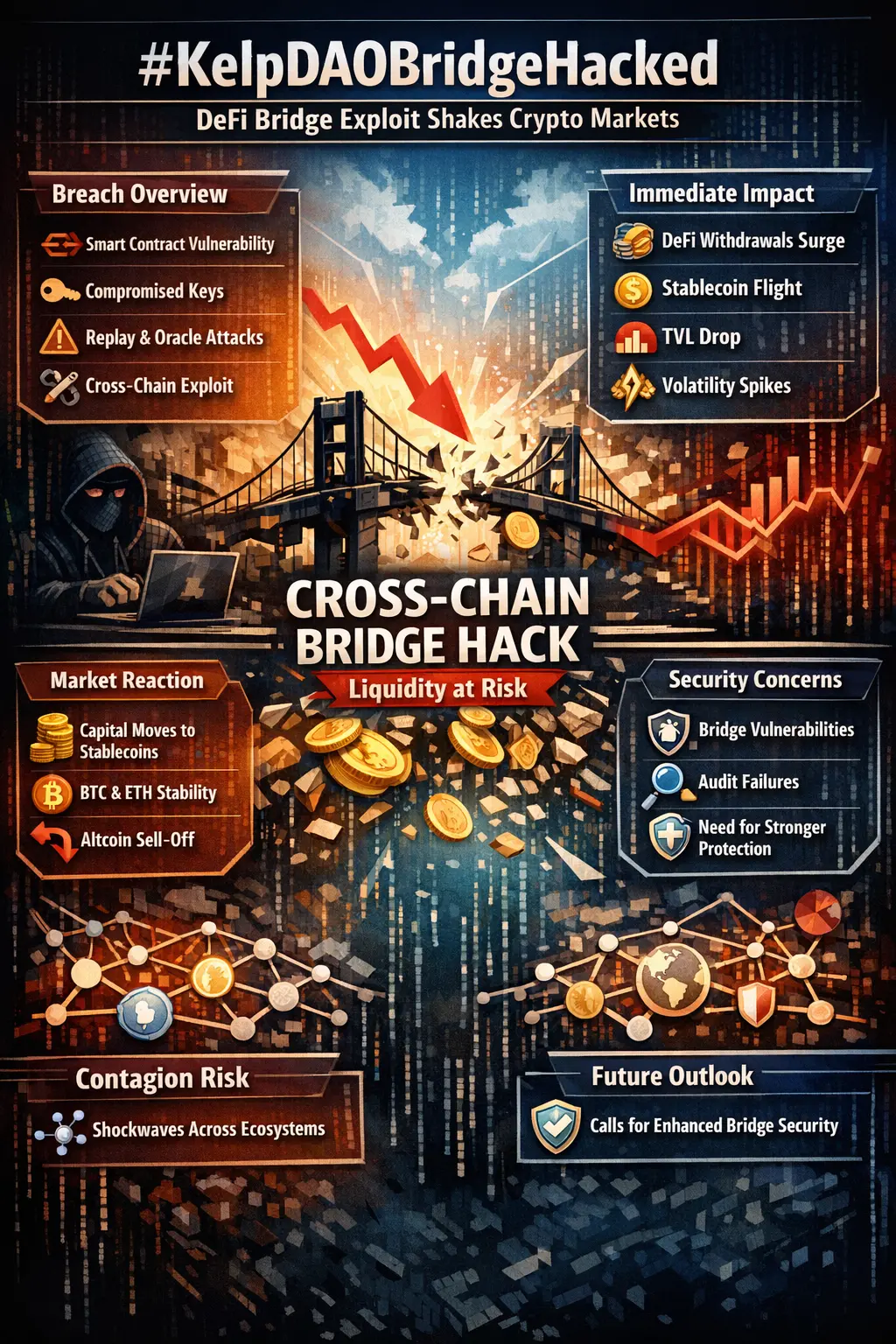
#KelpDAOBridgeHacked
The reported exploit involving KelpDAO’s bridge infrastructure has once again highlighted a persistent structural vulnerability in decentralized finance: cross-chain bridge security. While DeFi continues to expand in scale and complexity, bridge protocols remain one of the most systematically exploited layers due to their high-value liquidity pools and often intricate smart contract logic.
This incident is not isolated in its implications. Bridge hacks historically have triggered broader market concerns, even when the direct financial impact is contained, because they cha
ETH2.88%
BTC2.15%
BlackRiderCryptoLord
#KelpDAOBridgeHacked
The reported exploit involving KelpDAO’s bridge infrastructure has once again highlighted a persistent structural vulnerability in decentralized finance: cross-chain bridge security. While DeFi continues to expand in scale and complexity, bridge protocols remain one of the most systematically exploited layers due to their high-value liquidity pools and often intricate smart contract logic.
This incident is not isolated in its implications. Bridge hacks historically have triggered broader market concerns, even when the direct financial impact is contained, because they challenge confidence in interoperability layers that underpin much of the multi-chain ecosystem.
Incident Overview & Technical Surface
KelpDAO’s bridge mechanism—designed to facilitate asset movement and liquidity integration across networks—has reportedly been compromised through a vulnerability that allowed unauthorized extraction or manipulation of bridged assets. While full forensic details are still emerging, such exploits typically involve one or more of the following vectors:
Smart contract logic flaws in validation or signature verification
Compromised multisig or governance keys
Replay or message verification vulnerabilities across chains
Oracle manipulation or relay-layer exploitation
Bridge systems are inherently complex because they must maintain consistency between independent blockchain environments, each with different consensus assumptions. This complexity increases attack surface relative to single-chain protocols.
Systemic Risk in Cross-Chain Infrastructure
Bridges act as liquidity highways between ecosystems. When compromised, they do not just create isolated losses; they introduce trust shocks across multiple networks simultaneously. This is particularly critical in a market where liquidity is fragmented across Ethereum L2s, alternative L1s, and modular blockchain architectures.
Each major bridge exploit historically has led to:
Temporary liquidity withdrawal from DeFi protocols
Increased stablecoin redemption pressure
Short-term widening of token price spreads across chains
Elevated scrutiny of cross-chain protocols and custodial assumptions
The KelpDAO incident reinforces the reality that interoperability remains one of the least mature layers of crypto infrastructure from a security standpoint.
Market Reaction & Liquidity Behavior
In the immediate aftermath of such events, markets typically exhibit localized risk aversion rather than system-wide panic. Assets directly connected to the affected ecosystem often experience sharper drawdowns, while major assets like BTC and ETH tend to absorb only mild volatility unless contagion spreads.
Key observed behaviors in similar events include:
Temporary outflows from DeFi protocols into stablecoins
Increased bridge withdrawal activity as users de-risk exposure
Short-term decline in total value locked (TVL) across impacted chains
Elevated implied volatility in mid-cap DeFi tokens
However, unless the exploited funds are large enough to threaten systemic liquidity, the broader crypto market typically stabilizes after initial repricing.
DeFi Security Landscape Context
Bridge exploits remain one of the most expensive attack vectors in crypto history. Past incidents have collectively resulted in billions of dollars in losses across ecosystems. Despite improvements in auditing standards and multi-layered security designs, the fundamental issue persists: cross-chain messaging requires trust assumptions that are difficult to fully eliminate.
Current mitigation approaches include:
Zero-knowledge proof-based verification systems
Decentralized validator networks for message verification
Rate-limiting and circuit-breaker mechanisms
Increased formal verification of smart contracts
Gradual migration toward native interoperability standards
Yet none of these fully eliminate risk; they primarily reduce probability and impact.
Capital Rotation & Narrative Impact
DeFi-related security incidents often temporarily weaken capital inflows into experimental yield or cross-chain strategies. Investors typically rotate capital into:
Major L1 assets with stronger liquidity profiles
Stablecoins as risk-off positioning
CeFi or custodial yield products perceived as safer in the short term
Narratively, such events slow down momentum in “composability” and “interoperability scaling” themes, even if the long-term thesis remains intact.
Derivatives & Volatility Response
In derivatives markets, bridge hacks generally result in:
Short-term spike in implied volatility for affected tokens
Increased demand for downside protection options
Liquidation clusters in leveraged DeFi positions
Mild spillover into broader altcoin volatility curves
However, systemic derivatives stress is usually limited unless the exploited protocol is deeply integrated into leveraged lending markets or collateral systems.
Key Risk Considerations Moving Forward
The KelpDAOBridgeHacked event reinforces several structural considerations for market participants:
Cross-chain infrastructure remains a high-risk layer despite rapid innovation
Liquidity fragmentation amplifies shock transmission across ecosystems
Security risk is increasingly a macro variable in DeFi valuation models
Audits alone are insufficient without real-time monitoring and adaptive defenses
Outlook
Unless further vulnerabilities are discovered or additional funds are compromised, the immediate market impact is likely to remain contained within the DeFi sector. However, repeated incidents of this nature contribute to a gradual repricing of risk across cross-chain infrastructure projects.
Over the medium term, this incident may accelerate:
Adoption of more conservative bridge designs
Increased institutional preference for native-chain deployments
Greater emphasis on security-first DeFi protocols
Regulatory scrutiny of cross-chain custodial mechanisms
Conclusion
#KelpDAOBridgeHacked is another reminder that while DeFi innovation continues at a rapid pace, infrastructure security remains an unresolved bottleneck. Bridges, as critical interoperability layers, represent both the backbone of multi-chain growth and one of its most persistent systemic risks.
Market reaction is expected to stabilize once liquidity adjusts and exploit details are fully assessed, but the broader narrative impact reinforces caution around cross-chain exposure in the current risk environment.
repost-content-media
  • Reward
  • Comment
  • Repost
  • Share
Load More