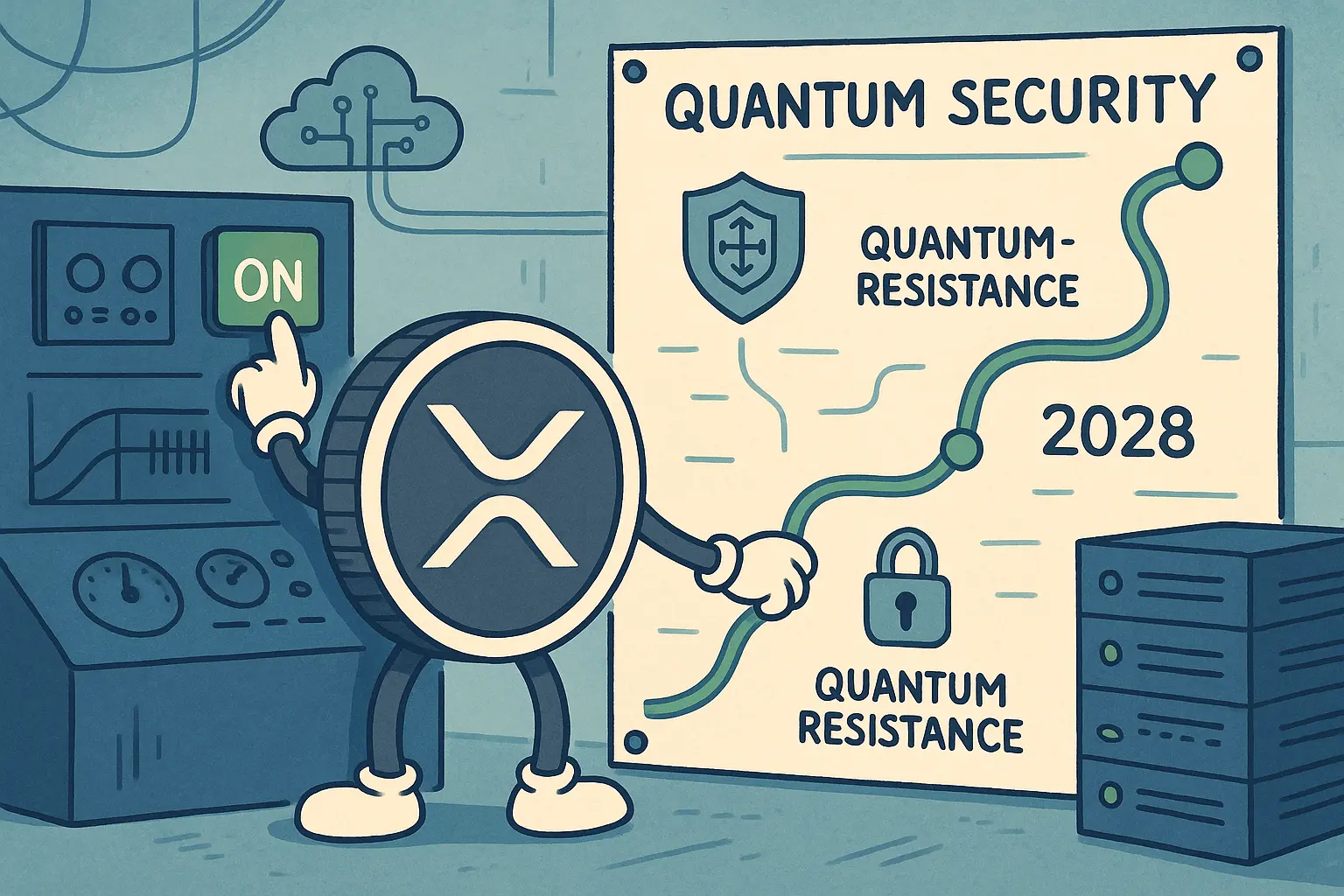
Ripple’s Senior Director of Engineering, Ayo Akinyele, released its latest “Insights” report on April 20, outlining a multi-stage roadmap aimed at making XRP ledgers (XRPL) fully capable of post-quantum security defenses by 2028. Ripple is working with Project Eleven to accelerate development, including validated node testing and an early custody prototype.
Why XRPL Needs to Prepare for Post-Quantum Security
XRPL faces quantum-security risks that are structurally unique. On XRPL, every signed transaction exposes the public key on-chain—harmless in a traditional cryptographic environment, but with sufficiently advanced quantum computers, this could allow attackers to derive private keys from public keys, threatening the long-term security of wallets.
Akinyele noted that the “collect now, decrypt later” characteristic means that responding only when quantum threats break out is already too late. While today’s protective measures won’t immediately fail, it underscores the urgency of building systems that safeguard long-term asset security as early as possible.
Four-Stage Roadmap: From Emergency Response to Full Protection
Ripple’s roadmap includes four sequential stages:
First stage (emergency response plan): Develop contingency plans in case existing cryptographic standards become ineffective, including the “Quantum-Day” framework, to ensure that once a vulnerability is exploited, user accounts can be safely migrated to post-quantum addresses.
Second stage (algorithm evaluation): Assess the performance of post-quantum cryptographic algorithms recommended by the U.S. National Institute of Standards and Technology (NIST) in real XRPL network environments.
Third stage (performance testing): Measure the real-world impact of post-quantum algorithms on network throughput, storage requirements, and verification efficiency.
Fourth stage (parallel testing on the development network): Conduct parallel tests on the XRPL development network so developers can evaluate performance trade-offs before full implementation, ensuring stability for official deployment.
XRPL’s Native Advantages: Support for Gradual Migration
XRPL’s key rotation and deterministic key generation features provide important technical advantages, allowing a gradual transition to post-quantum standards without forcing users to give up existing accounts. Akinyele emphasized, “We should not treat the response to quantum threats on XRPL as a single standalone upgrade, but as a multi-stage strategy—carefully migrating existing global financial infrastructure without impairing the value of the digital assets that XRPL protects.”
Frequently Asked Questions
What is a “collect now, decrypt later” attack, and what impact does it have on XRP?
An attacker collects encrypted data (such as publicly available public keys on-chain) before quantum computers are powerful enough, and then decrypts it once future quantum technology matures. For XRPL, every confirmed transaction leaves a public key on-chain, which means historical records may face the risk of being reverse-engineered and analyzed when future quantum threats become mature.
What are the four key stages of XRPL’s quantum-security roadmap?
The first stage formulates the “Quantum-Day” emergency migration plan; the second stage evaluates the post-quantum cryptographic algorithms recommended by NIST; the third stage tests the performance impact of these algorithms; the fourth stage performs parallel testing on the XRPL development network to ensure the stability of official deployment.
Why does Ripple frame this as a “multi-stage strategy” rather than a single upgrade?
XRPL protects global financial infrastructure, and any rapid, non-structured replacement of cryptographic standards could cause irreversible damage to the assets of hundreds of millions of users. A phased strategy allows developers to evaluate performance impacts in test environments, giving users ample time to proactively migrate instead of being forcibly disconnected from existing accounts.
Disclaimer: The information on this page may come from third parties and does not represent the views or opinions of Gate. The content displayed on this page is for reference only and does not constitute any financial, investment, or legal advice. Gate does not guarantee the accuracy or completeness of the information and shall not be liable for any losses arising from the use of this information. Virtual asset investments carry high risks and are subject to significant price volatility. You may lose all of your invested principal. Please fully understand the relevant risks and make prudent decisions based on your own financial situation and risk tolerance. For details, please refer to
Disclaimer.
Related Articles
Arthur Hayes: I'll Believe in XRP's Use at Scale When I See On-Chain Evidence
Arthur Hayes calls for on-chain evidence of XRP at scale; Iran tolls on oil tankers reportedly paid in Bitcoin to bypass sanctions, with pre-cleared shipments. Jim Rickards cites Ripple as part of a broader crypto-led parallel financial system.
Abstract: The article compares Hayes's demand for XRP's real-world on-chain use with reports of Bitcoin toll payments by Iran and notes Rickards' view that Ripple could play a role in a broader crypto-driven parallel financial system.
GateNews43m ago
Crypto Investor Predicts Bitcoin ATH at $140,000 and XRP ATH at $7 in May
Crypto investor predicts Bitcoin ATH at $140,000.
Similarly, the expert expects an XRP ATH at $7.
Both these new ATH targets for BTC and XRP are expected to arrive in May.
The prices of Bitcoin and Ethereum seem to be trading at a bullish trajectory, having just broken past major
CryptoNewsLand3h ago
Altcoins Surge Back Above $1.3T as Markets Rally After Greenland Crisis Resolution
On January 22, altcoins rebounded nearly 10% to $1.39 trillion due to eased global tensions, with Ethereum leading gains. Despite some volatility, the combined market cap stabilized at $1.32 trillion as other altcoins also showed modest recovery.
Coinpedia4h ago
Ripple XRP Ledger Is Set to be Quantum-Resistant by 2028, Signaling Highly Bullish Future for XRP Price
Ripple XRP Ledger is set to be quantum-resistant by 2028.
This signals a highly bullish future for XRP.
Tron is also working to catch up with this progressive move.
Crypto and blockchain continue to chase success and progress with no concern for the current state of markets. For
CryptoNewsLand5h ago
Ripple Plans Quantum-Resistant XRP Ledger by 2028
Ripple announced on Monday a multi-stage roadmap to build quantum-resistant infrastructure for the XRP Ledger (XRPL) by 2028, addressing growing concerns about the security of existing cryptographic systems against future quantum computing threats.
Quantum Threat Context
While quantum computing t
CryptoFrontier5h ago
XRP Trading Comes to WhatsApp, Says Solana Developer: “Ready for Baby Boomers”
XRP is now available for purchase through a WhatsApp chat bot, an important milestone toward making meme coins mainstream. On April 20, Solana’s lead developer Anatoly Yakovenko shared that he swapped 0.1 SOL for 5.99 wXRP, with the entire process completed via a WhatsApp chat bot. He said Solana is ready for the Baby Boomer generation.
MarketWhisper12h ago


