
For the week of April 6, the tokenized Pokémon trading card market’s weekly revenue rose to $5.38 million, slightly below the September 2025 peak. The path toward the near-high this time is structurally different: the September 2025 peak was concentrated in a single week driven by the Collector Crypt TGE, while the current high comes from an organically built-up total over six consecutive weeks, with Courtyard serving as the primary contributor.
The Courtyard Model: A Liquidity Wrapper for Physical Cards + Redeemable NFTs
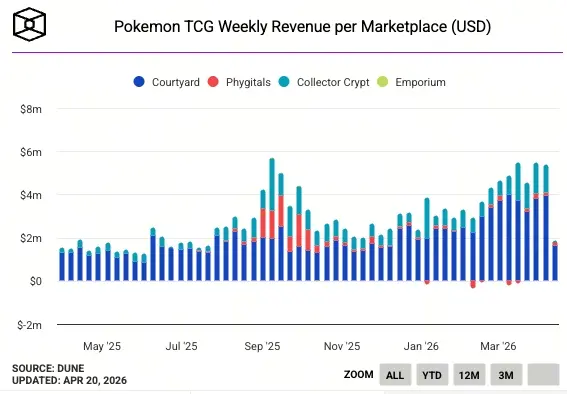
At the core of Courtyard’s design is this: users’ physical Pokémon cards are held in custody by a third-party institution, and the platform is backed by NFTs redeemable for physical cards. This design attracts a specific group of users—traditional collectors who want fragmented liquidity but are unwilling to take on crypto-native speculative risk. The tokenized layer plays the role of a “liquidity wrapper,” rather than a purely speculative tool.
More importantly, the tokens can be used directly for physical fulfillment, meaning the pricing function of the on-chain marketplace gains anchor validation from real assets—an essential capability that nearly all projects failed to achieve during the 2021 NFT boom.
The fundamental difference between tokenized collectibles and the NFT era
The root cause of the failure of most NFTs in 2021 was that most NFTs lacked real-asset anchoring or clear utility cases, with value heavily dependent on market sentiment. The sustainability of the Courtyard model is built on three structural differences:
Each NFT corresponds to a real card that is securely held by an institution and can be redeemed at any time; demand comes from the existing collectibles market for Pokémon cards and does not rely on a “crypto narrative”; tokenization makes it possible to circulate high-value physical cards on-chain, reducing transaction friction costs for trading premium cards.
This structure formally moves tokenized collectibles out of the “NFT-related” category, upgrading them into an RWA subcategory with standalone viability.
Long-term outlook: sports cards, luxury watches, or the next replicable track
Analysts note that if the Courtyard model is replicable, the next application areas with the most potential include sports cards (NBA, MLB), high-end luxury watches, limited-edition sneakers, and other categories—ones with established collectibles markets but constrained physical liquidity. The short-term risk is this: once the bullish cycle in the physical Pokémon card market ends, platform transaction volume could drop significantly.
Frequently Asked Questions
How do Courtyard tokenized Pokémon cards work?
After users hand their physical Pokémon cards over to a third-party institution for custody, they receive an NFT credential corresponding to those cards. These NFTs can be freely traded on-chain, and holders can request redemption of the corresponding physical cards at any time. This mechanism allows collectors to operate with liquidity without selling the physical cards, while also retaining ownership of the physical assets.
What is the fundamental difference between this peak and the 2021 NFT boom?
The trading volume of NFTs in 2021 was mainly driven by purely speculative demand, with no real-asset anchoring. Courtyard’s current peak is built on organic demand (sustained accumulation over 6 weeks rather than a one-week TGE burst), real-asset endorsement (each NFT corresponds to a real card), and service to the existing collectibles market (not relying on crypto-native users), making its sustainability significantly stronger.
What are the main short-term risks for the tokenized collectibles track?
The biggest short-term risk is the cyclical pullback of the physical Pokémon card market itself. Currently, Courtyard’s demand is highly dependent on the heat of the physical card market; once the Pokémon card collectibles hype fades, the tokenized market’s trading volume may also decline. Whether the platform can successfully expand into other categories such as sports cards and luxury watches is key to its long-term sustained growth.
Disclaimer: The information on this page may come from third parties and does not represent the views or opinions of Gate. The content displayed on this page is for reference only and does not constitute any financial, investment, or legal advice. Gate does not guarantee the accuracy or completeness of the information and shall not be liable for any losses arising from the use of this information. Virtual asset investments carry high risks and are subject to significant price volatility. You may lose all of your invested principal. Please fully understand the relevant risks and make prudent decisions based on your own financial situation and risk tolerance. For details, please refer to
Disclaimer.
Related Articles
Ethereum Open Interest Falls $2B as Derivative Trading Stalls
Gate News message, April 21 — Ethereum's derivatives market saw a significant deleveraging event over the past week, with traders closing over $2 billion in futures positions. ETH open interest fell to $12.4 billion, according to Coinglass, marking the second major capitulation event in 30 days. ETH
GateNews43m ago
Major CEX Sees $80.53M USDT Outflow in Past Hour
Gate News message, April 21 — According to Coinglass, a major CEX experienced a net outflow of 80.53 million USDT over the past hour.
GateNews1h ago
Why the Wealthy Are Doubling Down on Bitcoin-Backed Debt
The Xapo Digital Wealth Report for Q1 2026 highlights a major shift in how high-net-worth individuals manage their bitcoin, moving away from active trading and toward long-term capital preservation.
Key Takeaways:
Xapo members increased active bitcoin-backed loans by 8.9% in Q1 2026 to avoid
Coinpedia3h ago
Bitcoin Spot ETFs Post $1B Net Inflows Last Week, Largest in 3 Months
Abstract: Bitcoin spot ETFs attracted about $1 billion in net inflows last week, led by BlackRock's IBIT with $906.1 million and Morgan Stanley's MSBT with $71.1 million in its first full trading week, following $786.3 million the previous week.
Summary: Bitcoin spot ETF inflows totaled about $1B last week, the largest in three months; IBIT led with $906.1M, while MSBT added $71.1M in its first full week.
GateNews5h ago
Bitcoin Tops $75K as Ceasefire Hopes Drive Rally
Bitcoin rose on ETF demand while miners sold BTC; margins tightened and AI/HPC-focused pivots could turn miners into AI data-center players, potentially boosting valuations as AI demand grows.
Abstract: Bitcoin rose on ETF demand amid miner selling and tight margins. The report highlights a strategic pivot by public miners toward AI/HPC infrastructure, signaling a potential shift from pure bitcoin mining to AI data-center services and higher valuation multiples.
CryptoFrontier5h ago
Shiba Inu Sees 82.5B Token Outflow as Market Structure Shifts
Key Insights
Shiba Inu saw 82.5 billion tokens exit exchanges within 24 hours, signaling reduced supply pressure and increasing accumulation behavior among larger holders.
Exchange net flows remain positive as inflows persist, yet rising outflows suggest a gradual balance forming between
CryptoNewsLand5h ago


